
Rippon Tor - A 5 Minute Photo Adventure on Dartmoor
In the blog this week I head up to Rippon Tor to shoot sunrise and I also share with you what I think the key to making a successful landscape photography video is.
Rippon Tor, Sunrise and Fog
There are few better ways to start the day than by grabbing your camera and heading up to one of your favourite viewpoints on Dartmoor to watch the sunrise. Fortunately, at this time of year sunrise is at a time where it doesn’t feel unnatural to be awake. I think back to some of the early alarm calls I had this summer to get up for sunrise. No one should be waking up at 3:30 am!
I’m fortunate to live close to Dartmoor so when the weather conditions don’t turn out how I expect them, I don’t feel I’ve wasted a lot of time. Even then, any morning up on Dartmoor is a positive experience regardless of how the photos turned out. My most recent visits to Rippon Tor hadn’t yielded the types of images I wanted to get from this location so when I saw fog was forecast one Sunday morning that was all the encouragement I needed to return.
I’d seen forecasts of fog for the Haytor area before but thanks to those micro-climates you find on Dartmoor, I’d often arrive there to find none. My most recent visit was slightly different though as there was a thick bank of fog in the valley below Emsworthy Tor. As exciting as this was, it wasn’t really in a position where I felt I could take a good photograph. If the conditions hadn’t looked more favourable up on Rippon Tor, I might have taken a risk and done some exploring.
As I approached the summit of Rippon Tor, I could see another bank of thick sea fog that would prevent me from getting the light just as the sun broke over the horizon. I had made the poor choice of leaving too early from Rippon Tor last time there was a lot of cloud and fog out at sea, only for the sun to break through as I descended. I wasn’t going to make the same mistake this time.
In this 5 Minute Photo Adventure, you can see how I got on on my latest visit and I also share with you what I think the secret is to creating a successful landscape photography video. Enjoy!
Do you find it difficult to get accurate fog forecasts? What’s your favourite type of foggy photograph to take? Let me know in the comments below.
Rippon Tor Photographs
Here are the images you see me capture in the video. Enjoy!
Rippon Tor at Dawn #1, Dartmoor, Devon - Nikon Z7, Nikkor 14-30mm f/4 at 28mm, f/11, 1.6 seconds at ISO 64, Kase Filters CPL, 4:5 crop.
Rippon Tor at Dawn #2, Dartmoor, Devon - Nikon Z7, Nikkor 14-30mm f/4 at 25mm, f/11, 1.3 seconds at ISO 64, Kase Filters CPL.
Rippon Tor at Dawn #3, Dartmoor, Devon - Nikon Z7, Nikkor 14-30mm f/4 at 15mm, f/11, 1 second at ISO 64, Kase Filters CPL, 4:5 crop.
Rippon Tor at Dawn #4, Dartmoor, Devon - Nikon Z7, Nikkor 14-30mm f/4 at 15mm, f/11, 1/5th second at ISO 64, Kase Filters CPL, 16:9 crop.

Why I'll Never Bore of Dawlish Warren
In this blog post, I share my latest photographs from Dawlish Warren and tell you why I don't think I'll ever get bored of photographing this wonderful south Devon coastal location.
How Many Times?
Searching through this blog I can count more than 15 posts that feature photographs from Dawlish Warren. To be honest this is more than I even thought there were and given that I’d been photographing Dawlish Warren even before I started the blog 4 years ago, I hate to think how many times I’ve been to this beach on the south Devon coast.
I say hate, but there is obviously something special about Dawlish Warren that makes me keep coming back.
Dawlish Warren Sunrise #2, Devon - Nikon Z7, Nikkor 14-30mm f/4 at 19mm, f/11, 1.3 seconds at ISO 64, Kase Filters K9 CPL and ND Grad.
Every Visit in Unique
The one factor that keeps me coming back is that every visit is unique. Unlike many locations, the seasons don’t have a direct impact on what you photograph there. Apart from what time sunrise is, it doesn’t matter if it’s spring, summer, autumn, or winter at Dawlish Warren. The two factors that make it so variable are the weather and the tides.
The tide levels and times might be predictable, but every high tide resets the beach. Each time the tide comes in and then goes out the sand and the layout of the beach is subtly different. Sand patterns, stones, and debris all come and go. Even how the wet the groynes are results it a vastly different look for incoming tides compared to outgoing tides.
The weather delivers the most variety though. Wind and air pressure can impact the effect of the tides and the strength of the waves. This can change your whole approach to your photography for that visit. Making a choice between a shorter exposure time to capture movement or going for a longer exposure to smooth out the water is a creative decision but how the water is behaving can limit or extend your creative options (depending on how you look at it).
To add into the mix, you’ve got ever-changing cloud coverage. Even on overcast days, there are shots to be had but it is perhaps when the sun just rises above the horizon that excites me the most. It’s a special moment when the reds and oranges of the morning light catch the water and the sides of the groynes.
All these variables mean that I’ve never looked through the viewfinder and thought this looks familiar.
Dawlish Warren Sunrise #4, Devon - Nikon Z7, Nikkor 14-30mm f/4 at 16m, f/16, 1 seconds at ISO 64, Kase Filters K9 CPL and ND Grad.
More to Discover
With 15 groynes there is a lot to photograph. I’ve probably only photographed a third of them and given that each groyne can be photographed from two sides, I’ve barely scratched the surface.
But there is more to Dawlish Warren than the groynes. Immediately behind you are the dunes is the nature reserve. The nature reserve is well known for its birds, but I’m far from a wildlife photographer. The dunes, however, are well worth a visit. I’ve only recently started photographing them, but with long grasses, fences, big views, and sweeping dunes they are well worth photographing.
At the top of the beach are the colourful beach huts. Having only photographed these once I must spend a bit more time with them. I’m sure there are some interesting compositions to be made there.
Dawlish Warren Sunrise #1, Devon - Nikon Z7, Nikkor 14-30mm f/4 at 23mm, f/13, 1.6 seconds at ISO 125, Kase Filters K9 CPL and ND Grad.
Different Styles
Finally, I’ve discovered that Dawlish Warren beach is a good location for trying something a little different. When I captured the images in this blog post I was with my friend and fellow photographer Neil Burnell and he was capturing images using ICM and multiple exposure techniques. These aren’t techniques that have previously excited me but seeing the results Neil was getting certainly changed my mind.
I gave both techniques a try, and while I found ICM tricky, the effect of multiple exposures has inspired me to give this technique further work. The beach, with its constantly changing view, seems the ideal location to use this technique. While I did capture some multiple exposure photographs on this visit, I don’t think they are worth sharing here. It is a technique I will continue with next time I’m at Dawlish Warren and this will open even more creative opportunities as this varied and much-loved location.
For all these reasons, this is why I will never bore of photographing Dawlish Warren.
Dawlish Warren Sunrise #6, Devon - Nikon Z7, Nikkor 14-30mm f/4 at 28mm, f/10, 0.4 seconds at ISO 64, Kase Filters K9 CPL and ND Grad.
Not Every Photograph Needs to be a Masterpiece
As a landscape photographer I'd like every shoot to result in a portfolio class image, but this is an unrealistic expectation. Sometimes you just need to take joy in the experience of capturing an image and learning from it.
Embrace the Grey Once Again!
I’ve made several videos on the theme on embracing the grey and because I live in an area where overcast days aren’t exactly unheard of it might not surprise you that I’ve decided to do another one. For me, the key to a successful shoot in grey and overcast conditions is to find the right subject (as I discussed in this video).
There’s been a location near to home that I’ve been wanting to photograph for a while and that’s the Philip Lucette Light near Teignmouth. I found out about this interesting location from an image I saw from Neil Burnell and a video from Lynne Luxon-Jones. It looked like an interesting subject to photograph and I thought it would make for a great #EmbracetheGrey subject.
In the video below you can follow me along as I photograph this location for the very first time. I also show you how I edit the image to give me a specific look and feel, and I of course make a print of the image. I also discuss in the video the importance of just going out to take pictures, and not to worry about every shot being a masterpiece. After all, we should love the art of taking a picture first and foremost.
Enjoy!
Philip Lucette Light #2, Shaldon, Devon - Nikon Z7, Nikkor 24-200mm f/4-6.3 at 48mm, f/8, 214 seconds at ISO 64, Kase Filters CPL and 10 Stop ND
In the Danger Zone
In this 5 Minute Photo Adventure, I head further and deeper into Dartmoor National Park than I've ever been before. I leave civilisation and walk along open moorland for an hour until I reach the Danger Zone! There I find a new location to photograph and I experience some wild Dartmoor weather.
That Looks Interesting
Some days I have a clear plan of where and what I’m going to shoot. I go out with conviction and even though it might not turn out how I had hoped, I know I gave it my best shot. There are also days where I just sit in front of my computer scratching my head on what to do. This indecision is often caused by a weather forecast that doesn’t favour any particular location or scene.
It’s these times that I often look to try and go somewhere new. I’m taking a risk with the weather so I might as well take a risk on a new location. Though I’ve got plenty of locations on my custom Google Map that I haven’t visited, this time I decided to check through my back catalogue of Outdoor Photography magazines instead.
As I browsed my collection of magazines with a cup of coffee, a location called Oke Tor on Dartmoor caught my eye. I looked it up on OS Maps and saw that it was just a little bit further on from one of my favourite locations, Belstone Tor. I also noticed that Oke Tor was just inside the Okehampton military danger zone so I made sure to check if the zone would be inactive before making any further plans. Fortunately, no firing was planned so I made plans to enter the danger zone!
With plans made to visit a new location and with the weather forecast predicting anything from clear blue skies to heavy rain showers I thought it might be an adventure worth filming. While it is always nice to show a polished video with great images, I’ve always said that I wanted to show a realistic side of landscape photography on this blog as well.
While the video below is a bit rough and ready, and the photographs are not my best work, I wanted to share with you the adventure of going somewhere new for the first time, battling the weather and grabbing those early compositions. I hope you enjoy it!
Oke Tor (Dartmoor) Photographs
Oke Tor #1, Dartmoor, Devon - Nikon Z7, Nikkor 14-30mm f/4 at 14mm, f/11, 0.4 sec at ISO 64, Kase Filters K9 CPL and ND Grad.
Oke Tor #2, Dartmoor, Devon - Nikon Z7, Nikkor 14-30mm f/4 at 18mm, f/11, 1/4 sec at ISO 64, Kase Filters K9 CPL and ND Grad.
Oke Tor #3, Dartmoor, Devon - Nikon Z7, Nikkor 14-30mm f/4 at 15mm, f/11, 1/4 sec at ISO 64, Kase Filters K9 CPL and ND Grad.
Oke Tor #4, Dartmoor, Devon - Nikon Z7, Nikkor 14-30mm f/4 at 14mm, f/14, 1/3 sec at ISO 64, Kase Filters K9 CPL and ND Grad.
Oke Tor #5, Dartmoor, Devon - Nikon Z7, Nikkor 14-30mm f/4 at 14mm, f/11, 1/3 sec at ISO 64, Kase Filters K9 CPL and ND Grad.
Oke Tor #6, Dartmoor, Devon - Nikon Z7, Nikkor 14-30mm f/4 at 14mm, f/11, 1/3 sec at ISO 64, Kase Filters K9 CPL and ND Grad.

Back to Bowerman's Nose - Part 2
In part two of my two-part blog from Bowerman’s Nose, I return to capture my planned images of sunrise.
Sunrise at Bowerman’s Nose
In part one of this two-part blog from Bowerman’s Nose, I talked about returning to one of my favourite locations, planning for a sunrise shoot and sharing with you some of the images I took that evening. In part two I’m going to share with you the story and images from my sunrise shoot at Bowerman’s Nose.
At first, I wasn’t sure if the forecast conditions were going to be worth the 03:30 alarm call. As much as I love sunrises rise there is still something about a 03:30 alarm call that still fills me with dread. I’m much happier to take a risk on a 5 am alarm call, but anything alarm call that starts with 3 am needs to carefully be considered. Without a clear and concise weather forecast, I should have just postponed for another day but the images I had captured in part 1 had inspired me to take a risk. I set my alarm for 03:30 and crossed my fingers.
The alarm went off and by the time I was in my car with a large, strong cup of coffee, I was surprisingly upbeat and excited. Even before I set off, I could see the sky was looking interesting so I was hopeful that my early alarm call might pay off.
Around Sunrise
Even though I had explored the area at sunrise to try and work out where I would want to shoot from at sunrise, there was still an element of working out on the fly. You can plan and visualise all you want but sometimes it’s not until you are there, and you can see what the light is like that you can work out what your compositions are going to be for that particular trip.
Bowerman's Nose Sunrise #1, Dartmoor, Devon - Nikon Z7, Nikkor 14-30mm f/4 at 16mm, f/13, 5 secs at ISO 64, Kase Filters K9 circular polariser.
I don’t mind having this unknown element in my plans. It adds a little excitement to the adventure! As the sun rose the colours and the light continually changed forcing me to move around the location trying out different compositions.
Bowerman's Nose Sunrise #2, Dartmoor, Devon - Nikon Z7, Nikkor 14-30mm f/4 at 20mm, f/11, 0.4 secs at ISO 64, Kase Filters K9 circular polariser.
One of the main changes between shooting the tor at sunrise is that it becomes possible to photograph it from the other side. The side I show in these photographs would typically be in shadow at sunset. I found it interesting to see how different the tor looked at this angle.
Bowerman's Nose Sunrise Panorama #1, Dartmoor, Devon - Nikon Z7, Nikkor 14-30mm f/4 at 20mm, f/11, 1/6th secs at ISO 64, Kase Filters K9 circular polariser, 7 image stich panorama.
After Sunrise
After capturing my sunrise images, I packed my back and intended to go home. I had been exploring the hill behind the tor and as I descended back down the hill, I began to wonder what some of my sunset composition would look like with the light coming from a different direction. As I had plenty of time to spare, I decided to hang around a little longer and wait for the sun to get high enough to illuminate the areas of the ground currently in shadow.
Bowerman's Nose Sunrise #3, Dartmoor, Devon - Nikon Z7, Nikkor 14-30mm f/4 at 17mm, f/8, 1/30th secs at ISO 64, Kase Filters K9 circular polariser, 4 image focus stack.
It took a little longer than I thought for the light to reach those areas and I was starting to get concerned that the light would then be too harsh. Fortunately, even though it was an hour after sunrise, the light remained soft and golden, illuminating the foreground nicely. Though the compositions are like those that I might take at sunrise, I like the way the light from the rising sun makes them subtlety different.
Bowerman's Nose Sunrise #4, Dartmoor, Devon - Nikon Z7, Nikkor 14-30mm f/4 at 15mm, f/11, 1/80th secs at ISO 64, Kase Filters K9 circular polariser.
After taking those images I felt I’d had a successful morning and I’d captured some nice images. At the very least I felt that the 03:30 alarm call was well justified. Even without the photographs, it was a beautiful morning up on Dartmoor. With light winds and warm (for Dartmoor) temperatures, it was one of those mornings where is just fantastic to watch the start of the day.
As I left Bowerman’s Nose, I started to feel tired and hungry but also delighted that I’d made the effort to get up early. I love the buzz you get when you just know you’ve got some images on your memory card that are going to process well.
One thing is for sure, I will be returning to Bowerman’s Nose for another sunrise shoot. I won’t, however, be looking forward to that very early alarm call!

Back to Bowerman's Nose - Part 1
In part one of a two-part blog I return to Bowerman’s Nose on Dartmoor to capture some sunset images and prepare for my return at sunrise.
Bowerman’s Nose - An Old Friend
Amongst all the Dartmoor tors, Bowerman’s Nose must be one of the most unique there is. I’m not claiming to have seen all the tors, but for the tors I have seen none come close to the size and shape of Bowerman’s Nose. Since I discovered it, I have been trying to capture an image of the tor that makes the most of its uniqueness and the surrounding landscape.
I have come close to getting a shot that matches my vision but there always seems to be something that isn’t quite right. That could too much cloud, not enough cloud, lack of light, or even direction of light. Maybe I’ll never be 100% happy with my shots from there. Maybe I don’t care, and I use this as an excuse to keep returning. I like shooting Bowerman’s Nose and over the years I have come to think of this location as an old friend. There is a certain comfort in returning to this unique location.
Planning for Sunrise
I hadn’t considered shooting Bowerman’s Nose at sunrise until I had spoken to friend and fellow Dartmoor photographer Neil Porter. Neil has captured some spectacular photographs of Bowerman’s Nose at sunrise and he recommended that I give it a try myself.
Photographing Bowerman’ Nose at sunrise isn’t an all-year-round option though. The hills behind the tor block the sunrise at certain times of year meaning that some planning with TPE is required. Using my local knowledge, some data from TPE and some handy tips from Neil, I worked out the rough window of opportunity to capture the tor at sunrise.
One thing was clear from the window of opportunity was that I was going to have to get up early in the morning! Even though I don’t live too far away, with a sunrise time of around 5 am, the alarm call was still going to be unsociable. I’m a morning person but a 3:30 am alarm call is still something I don’t go for without good reason.
Shooting Sunset
Weather planning aside I decided that I should head back to Bowerman’s Nose for a sunset shoot first so I can plan for my sunrise shoot. It would be a good opportunity to refamiliarise myself with the details of the location and plan out where I might place myself for sunrise. A bit of planning is rarely a bad thing and as a bonus I might even get some nice sunset pictures.
Bowerman's Nose Sunset #1, Dartmoor, Devon - Nikon Z7, Nikkor 14-30mm f/4 at 23mm, f/13, 1/8th sec at ISO 64, Kase Filters K9 circular polariser.
It appeared that luck was on my side this time and I did indeed get some bonus pictures. While the shots I captured weren’t necessarily good enough for my portfolio I’m still pleased with them. They are a good representation of what I saw, and they remind me of how pleasant Dartmoor can be when you get nice conditions.
Bowerman's Nose Sunset #2, Dartmoor, Devon - Nikon Z7, Nikkor 14-30mm f/4 at 22mm, f/13, 1/10th sec at ISO 64, Kase Filters K9 circular polariser.
It was not a wasted trip. Not only did I get some pleasing images, but I also now had a good idea of what and how I was going to shoot Bowerman’s Nose at sunrise.
Bowerman's Nose Sunset #3, Dartmoor, Devon - Nikon Z7, Nikkor 14-30mm f/4 at 18mm, f/13, 1/6th sec at ISO 64, Kase Filters K9 circular polariser, four image stitched panorama.
I hope you enjoyed these sunset images of Bowerman’s Nose and if you want to find out how I got on then check out part 2 of Back to Bowerman’s Nose.

Exploring More of Start Point
I'm no stranger to Start Point but I thought it was about time to explore the area to see if I could find some new compositions.
Discovering More
I'm spoilt for choice when it comes to locations on the south Devon coast to watch and photograph the sunrise. One of my favourites is Start Point and I've captured numerous photographs from this distinctive coastal location. While the photographs I've captured feature a variety of different weather conditions, most of them all have one thing in common. They've all be taken from roughly the same spot.
The view that I normally capture at Start Point. Read the blog post for this image here.
The spot I like is high up on the peninsula looking down towards the lighthouse and out to sea. This is a great view, but I've always believed that there are other compositions to be found. I did make one brief trip further south-west along the coast one evening and I really liked the side-on view of the peninsula and the lighthouse. I've been meaning to go back for some time.
I would go to Start Point more often but it is a bit of a trek to get there. As the crow flies it's not far but by car, it's about an 80-minute drive from home and not always on the greatest of roads. As part of my personal commitment to do more exploring in 2020, I decided that I would make the effort to not only explore the views further down the coast but to also check out Mattiscombe Sands (which is only a short walk from Start Point).
At this time of year, the sunrise time isn't too late in the morning but also not too early that you need to get up at 3 am. With the weather conditions looking OK I decided that it was time to head back to Start Point. I contacted with my friend and super talented photographer Andy Campbell who was more than happy to join me on my latest adventure.
Old Location, New Views
Arriving at Start Point on the 21st of February, I was tempted to head straight to my favourite viewpoint and bag a safety shot but I managed to pull myself away and move further down the coast. I soon found a viewpoint I liked and started taking some photographs. The view gave me a side-on look at the peninsula and lighthouse and it looked dramatic. Unfortunately, I don’t have any photographs to share with you from that viewpoint as the light was pretty dull and none of the resulting images processed particularly well. It is a viewpoint I will be back to though so expect to see an image from there soon!
I then took a walk a little further down the coast again and though it is a similar view to the previous one I just described, this view has the addition of some jaggy foreground rocks which I like. I am happy to share a couple of those photographs but for me, that viewpoint will come alive as a sunset location when the light hits that peninsula and the rocks. I will be coming back to photograph that spot again as well.
Start Point Sunrise #1, Devon - Nikon Z7, Nikkor 24-70mm f/4 S at 36mm, f/13, 0.6 secs at ISO 64, Kase Filters K9 CPL and ND Grad.
With my recce mission of Start Point complete, me and Andy took a walk along to Mattiscombe Sands. The sunrise had been long gone by then so we weren't going to be taking any photos but from what we could see there is a lot of potential at that location given the right tide. Another location marked for a future visit!
Start Point Sunrise #2, Devon - Nikon Z7, Nikkor 24-70mm f/4 S at 28mm, f/13, 0.8 secs at ISO 64, Kase Filters K9 CPL and ND Grad.
Though my visit to Start Point was a short one it was a successful one. I wasn't expecting to get great images that morning, but I did want to check out some new viewpoints of Start Point and Mattiscombe Sands for future visits. So, in that sense, it was time well spent. Plus, I got to catch up with my friend Andi. Even when the conditions aren't great, if you've got a friend along with you it can still be a lot of fun.
I'll be heading back to Start Point again as soon as I can so stay tuned to my blog for more photos, blog posts and even a video!
Are there any locations you are planning to photograph this year that you haven't before? Let me know what is on your hit list in the comments below.
Remembering Why I Love Photography - Dawlish Warren
Grab yourself a cup of coffee because it's time for another 5 Minute Photo Adventure! In this episode, I head to Dawlish Warren where I reminded that it's always worth hanging on for just another 5 minutes. Even after all these years, landscape photography can still surprise and delight me.
Just Another 5 Minutes
Over the years I have produced fifteen 5 Minute Photo Adventure videos, but I’ve never made one from Dawlish Warren. This is a bit odd as it is the location, I photograph the most every year. You’ll find many blog posts on this website that feature Dawlish Warren, and it has been the location for many videos. However, I don’t think it’s ever been the primary feature of a video and it’s never featured in its own 5 Minute Photo Adventure.
A few weeks ago (14th March to be precise), I had a little spare time and after checking the weather forecast, I thought that a dawn shoot from Dawlish Warren might yield some nice results. This would also be the perfect opportunity to feature Dawlish Warren in a 5 Minute Photo Adventure.
I’m not going to write too much here about my time at Dawlish Warren because I’ll only be repeating what is in the video. The one thing I will say is that it pays to be patient. The conditions at the point of sunrise weren’t great and I wasn’t expecting to get any nice light. While I was enjoying my time on the beach, I was ready to call it a day on the photography.
Experience has taught me though that it is sometimes worth holding on a little longer past sunrise/sunset and that’s exactly what I did. Once the sun broke over the lower cloud I got some glorious light and I captured some of my favourite ever images from Dawlish Warren. Sure, a little more cloud in the higher reaches of the sky would have made the photos even better, but I cannot fault the experience of being there and having the opportunity to capture those images.
I really hope you enjoy my latest 5 Minute Photo Adventure from Dawlish Warren and if you scroll down a little further you’ll be able to see the images from the video in a bit more detail. Let me know which image is your favourite in the comments below.
The Photographs
Dawlish Warren Sunrise #1, Devon - Nikon Z7, Nikkor 14-30m f/4 at 15mm, f/13, 5 secs at ISO 64, Kase K9 CPL.
Dawlish Warren Sunrise #2, Devon - Nikon Z7, Nikkor 14-30m f/4 at 19mm, f/13, 10 secs at ISO 64, Kase K9 CPL.
Dawlish Warren Sunrise #3, Devon - Nikon Z7, Nikkor 14-30m f/4 at 25mm, f/13, 8 secs at ISO 64, Kase K9 CPL.
Dawlish Warren Sunrise #1, Devon - Nikon Z7, Nikkor 14-30m f/4 at 20mm, f/13, 0.4 secs at ISO 64, Kase K9 CPL.

Just a Little Bit of Snow on Dartmoor
Even the slightest chance of snow is enough to make me set my alarm for 4:30 am and head up to one of Dartmoor’s highest tors.
Who Loves Snow?
There is something about snow that makes some UK based landscape photographers very excited, and I admit, I’m one of them. I think this is for two reasons. First is that we don’t often get a lot of snow in the UK. Some parts of the country like the Highlands of Scotland get more than say Devon, but it is rare for us to get widespread heavy snowfall. The other appealing aspect of snow is how it can transform a location. Your favourite viewpoints can take on a different look and it can make some locations that you would never normally photograph suddenly become beautiful. So when I heard that snow was forecast on Dartmoor I immediately started to make plans for a dawn shoot.
Do You Want To Build a Snowman?
While the weather forecast was predicting snow, I already knew it wasn’t going to be a great big dumping of the stuff. While the forecast was predicting a 95% chance of snow, it was only forecast for short periods and on the very highest reaches of Dartmoor. I guessed that it would be similar conditions to the time I got snow up on Belstone Common (which you can see below). There certainly wasn’t going to be enough snow to build a snowman.
Great Mis Tor
To make the most of what snow there was going to be I needed to choose a Dartmoor location that was both high, reasonably easy to access, and offered some interesting compositions. Two tors spring to mind that meet these criteria, Great Staple Tor and Great Mis Tor. With Great Mis Tor being around 90 meters higher than Great Staple Tor I opted to go there. Experience has taught me that even a small difference in height can mean the difference between snow or no snow.
When I arrived at the car park for Great Mis Tor things looked positive. There was already a light dusting of snow. By the time I got to the Tor things were looking not too bad. As expected, it wasn’t a blanket of snow but I felt there was enough to work with. It reminded me of my last visit to Great Mis Tor where I also had snow that morning.
A Snowy Dawn at Great Mis Tor #1, Dartmoor, Devon - Nikon Z7, Nikkor 14-30mm f/4 at 14mm, f/13, 1/5th sec at ISO 64, Kase Filters K9 CPL and ND Grad.
While the addition of snow to a scene is often a welcome addition, that doesn’t mean that the photography becomes easy. With only a little bit of snow what I really needed to add something to the scene was a bit of morning light. There were plenty of showers passing through and they would leave gaps in the sky, but I never really got a decent break in the light. As is always the way, there were many patches of great light in the surrounding landscape, just not where I was!
A Snowy Dawn at Great Mis Tor #2, Dartmoor, Devon - Nikon Z7, Nikkor 14-30mm f/4 at 14mm, f/13, 1/5th sec at ISO 64, Kase Filters K9 CPL and ND Grad.
Looking back at my images I feel they are lacking something. I know that I talk about the quality of the light a lot but it really can make a difference when shooting Dartmoor. I’m more than happy to Embrace the Grey at the right locations, but this rarely works for me on Dartmoor. Don’t get me wrong, the images are pleasing enough but even without good light, I think the compositions need a little tweaking. I’ve only shot Great Mis Tor a couple of times so I can’t expect to instantly come away with great compositions with little experience there. I’ll just need to keep going back. Which is no bad thing?
A Snowy Dawn at Great Mis Tor #3, Dartmoor, Devon - Nikon Z7, Nikkor 14-30mm f/4 at 17mm, f/11, 1/13th sec at ISO 64, Kase Filters K9 CPL and ND Grad.
Photography challenges aside, I had a great time. I know standing on a snowy, windy tor, 538m up isn’t everyone’s idea of fun, but for me, it was the perfect way to witness the start of a new day. The photos capture what I saw that morning and combined with the experience of actually being there, it made for a perfect morning in the wilderness.
Have you managed to capture any snowy images this year? Is snow a bonus or a hindrance for your photography? What snowy scenes do you like to capture? Let me know in the comments below.

Discovering Beauty in a Winter Woodland
In the blog this week I head back to Holne Bridge to show you why I’m photographing one of my favourite autumn locations in the middle of winter.
Inspired by a Bit of Luck
I recently shared a blog post in which I talked about having a Plan A, B and C and how I ended up photographing one of my favourite autumn locations in winter. The photographs I captured surprised me and they made me realise that I was maybe missing a trick by ignoring Holne Bridge in the winter.
If I was missing a trick then I thought other photographers might be missing out on great photographs from their favourite seasonal locations by not shooting them off-season. As I already wanted to head back to Holne Bridge to capture some more winter landscape photographs I decided that I would create a video of my experience and share it with you in the hope that it will inspire you to do something similar.
Using a Circular Polariser
Over the last few weeks I’ve been chatting to a fellow photographer who is just starting out with his use of filters and I said one of the most important filters for most landscape photographers is the circular polariser. This statement was particularly true for me at Holne Bridge. In fact when it comes to photographing water the circular polariser is an essential bit of kit for me.
In the photographs below you’ll find an example of the same scene, one photograph was taken with the polariser on, and the other with no polariser. I think it clearly shows how much of a difference this filter can make. I’ve included a little demo of the effects of a circular polariser in the video as well. (If you are interested I use the Kase Filters K9 circular polariser).
I really hope you enjoyed this video and that it’s maybe inspired you to visit one of your favourite locations off-season. If it has or you already do something like this then please let me know in the comments below.
The Photographs
As always, here are the photographs that I captured in the video. Just click on them to see them in a larger format.
Holne Bridge at Winter, Dartmoor, Devon - Nikon Z7, Nikkor 14-30mm f/4 at 23mm, f/13, 1/4 sec at ISO 200, Kase Filters K9 holder and CPL.
The same image as above but without the polariser.
Winter River at Holne Bridge, Dartmoor, Devon - Nikon Z7, Nikkor 14-30mm f/4 at 18mm, f/13, 1/4 sec at ISO 400, Kase Filters K9 holder and CPL.

Imperfect Panoramas
In the blog this week I head up to Belstone Common on Dartmoor to capture some panoramic images. However, the results aren't exactly perfect.
Ho Ho Ho!
First of all let me wish you a happy Christmas! No matter how or why you celebrate over the festive period I do hope you a good time doing it. Even though I've written this blog post before Christmas day I can feel pretty sure I had a good time at Christmas myself. It's fair to say I'm probably a little fatter but also a little happier for having spent some time with my family. Besides, a little time away from the camera can also be beneficial.
I didn't write this blog post just to tell you how fat I've got but rather to tell you about a recent trip to Dartmoor I had and how the images I captured didn't exactly work out. Don't worry though, it's not a long tale of disasters and epic challenges that will take you half an hour to read. I just thought I'd briefly share the story of that morning. I'll have you back to mince pies and brandy before you know it.
Creating Panoramic Images
The reason I was up on Belstone Common was that I was looking for new locations to capture panoramic images, with a view of creating a video to show how I got about capturing them. My original plan was to shoot the video when I was up in Scotland at the end of October, but rubbish weather put a stop to that. Never mind though, it's not as if Dartmoor doesn't have any locations worth visiting is it!
Belstone Common is one of my favourite places on Dartmoor to capture landscape photographs but I don't ever remember going up there to take panoramic images. As I was already familiar with the location capturing panoramic images would be easy, right? Well, I hadn't really given much thought as to how different it would be and so when I got up to the location an obvious panoramic composition didn't jump out to me as I thought it might.
Belstone Panorama #1, Dartmoor, Devon - Panasonic Lumix S1R, Lumix S 24-105mm f/4 at 28mm, f/13, 1.3 seconds at ISO 100, Kase Filters CPL. Seven vertical image panorama at 16:7.
What I was finding was that just because I had a viewpoint that would normally work well with a wide angle lens, that didn’t mean I could also make a panoramic out of it. The main challenge was that the locations where I would normally stand were close to some of the tors, but I couldn’t get far enough away to make a panoramic image work, without losing sight of the tors. This was going to be more difficult than I thought. Difficult but not impossible though.
As I was up there for sunrise the conditions were changing quickly so I got myself in a bit of panic as I struggled to find a suitable composition. This is where the problems can start. Being in a rush is never a good thing for photography. I kept second guessing myself as to where I should be so I would take my shots in a bit of a rush. In addition it was also freezing up on Dartmoor. There was a bit of a wind and I was trying not to wear gloves so I could use the camera more easily (and quickly).
Belstone Panorama #2, Dartmoor, Devon - Panasonic Lumix S1R, Lumix S 24-105mm f/4 at 65mm, f/13, 1/4th second at ISO 100, Kase Filters CPL. Seven vertical image panorama at 16:7.
So here lies the problem with the images you see on this blog post. While I know the compositions still need a little work, they are technically flawed. You might not even notice the flaws with the resolution you are looking at them but trust me they are a little bit "soft". This purely down to poor technique because I was rushing things. I should have taken into account the strength of the wind, and also let the camera settle down between frames. All stuff I already knew I had to do.
Why am I telling you this and sharing these imperfect panoramas? This blog has always been about sharing my successes and failures. We all get things wrong every now and again, and I'm no different. Photography isn't all about 5 star images. In fact sometimes it's not even about 2 star images! So don't worry if you've got something wrong and a shoot went badly. It happens to everyone and it's part of being a photographer.
Belstone Panorama #3, Dartmoor, Devon - Panasonic Lumix S1R, Lumix S 24-105mm f/4 at 25mm, f/13, 0.4 seconds at ISO 100, Kase Filters CPL. Seven vertical image panorama at 16:7.
So was my trip to Belstone a waste of time? No. Being outside to witness the start of a new day on Dartmoor is never a bad thing. Have you had any photography disasters? Have you been out on a shoot that just went wrong? Let me know in the comments below.

Holne Bridge - A 5 Minute Photo Adventure
In the blog this week I head to Holne Bridge with Panasonic Lumix S1R to capture the last of the autumnal colours on Dartmoor.
More Time with the S1R
If you a regular reader of my blog you'll know that I've had the Panasonic Lumix S1R on loan for the last few weeks. I've been putting it to good use and I've shot the autumnal colours at Fingle Bridge and produced a video called In The Footsteps of Colin Prior. With those bits of content produced I was ready to (sadly) send the camera back to Panasonic. However, the very kind folks at Panasonic Pro Services said I could keep it for a little longer.
Autumn at Holne Bridge
With the extra loan time I wanted to put the S1R to good use and make another video. As much as I'd loved to have produced another video on the scale of In The Footsteps of Colin Prior I'd have to produce something a little more close to home and within tighter time constraints. As I hadn't made one of my 5 Minute Photo Adventure videos for a while I thought this would be a perfect opportunity to do so. Though the best of the autumn colours were coming to an end I thought I might still be able to capture something interesting at Holne Bridge on Dartmoor.
Holne Bridge is one of my favourite locations to shoot autumnal colours and it was looking great when I visited there a few weeks before this trip (you can see the photos from that blog post here). I was a little unsure how the recent bad weather had impacted the leaves on the trees but fortunately for me local (and very talented) photographer Neil Porter drives through the area on a regular basis. He was kind enough to give me an update and as it was looking positive we both decided to meet up for spot of landscape photography.
A 5 Minute Photo Adventure
It was a great morning of photography and it was great to be joined by Neil. He knows a lot of good spots along the river there and he introduced me to a couple of new ones which I was very grateful for. Anyway, I don't want to spoil the video too much so here it is:
I hope you enjoyed the video and all the content I've made with the Panasonic Lumix S1R. I've really enjoyed using the camera and hope to use one again in the future. I also have to say that the folks at Panasonic Pro Services (who organised the loan) have been fantastic. Really friendly and easy to work with. Should I ever decide to purchase any of the S1 cameras it's good to know that Panasonic have the support services network in place.
I've got some exciting content coming up over the next few weeks including the return of On My Bookshelf, and some special new year videos, so stay tuned!
The Photographs
As always, here are the photographs from the video plus a couple of others that I captured after filming.
Holne Bridge at Autumn, Dartmoor, Devon - Panasonic Lumix S1R, Lumix S 24-105mm f/4 at 28mm, f/11, 1 second at ISO 200, Kase Filters CPL.
An Autumnal River Dart at Holne Bridge, Dartmoor, Devon - Panasonic Lumix S1R, Lumix S 24-105mm f/4 at 53mm, f/13, 1 second at ISO 200, Kase Filters CPL.
Downstream from Holne Bridge, Dartmoor, Devon - Panasonic Lumix S1R, Lumix S 24-105mm f/4 at 29mm, f/13, 0.8 seconds at ISO 200, Kase Filters CPL.
Upstream to Holne Bridge, Dartmoor, Devon - Panasonic Lumix S1R, Lumix S 24-105mm f/4 at 24mm, f/13, 1.3 seconds at ISO 200, Kase Filters CPL.

Return to Holne Bridge
This week I return to Holne Bridge on Dartmoor to try out a new camera and to give my father-in-law a helping hand with his photography.
Almost Autumn on Dartmoor
Out of all the seasons to photograph I find autumn the most difficult. Despite the autumnal season lasting a few months, the colours are really only at their best for a few weeks. If there are a few windy days this can shorten that period even more. The result of this really short period is that I sometimes miss the best of autumn all together. Last year was one of the few years that I actually made it out when the colours were nearly at their peak. I was lucky enough to capture images from Fingle Bridge and Holne Bridge.
Encouraged by what I captured last year I was really keen to get out again this autumn. Though my primary plan was to head out when the colours were at their best, I thought it would be useful to also head out early on in the season as well. I wanted to do this for a number of reasons. Firstly, I promised to take my father-in-law out for a shoot as he was going on a Dawn2Dusk Photography workshop and wanted to refresh his skills before going. I also wanted to refresh my knowledge of Holne Bridge, which I think is a great location for shooting autumnal landscapes.
The final reason was I wanted to try out the Panasonic Lumix S1R. This camera was on loan to me and I was keen to familiarise myself with it before putting it to use on the project I had planned for it. Fortunately for me I was already used to the handling and interface thanks to my use of the Panasonic Lumix G80 (which is my primary vlogging camera). However, the S1R has a much richer set of features and configuration options compared to my G80 so there was still plenty to familiarise myself with.
Two Mirrorless Cameras
Even though I had the S1R with me, I also decided to take along my Nikon Z7. There wasn’t any special reason for this other than I had a 24-105mm for the S1R and a 14-30 mm for the Nikon Z7 and I wanted to cover a wide range of focal lengths. I’m not planning on reviewing or comparing the two cameras (that’s not really my thing) but if you do want to see how the photos compare I have included a couple of shots from each camera for you to have a look at.


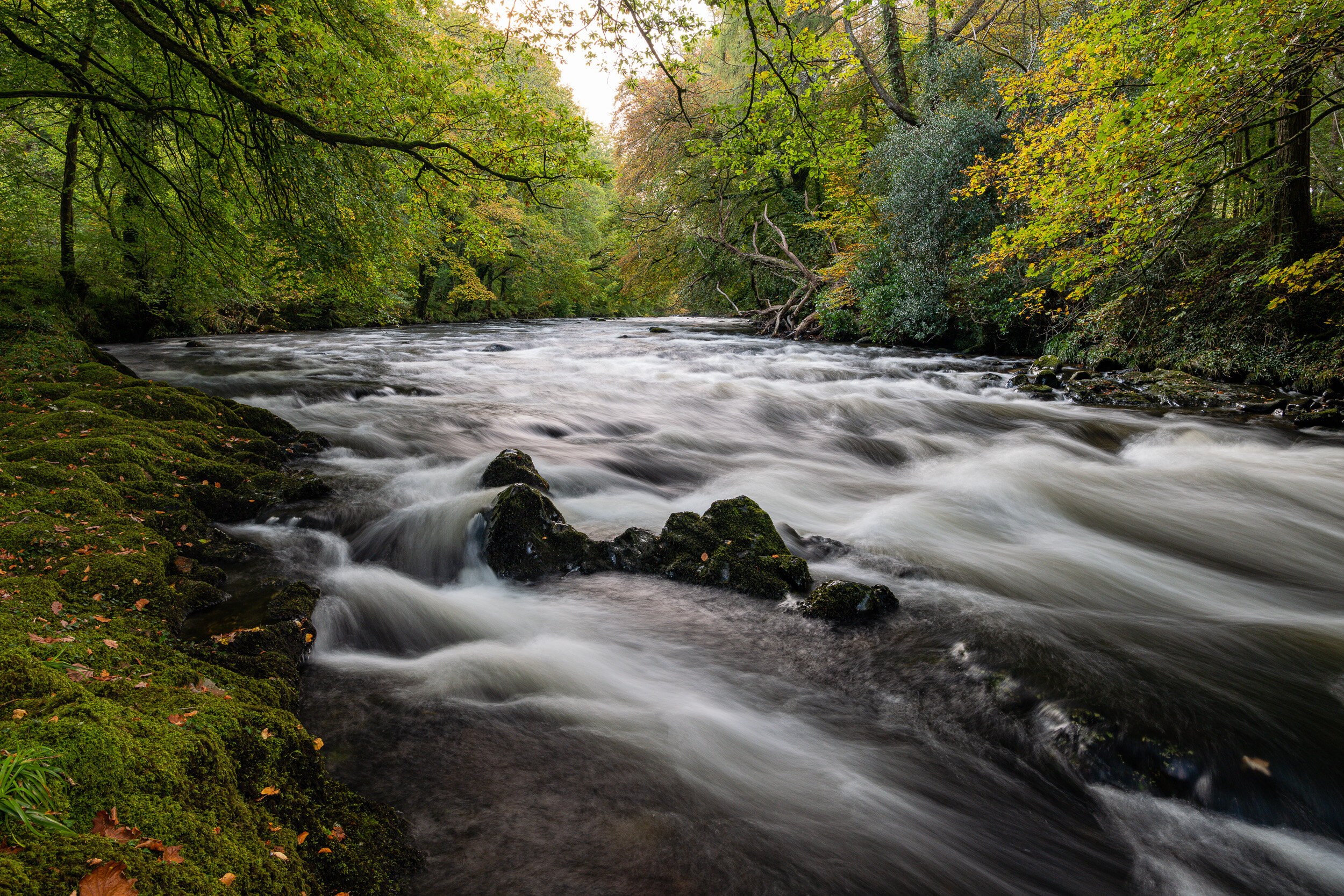
From my perspective the image quality from both cameras was superb and the only differences in the actual output are as a result of post-processing and focal length.
You’ll be able to see what I got up to with the S1R in a few weeks time so stay tuned!
Vibrant Colours
Moving away from gear and back to photography, even though I was a little early for peak autumnal colours the colours I did find were wonderful. There were splashes of yellow from the leaves but there was still a lot of green about which looked wonderfully vibrant.
Holne Bridge #5, Dartmoor, Devon - Nikon Z7, Nikkor Z 14-30mm f/4 at 14 mm, f/11, 2 seconds at ISO 400. Kase Filters K9 filter holder and CPL.
Despite the high water levels and the low light levels (we arrived a little to close to sunset), we both had a great time photographing this stunning Dartmoor location. I familiarised myself with the S1R and Holne Bridge, and more importantly, my father-in-law got himself into the swing of taking photographs again. Considering we were there for probably less than an hour we both felt it was a productive session.
Do you have plans for some autumnal photography? What locations do you like to shoot in the autumn? Let me know in the comments below.

Dawlish Warren - Three in a Row
Is there any benefit to going to the same location three times in a row? In the blog this week I find out.
Let me start off by apologising. I know this is now the third blog post in a row to feature Dawlish Warren but because of some not very interesting reasons, it's the only place I've managed to get out to photograph recently. I also have a special blog post from Dawlish Warren to share with you in a couple of weeks time as well! However, I will be mixing things up over the next few weeks. I've got one more blog post on a local location before I head to Scotland for a week of uninterrupted photography, so expect plenty of interesting blog posts, photos and videos from that trip!
After last weeks blog post from Dawlish Warren where I talked about becoming complacent with my compositions, I was determined to try a little harder this time out. I wasn't sure what to make of the weather forecast. One weather forecast was predicting dry conditions and high clouds, while another was saying overcast and showers Regardless of the weather I thought this was going to be my only opportunity to get out with the camera this week so I decided to go for it anyway.
I arrived at Dawlish Warren a little earlier than normal so I sat in my car and enjoyed the cup of coffee that I had bought from the petrol station on the way there. You simply can't beat the feeling of that first cup of coffee in the morning, so as I walked towards the beach I already had a bit of a skip in my step. As I walked along the beach and breathed in the sea air I decided that this was indeed a fantastic place to watch the start of a new day.
Caffeine highs aside the weather was actually a mix of the two forecasts. There were some great looking patches of sky and some big rain clouds kicking about. However, as is often the way, there was a big bank of thick cloud on the horizon where the sun was going to rise. No vibrant morning light for me. Though I knew I probably wasn't going to get any amazing pictures, I thought I would use the time constructively and work on some compositions. This is all good practice. I'd rather work out some new compositions during average light rather than when the conditions are amazing. Better to practice when there is less pressure.
So was this third consecutive trip the most productive? I'm not sure, so I'd be interested to hear your thoughts. Here is the image from this week, plus the other two from the previous weeks.


I personally don't have a favourite. They all have different qualities and minor issues. For me at least, it's only by looking at them all together do they deliver in a completely different way. While no one image is a stand out image, by shooting the same location in 3 slightly different ways under 3 slightly different weather conditions I have increased my working knowledge of this location. I can see from the photographs which style of image works for a certain combination of gryone and weather. This means I can be more effective and efficient for future visits. I can use my knowledge of the location to create a composition that is suited to whichever groyne I'm shooting and the weather. Hopefully, this will result in me capturing better images.
I said at the start of this blog post that I wanted to apologise for the 3rd Dawlish Warren blog post in a row, but by writing this very blog post I've gained a new perspective and that’s something that I didn't expect.
I'll see you next week when I promise you that the blog post won't be about Dawlish Warren.

Does Familiarity Breed Complacency?
I’m no stranger to photographing Dawlish Warren, but is that familiarity gradually leading to poorer images?
Under Normal Circumstances
Under normal circumstances I wouldn’t have bothered heading to Dawlish Warren last Friday. I had already been there the week before, and with the weather forecast not exactly predicting spectacular conditions, I wouldn’t have normally visited this location again. However, these weren’t normal circumstances. My friend and newly turned professional photographer, Chris Sale, was in the area and he was keen to visit the beach at Dawlish Warren.
Chris was staying in Cornwall for a week to immerse himself in photography and see his mum. This was also going to be an excellent opportunity for us to catch up and do a little photography. Unfortunately for us the weather was pretty poor all week. The one evening I was able to meet up with Chris the weather was particularly poor.
We had decided to meet at Trebarwith Strand, a wonderful coastal location to photograph, but the wind was howling. While stormy weather can sometimes be used to great effect, this wasn’t one of those evenings. The wind had churned up the sea into a mass of white water and foam. Only a mad person would have ventured down onto the beach and the view from the cliffs wasn’t exactly inspiring. In the end I didn’t take any photographs so we went to the pub and had a very nice pizza.
With Trebarwith a right off, we committed ourselves to a dawn shoot. Chris had always wanted to photograph the beach at Dawlish Warren so we decided to head there on Friday morning. Unfortunately, yet again, the weather forecast was poor. High winds, lots of cloud and the potential for rain didn’t fill me with enthusiasm. I did however want to head out on another shoot with Chris and go out for a spot of breakfast, so I thought it was worth a punt.
More Chat than Photography
Arriving at Dawlish Warren the conditions were slightly better than forecast but still not particularity inspiring. I already knew I probably wasn’t going to get a better shot than last week. No worries though, Chris was with me and the banter was flowing.
Even after many years of photographing Dawlish Warren, it is still a place that excites me, but sometimes when I feel I can’t get a better or a different image than previous visits then I do perhaps get a little lazy with my photography. That familiarity with a location can sometimes make me a bit complacent.
While I do like the image I captured that morning, I think I could have taken a better shot if I’d focused a little more on what I was doing and the conditions I had to work with.
Into the Void, Dawlish Warren, Devon - Nikon Z7 with Nikkor Z 14-30 mm f/4 at 29 mm, f/8, 224 sec at ISO 64, Kase Filters K8 holder, CPL, and 10 stop ND.
So what exactly do I feel is wrong with the photograph? While I like the long exposure, the slightly desaturated colour palette, and the way the groyne fades into the sea, I’m not that happy with the location in the frame where the groyne appears in the photograph. For me at least, I think the right-hand side of the groyne needs to be more prominent and perhaps start further down in the frame. This probably would have been best achieved by moving closer to the groyne and perhaps turning to face it more directly.
I could change the relative position of the groyne in this image through a crop but I would lose a lot of the sea in the foreground. The best option of course is just to get it right in camera in the first place!
While I like the image, it definitely has room for improvement. Perhaps if I’d been a little less complacent and was focusing more on all the elements of the composition, I might have made a slightly different but improved image. Photography is a constant journey of learning, and this trip to Dawlish Warren has taught me not to be so complacent or lazy with composition, even when I don’t think I can improve on previous images.
Do you agree with my critique? Do you sometimes get complacent when photographing your favourite locations? Let me know in the comments below.

Get Your Camera Out!
With sunrises now being at a much more sociable time of the morning I decided to get myself back into the swing of early morning rises and head to my favourite local beach.
Summer Sunrises
I like to think I don't have much of a problem getting up early in the morning so I can capture sunrise images. During the summer months the shock of a 3 am alarm call is enough to shake the resolve of even the hardest landscape photographer. While I can and have got up at this time in the morning it often means a fairly difficult rest of the day.
The difficult part is when I return from the shoot. It would be lovely if I could just come home, have some breakfast and then have a nice little nap. For a couple of hours. In reality though I have to plough through the rest of the day as if I had just got up at 7 am. It's hard to function with little sleep and still behave like a normal human being. It is for those reasons that I will only get up for a 5 am sunrise if the weather is promising to be epic or I am meeting someone.
Winter Sunrises
As the nights start to draw in it's getting harder for me to get out to shoot sunsets, so as I sat at my computer the other day planning out my photographic week it suddenly dawned on me (excuse the pun), that sunrises are now at a much more sociable hour! With a 7 am sunrise I don't have to set an alarm until 5 am, maybe even 5:30 depending on the location.
To get myself back into the swing of early morning rises I decided that I would make life easy for myself and go somewhere I know and that is local. If you've been reading my blog for a while you'll know exactly the location I'm talking about. Yep, that's right, Dawlish Warren. I've created many videos and blog posts from this location. There are too many to list here, so if you want to see what I captured on previous trips just use the search box at the top of The Exposed Blog page and search for Dawlish Warren.
Dawlish Warren - 2015. Nikon D750, Nikkor 16-35 mm f/4 at 35 mm, f/13, 72 secs at ISO 100.
Get Your Camera Out!!
I was actually rather excited to be heading out for a dawn shoot at Dawlish Warren. Not only I had I not been on a sunrise shoot for a while but I also hadn't been to Dawlish Warren for some time. It was hard to tell exactly what the sunrise would be like from the weather forecast but I wasn't going to let that put me off.
I arrived at Dawlish Warren about 6 am, roughly an hour before sunrise. As I strolled along the beach I took in a big lung full of fresh sea air and decided that there was no place better to start the day. I was the only person there and it was wonderful.
When shooting the beach at Dawlish Warren I normally like to shoot past groyne 9. Dogs aren't allowed past groyne 9 at any time of year so there is no risk of jumping dogs and unwanted footprints in the pristine sand. As I got to groyne 9 I could see a heavy bank of cloud on the horizon where the sun would rise from. This could be a problem but I decided not to let it get me down and so I sat down on one of the sand dunes to see how things might pan out.
As I watched the waves roll in that pesky bank of cloud wasn't shifting. The sky above Dawlish Warren was looking good with plenty of breaks in the cloud which, if the sun could break the horizon, would light up nicely. The time for sunrise approached, arrived, and went, but no sign of the sun in the sky.
Sitting there I did think to myself that I might not even bother getting the camera out. It's not as if I'd never been here, or would never return, or that I didn't have any good shots from this location. Experience has taught me though that it is always worth getting the camera out! So I got my camera out and I have to say that I'm glad I did. As the sun finally broke above the bank of cloud the sky started to get interesting. Not amazing, but interesting enough for me to want to take some photographs. I soon found my creative juices flowing and I got busy with the job of creating photographs.
Dawn at Dawlish Warren, Devon - Nikon Z7 with Nikkor Z 14-30 mm f/4 at 14 mm, f/13, 99 sec at ISO 64, Kase Filters K8 holder, CPL, and 6 stop ND.
Do you shoot sunrises all year round or wait like me until the autumn and winter months? What is your favourite sunrise location? Do you always get your camera out or have you gone home having taken no pictures at all? Let me know in the comments below.

7 AMAZING Devon and Cornwall Landscape Photography Locations
In this blog post I’m going tell you about 7 AMAZING locations in Devon and Cornwall for landscape photography. This post is PACKED full of photographs and videos to inspire your landscape photography!
Vignettes of Landscape Photography
Over the last week I’ve been publishing videos from my new series Vignettes of Landscape Photography. It’s a series of short videos on the locations that have inspired my landscape photography. Each episode is a mix of still photography and video clips that will hopefully not only show you the natural beauty and variety of the location but also inspire you to visit that location to capture your own photographs.
Now that all 7 episodes from series 1 have been published on YouTube, I thought I would bring them all together in a big blog post. Not only can you choose to play them all from the playlist I have created below, but if you scroll down you will find each individual episode along with a map and the images I captured from that location. I hope you’ll agree that these are indeed 7 AMAZING locations in Devon and Cornwall for landscape photography!
I really hope you enjoy this first series of Vignettes of Landscape Photography. Please leave me a comment below and let me know what you think. Did you have a favourite episode or a favourite image? What would you like to see from series 2? Have you been to any of these locations? Have you been inspired to visit any of the locations featured? Let me know in the comments below.
Bedruthan Steps
A Bedruthan Spring, Bedruthan Steps, Cornwall - Nikon D850, Nikkor 16-35 mm f/4 at 26 mm, f/11, 1/4 sec at ISO 64, Kase CPL and ND grad.
Spring Cliffs at Bedruthan, Bedruthan Steps, Cornwall - Nikon D850, Nikkor 16-35 mm f/4 at 22 mm, f/11, 1/2 sec at ISO 64, Kase CPL and ND grad.
Last Light at Bedruthan, Bedruthan Steps, Cornwall - Nikon D850, Nikkor 24-70 mm f/2.8 at 42 mm, f/8, 136 sec at ISO 64, Kase CPL, ND and ND grad.
Venford Falls
The Twin Falls of Venford, Dartmoor, Devon - Nikon D850, Nikkor 16-35 mm f/4 at 28 mm, f/11, 4 sec at ISO 64, Kase CPL.
The Fall, Dartmoor, Devon - Nikon D850, Nikkor 16-35 mm f/4 at 35 mm, f/11, 2.5 sec at ISO 64, Kase CPL.
The Flow, Dartmoor, Devon - Nikon D850, Nikkor 16-35 mm f/4 at 16 mm, f/11, 2.5 sec at ISO 64, Kase CPL.
Belstone Common
Stormy Belstone #1, Dartmoor, Devon - Nikon D850, Nikkor 16-35 mm f/4 at 16 mm, f/13, 1/3rd sec at ISO 64, Kase CPL and ND grad.
Stormy Belstone #2, Dartmoor, Devon - Nikon D850, Nikkor 16-35 mm f/4 at 16 mm, f/13, 1/3rd sec at ISO 64, Kase CPL and ND grad.
Daymark Tower
The Daymark Tower, Devon - Nikon D850, Nikkor 16-35 mm f/4 at 16 mm, f/13, 1/5th sec at ISO 64, Kase CPL and ND grad.
Tower in the Field, Devon - DJI Mavic Pro, 23 mm, 1/290th sec at f/2.2, ISO 100.
Stormy Belstone #1, Dartmoor, Devon - Nikon D850, Nikkor 24-70 mm f/2.8 at 70 mm, f/2.8, 1/125th sec at ISO 64, Kase CPL.
Trevose Head
Trevose Head #2, Cornwall - Nikon D850, Nikkor 24-70 mm f/2.8 at 26 mm, f/13, 2.5 sec at ISO 64, Kase CPL.
A Long Night Ahead - Trevose Head, Cornwall - Nikon D850, Nikkor 16-35 mm f/4 at 20 mm, f/13, 13 sec at ISO 64, Kase CPL and 6 stop ND.
Botallack
Botallack #1, Cornwall - Nikon D850, Nikkor 16-35 mm f/4 at 16 mm, f/11, 1.6 sec at ISO 64, Kase CPL and 6 stop ND.
Botallack #3, Cornwall - Nikon D850, Nikkor 16-35 mm f/4 at 30 mm, f/13, 90 sec at ISO 64, Kase CPL and 6 stop ND.
Brent Tor
Brent Tor, Dartmoor, Devon - Nikon D850, Nikkor 16-35 mm f/4 at 16 mm, f/14, 1/13th sec at ISO 64, Kase CPL.
Brentor Church Sunset #2, Dartmoor, Devon - Nikon D850, Nikkor 16-35 mm f/4 at 19 mm, f/8, 1/6th sec at ISO 64, Kase CPL. Focus stacked image.

A Tale of the Unexpected
Sometimes the best the shots are on the path rather than the destination itself.
Two Plans in One
Summer generally brings blue skies and warm weather. All very nice for relaxing in and drinking glasses of chilled white wine, but generally useless for landscape photography. After what had seemed to be an endless streak of blue sky evenings I had decided that enough was enough and I was going to go out with the camera. Worst case scenario I could do some exploration of new locations, and best case I might get some high-level cloud around sunset and be able to fire off a couple of frames.
I've been trying to explore more of my local coastline recently so I decided I would visit a location that had been recommended to me by a friend. It's the kind of location you want to visit on a high tide, with a bit of wind and lots of clouds. None of these conditions would be present on this visit, but as this was a mission of exploration, none of that mattered. I just wanted to scope out the location.
As I also had a bit of time I thought I would visit that location first and then head to a different location to catch the sunset. Looking at the map I could see I wouldn’t be far from Froward Point and as I hadn't shot that viewpoint in a while I decided to tag it onto my itinerary.
Blue Skies, Blue Ocean
It was a beautiful summers evening as I set out in my car to my first location. Despite it not being ideal conditions for landscape photography summer is a great time to be driving around Devon. Everything looks lush and green and you can't help but feel everything is going to be just fine!
That sense of well-being and calm continued as I made the last part of my journey to the first location on foot. As I already knew I wasn't going to be taking any "serious" pictures at the location it didn't bother me that it was calm seas and bright blue skies. I took a number of test shots from various different angles. I had to try hard to envisage the location in less settled conditions, but I at least now had a good idea of what I might want to achieve next time. Definitely a location to return to.
I was soon back in the car and crossing the River Dart using the ferry. This is something I haven't done before so it was an added bit of excitement to my little road trip!
Golden Fields
To get to Froward Point you first have to park at the Brownstone National Trust car park and then walk the rest of the way. As you make your way down to the coastline you walk by Daymark Tower, a popular location for photography and a location I’ve shot myself many times. In fact, I had shot it a few weeks before so I was happy enough to pass it by. However, as I walked by it did catch my eye. Instead of the crops being a greeny yellow colour they had turned a golden colour and looked quite different. It did cross my mind that it might photograph well when the sunsets, but I carried on walking, focused on getting to the coastline.
You can shoot Froward Point from a number of different angles as you can see from this blog post here and here. For this visit I decided to go for the spot almost directly below the NCI lookout. I have to admit that when I arrived I just wasn't feeling that excited about shooting there. I'm not sure why this was. The sky now had a few very high-level clouds in it but the rest of the scene wasn't really doing it for me.
I think at the back of my mind I knew that I would have been better off back at Daymark Tower and shooting those golden fields of crops. As time progressed and my desire to photograph Froward Point didn't increase I decided there was no point in waiting until sunset and so I packed my bag and started to walk back to the car.
As I approached Daymark Tower I could see how good the light looked on the tower and the crops. With about 15 minutes of good light left I get to work very quickly and captured these images.
Field of Gold, Daymark Tower, Devon - Nikon D850, Nikkor 16-35mm f/4 at 17mm, f/13, 1/3rd second at ISO 64.
Tower of Gold, Daymark Tower, Devon - Nikon D850, Nikkor 70-200 f/2.8 at 70mm, f/11, 1/6th second at ISO 64.

Fire Beacon, Daymark Tower, Devon - Nikon D850, Nikkor 16-35mm f/4 at 24mm, f/13, 0.4 second at ISO 64 (single image crop at 16:7).
Though I've shot Daymark Tower a few times, I'd never photographed it looking like this. A combination of clear skies, golden light, and golden crops made for some very pleasing images. Considering I hadn't planned on capturing images at Daymark, these unexpected images were very welcome!
Have you ever passed a location and then wished you'd gone back? Have you ever gone to one location but decided to go somewhere that you had originally dismissed? Let me know in the comments below.

Beautiful Blue Butterflies at Berry Head
In the blog this week I’m out again taking macro photographs. This time it’s butterflies and I had no idea how beautiful these creatures are!
More Macro
In the blog last week I talked about Discovering the Joy of Macro Photography. This was my first real attempt at macro photography and I have to say, I really enjoyed it! Yes, it was challenging, but it was a very rewarding type of photography.
From that experience I knew that this was a genre of photography that I would want to do again. So when friend and fellow photographer Neil Burnell said he was heading out to photograph some butterflies and would I like to come, there really was only one answer I could give!
Common Blue #1, Devon - Nikon D850, Zeiss 100mm f/2 at f/3.5, 1/400th second at ISO 1600
Beautiful Bokeh
One of the challenges I have with doing macro photography is that I don’t actually own a macro lens. I borrowed a Nikkor 105mm f/2.8 when I shot the banded demoiselles last week and I was going to have to borrow again for this shoot. Fortunately for me Neil offered to lend me his beautiful Zeiss 100mm f/2 Makro-Planar lens.
As soon as I started using this lens I noticed what a different experience it was from using my Nikkor lenses. The focusing can only be described as buttery smooth! It made precisely focusing the lens a real joy. That didn’t necessarily make capturing the images easy as the subject could still move because of the gentle breeze but at least when it was still you could be confident with the focusing. Couple that with the D850’s focus peaking in live view, the job of focusing was at least made a little simpler
As a landscape photographer I’m not that concerned with bokeh. Most of the time I’m trying to get front to back sharpness so I rarely use wide apertures. In this instance though I very much wanted to create some lovely bokeh in my shots. I’d been looking at Neil’s work in this area but it soon became apparent to me that even though the Zeiss lens could create some lovely bokeh, putting the subject and the other elements all together to create the look was more challenging than I had originally thought!
Common Blue #2, Devon - Nikon D850, Zeiss 100mm f/2 at f/3.2, 1/800th second at ISO 1600
Easy To Miss
As with my previous macro adventure, having someone along with the relevant knowledge was key. Neil knew exactly where to find the butterflies and identify which species they were. The thing that got me though was how small they were! Both the Common Blue and Small Blue that I photographed were tiny. They were about the size of a thumbnail and could be easily missed.
Being so small it’s hard to see all the beautiful detail in these wonderful creatures. This is where the joy of macro photography gets me. Put a macro lens on your camera and suddenly you can see all the tiny details from the stripes along the antenna, the hairs an the thorax and the striking patterns of the wings. A macro lens really does open up a whole new world of natural beauty.
Small Blue, Devon - Nikon D850, Zeiss 100mm f/2 at f/2.8, 1/160th second at ISO 2000
These last two trips out with the camera to do macro photography have really opened my eyes on how I could capture the “landscape” in a different way. Yes, I love taking those big landscape photographs but I’m also quickly learning that there is a whole other world of photography down at my feet.
Just before I finish up the blog, I just want to thank Neil again for inviting me out. Without his local knowledge I would have been a bit lost! As I’m finding out with macro photography, knowledge of your subject is as important as being able to use your camera gear. If you’re looking to develop your macro photography and then definitely check out Neil’s 1-2-1 close up tuition page.
I’m not sure what will be in the blog next week, but one thing is for sure, if there is a chance to do more macro photography I’ll be taking it!
Are you a macro photographer? What is your favourite subject to photograph? Let me know in the comments below.

Feeling the Pressure of Landscape Photography
In the blog this week I head up to Belstone Common on Dartmoor to capture some landscape photographs. I also discuss some of the pressure I feel while out with my camera.
Is Landscape Photography Stressful?
Is landscape photography stressful? For me at least, no. Being outdoors with my camera is one of the most relaxing and sometimes exciting things I get to do. However, I do sometimes put myself under a bit of pressure. My time out with the camera is limited, so I always want to make the most of the time I do have.
The pressure really comes from trying to make the right decision on where to go. Sometimes the answer is clear and the location to go obvious. Other times, it can be a real headache. I probably spend too much time worrying about where to go if I’m honest.
When I’m out though, all that pressure goes. I’m outdoors, I’ve got my camera, and I’m having fun. Even if the photography is rubbish, I’m still outside enjoying the great outdoors!
While I was up on Dartmoor the other day, I decided to put these thoughts to camera while I was out capturing some dawn images of Belstone Common.
I hope you enjoyed the video. Do you put yourself under pressure for your photography? Is being outdoors generally more important than the photography? Let me know in the comments below.
Belstone Common, Dartmoor
Here are the photographs you saw in the video. Enjoy!
First Light at Belstone, Dartmoor, Devon - Nikon D850, Nikkor 16-35 mm f/4 @ 16 mm, f/13, 3 secs @ ISO 64.
Dawn on Belstone Common, Dartmoor, Devon - Nikon D850, Nikkor 16-35 mm f/4 @ 16 mm, f/13, 5 secs @ ISO 64.
Belstone Tor and Belstone Common at Dawn, Dartmoor, Devon - Nikon D850, Nikkor 16-35 mm f/4 @ 26 mm, f/13, 3 secs @ ISO 64.
Who Left All These Rocks Here, Dartmoor, Devon - Nikon D850, Nikkor 16-35 mm f/4 @ 17 mm, f/5.6, 1/13 secs @ ISO 64, focus stacked image.