
A Honeypot Location Does Not Guarantee Success
In my bog this week I share with you some of the photographs I took on a recent visit to Kilchurn Castle in Scotland. On paper, I had all the right conditions, but that doesn't necessarily mean the photography is easy.
Photographing Kilchurn Castle
Kilchurn Castle on the banks of Loch Awe is a well-photographed location. With a ruined castle, a Scottish loch, and mountains in the background, it’s no wonder why it’s so popular with tourists and photographers alike.
When a location becomes extremely popular with photographers it is often labelled as a honeypot location. Photographers have varying views on if you should shoot a honeypot location or not. I have shared my views on this topic in a previous video. Check it out to see if you agree.
While Kilchurn Castle could be considered a honeypot location, that is not the only reason I chose to photograph it. I have a personal connection with this location. I grew up just a few miles away from the castle, under the shadow of the very same mountain that dominates the background to the castle. As a child, I will have visited the castle, see it from the road, and passed by it on the train. The view of this quintessential Scottish castle has been engrained onto my brain.
Unfortunately, I became a photographer long after leaving the area, so I’ve only been able to photograph it a few times. I’ve had varying degrees of success and you can watch a video I made there below.
Returning to Scotland
After a break of over 2 years (thanks to things like COVID), I finally made a return trip in October. The purpose of the trip was to see family but as a photographer, there was no way I was going to leave my camera at home!
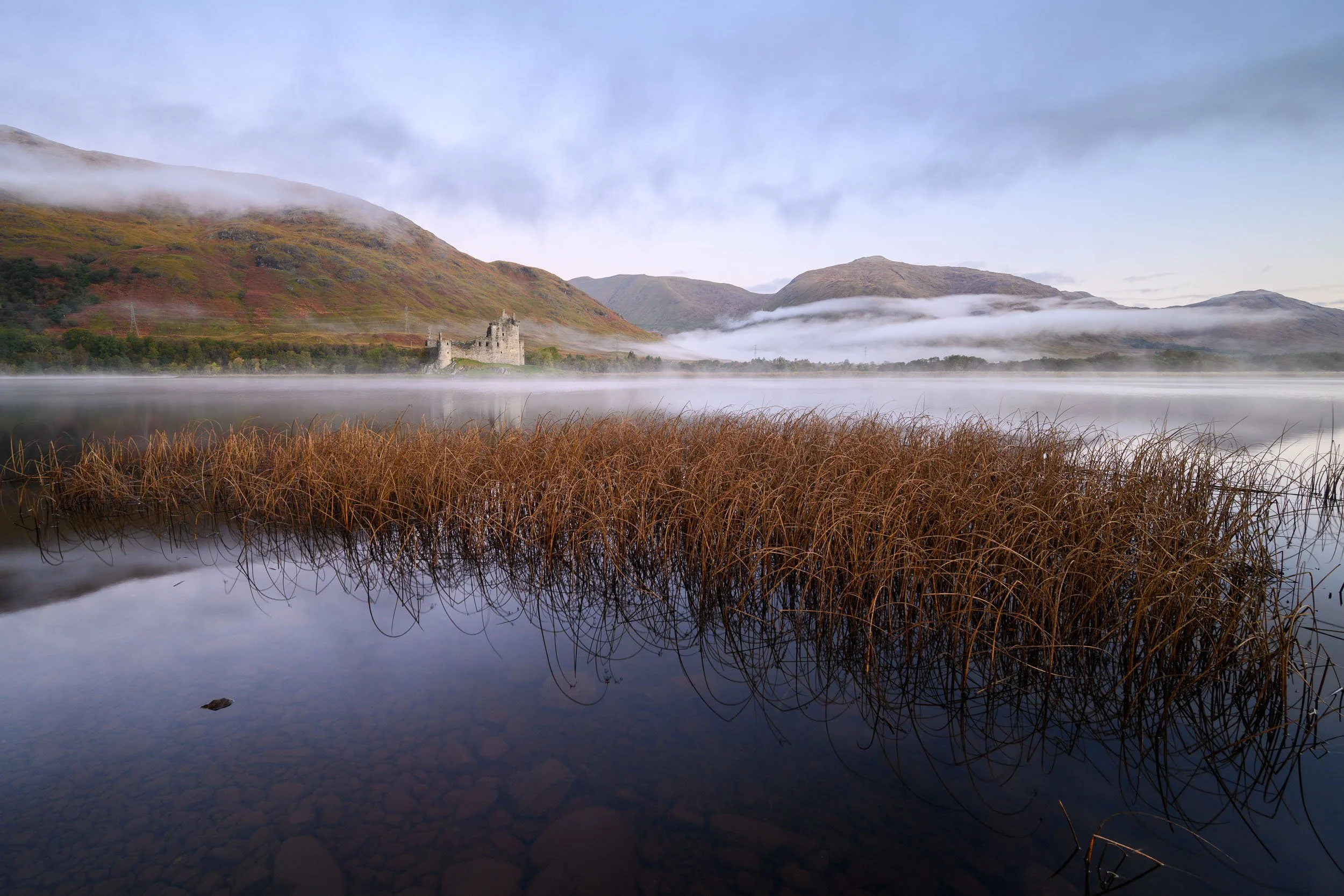
Given that Kilchurn Castle was so close to where I was going to be staying, I kept an eye on the forecast in the hope that an opportunity would present itself. Sure enough, one of the morning forecasts predicted mist and calm winds. While there are many shots of the castle in mist being reflected in the water, it’s a photograph that I hadn’t taken so I made my plans for a dawn shoot to see if I could put my own stamp on this classic viewpoint.
It was mid-week morning in October so at most I expected to see one or two other photographers there. To my surprise I got the last parking space when I arrived! As I walked down to the water's edge, I could see lots of photographers. There were probably at least two workshop groups there.
This didn’t spoil things for me. Far from it. I was still able to find a spot I was happy with, so I got my camera out and got shooting.
A Misty Morning at Kilchurn Castle #1, Loch Awe, Scotland - Nikon Z7, Nikkor 14-30mm f/4 at 14mm, f/8, 1 second at ISO 64.
Nice Conditions But…
The conditions were just as predicted. There was mist floating about and the waters were mostly calm. You would of course think that this would make the photography easy, but that’s not the case. It’s always a combination of factors that make for the most interesting photographs. Mist, yes, but is it the right place to add atmosphere to the image? Calm winds, yes, but not everywhere so getting perfect reflections is challenging. Clouds in the sky? What clouds! And when I finally got light on the castle, it was harsh and most of the mist had cleared, and the wind had picked up.
A Misty Morning at Kilchurn Castle #2, Loch Awe, Scotland - Nikon Z7, Nikkor 14-30mm f/4 at 30mm, f/8, 3 seconds at ISO 64, 16:9 crop.
It’s not to say that I’m unhappy with my images. Far from it. Each photograph has its own merits and I tried to make the most of the conditions at the time of capture. However, none of the images are successful in their own right. There is some sort of compromise in each one.
A Misty Morning at Kilchurn Castle #3, Loch Awe, Scotland - Nikon Z7, Nikkor 24-200mm f/4-6.3 at 48mm, f/11, 1/25th second at ISO 64, stitched panorama.
This is not to take away from the enjoyment of being there that morning. I loved it. Watching the reflections come and go, and to see the mist dance and snake over the landscape was a joy. But just because you are at a honeypot location with visually great conditions does not mean you can always make for a stunning image.
My advice is to always enjoy a location for what it is and make the best photograph you can. If you come away with an amazing image, it’s a bonus, but if not, don’t sweat it.
It might be a while before I get back to Kilchurn Castle, but no matter the conditions when I do, it’s a view that I will cherish.

Should YOU Photograph the Honeypot Locations?
Is there any point in capturing your own images from the landscape photography honeypot locations? With so many images captured from these popular locations you could be forgiven for giving them a miss. In this blog post I head to Glencoe in Scotland to photograph one of its most popular viewpoints and discuss why I think everyone should shoot a honeypot location.
They Are Honeypot Locations for a Reason
This is going to be a bit of a short blog post. There are a couple of reasons for this. Firstly, most of what I want to say is said in the video to go with this post, so there’s little point repeating it all here. I’m also a little short in time because I’ve got lots of exciting content to work on that I want to get ready before the festive period really starts.
All that aside, I’ve been wanting to make this video for a while. My original plan was to shoot it down at Durdle Door but I never quite made it there this year. When I started making plans for my trip to Skye I knew I was going to stop off in Glencoe so I decided that I would make the video there. Glencoe is not short of a few honeypot locations but I settled on the viewpoint with the small waterfall (on the river Coupall) and Stob Dearg in the background. There can’t be that many of you that haven’t seen that viewpoint before!
It’s a stunning viewpoint and one that I can’t resist photographing every time I’m in Glencoe. These viewpoints aren’t called honeypot locations for no reason! However, in some circles, photographing these locations and viewpoints can be frowned upon. While it is true that getting something new from these locations can be tricky, I don’t think this is a reason to not shoot them.
If you want to know why I think you should shoot them, check out my video below:
I’m sure most of you have already shot a few honeypot locations and have enjoyed the experience of capturing your own images. If you haven’t though, I hope this video has inspired you to visit places like the Glencoe viewpoint in the video, or even Durdle Door.
Do you have a favourite honeypot location? Are there any honeypot locations you’d like to shoot? Let me know in the comments below.
One Location, Many Viewpoints
If you want to see the images from the video in a bit more detail you’ll find them below.
The River Coupall and Buachaille Etive Mor, Glencoe, Scotland - Nikon Z7, Nikkor 14-30mm f/4 at 22mm, f/13, 1 second at ISO 200, CPL and 3 stop ND.
River Coupall Falls, Glencoe, Scotland - Nikon Z7, Nikkor 14-30mm f/4 at 15mm, f/13, 1/8th at ISO 160, CPL.
The River Coupall and Stob Dearg, Glencoe, Scotland - Nikon Z7, Nikkor 14-30mm f/4 at 22mm, f/13, 4 seconds at ISO 160, CPL and 3 stop ND.