

From Dawn to Dusk - Mastering the Light in Landscape Photography - On My Bookshelf S07E03
Mark Bauer and Ross Hoddinott are two of the UK's leading landscape photographers and in this episode of On My Bookshelf I look at their latest book 'From Dawn to Dusk - Mastering the Light in Landscape Photography'.
An Updated Edition by Ross and Mark
Over the last few years Ross and Mark have been publishing updated editions of their co-authored books on landscape photography technique. Now it’s the turn of ‘From Dawn to Dusk: Mastering the Light in Landscape Photography’ to get the updated edition treatment.
I’m not going to say too much more here as I cover all the book essentials in the episode of On My Bookshelf below, but needless to say, if you are looking to improve your landscape photography technique and capture photographs no matter what time of day, then this book from two of Britain’s leading landscape photographers is probably for you.
Enjoy the episode!
Purchase Ross and Mark’s Books
🛒 Purchase 'From Dawn to Dusk: Mastering the Light in Landscape Photography, by Ross Hoddinott and Mark Bauer' here - https://amzn.to/4jPF8Ib
🎞️ Watch my 2018 interview with Mark and Ross about the 1st edition of 'From Dawn to Dusk - https://www.youtube.com/watch?v=r9M-V_75604.
Check out these other great books by Mark and Ross
🛒 Purchase 'Landscape Photography Workshop (Updated Edition)' - https://amzn.to/3qBTHIW
🎞️ Watch On My Bookshelf S06E02 'The Landscape Photography Workshop by Mark Bauer and Ross Hoddinott' - https://youtu.be/TCoLXnzInxs
🛒 Purchase 'The Art of Landscape Photography (Updated Edition)' - https://amzn.to/45Z3WHn
🎞️ Watch On My Bookshelf S05E02 'The Art of Landscape Photography by Ross Hoddinott & Mark Bauer' - https://youtu.be/OMLKcikpoJw
Please note that these are affiliate links (but not paid links or ads). By buying through these links I may receive a commission for the sale. This has no effect on the price for you.

The Landscape Photography Workshop by Mark Bauer and Ross Hoddinott - On My Bookshelf S06E02
In their updated edition of The Landscape Photography Workshop, two of the UKs leading landscape photographers, Ross Hoddinott and Mark Bauer, are aiming to teach you everything you need to know to take amazing landscape photographs. Have they succeeded?
An Updated Edition
As they did last year with The Art of Landscape Photography, Ross Hoddinott and Mark Bauer, have now updated The Landscape Photography Workshop. The updated edition of The Art of Landscape Photography is a book I can easily recommend to anyone wanting to develop their skills in composition. So, when I heard they were also updating The Landscape Photography Workshop, I thought I’d better check it out to see if it would become my book recommendation for those want to learn more about the technical aspects of landscape photography.
Well, the updated edition has arrived, I’ve read it and I can now share my thoughts in the latest episode of On My Bookshelf!
You can buy both updated editions of the books with the links below. They make an excellent pairing!
🛒 Landscape Photography Workshop (Updated Edition) - https://amzn.to/3qBTHIW
🛒 The Art of Landscape Photography (Updated Edition) - https://amzn.to/45Z3WHn

The Art of Landscape Photography by Ross Hoddinott & Mark Bauer - On My Bookshelf S05E02
In this episode of On My Bookshelf, I look at The Art of Landscape Photography by Ross Hoddinott and Mark Bauer. Will this book take your landscape photography skills from zero to hero?
Learning Landscape Photography from a Book
YouTube has a rich variety of educational content to suit anything you might want to do with your camera. It is a wonderful place to learn photography. I use YouTube myself to improve my photography skills, and though my channel isn’t focused on photography education, I do still hope that people can still learn something from my videos.
That all said, sometimes the best way to learn something is by using a good old-fashioned book. Getting your education from a book can prove to be a more effective medium than YouTube. If you take the topic of landscape photography composition, which is a broad topic, it can be difficult to find a video, or collection of videos that provide sufficiently broad cover of the subject. Typically, you will only get information on one small topic in each video and unless you know what you don’t know, it can be hard to know what topic to cover next.
A book such as The Art of Landscape Photography will often provide broader coverage of the subject, allowing the reader to consume the information they were looking for, but also highlight areas that they might not have had previously thought about.
I’m not saying that the humble book is the best way to learn photography, but it should feature in the formats of educational content that you do consume.
Now that we have positioned the importance of educational photography books, let’s look at The Art of Landscape Photography to see if it should have a place on your bookshelf.
Book and Author Links
You can purchase your copy of The Art of Landscape Photography here.
You can also get:
From Dawn to Dusk: Mastering the Light in Landscape Photography - https://amzn.to/3GA3jGv
The Landscape Photography Workshop - https://amzn.to/3gu7Gs0
Digital Macro & Close-up Photography: New Edition - https://amzn.to/3rzIeI1
Mark's excellent fotoVUE on Photographing Dorset. *** Use the discount code JULIAN to get 20% off all books if you buy at fotovue.com ***
You can see Ross and Mark's photography on their websites - https://www.rosshoddinott.co.uk/ and https://markbauerphotography.com/
You can also check out their workshops at - https://www.dawn2duskphotography.co.uk/

Essential Guide to Filters for Landscape Photography by Hoddinott & Bauer - On My Bookshelf S03E07
What are filters? Do I need filters? Which filters should I buy? How do I use filters? If you need answers to any of these questions, then the latest book to hit my virtual bookshelf could be the answer.
What Filters Should I Use for Landscape Photography?
Questions about filters is the one topic I get asked about more than any other. What filter kit should I buy? What filters do I need? All good questions and I do try and take the time to provide answers. However, I only use the Kase Filter system (which is very good by the way!) and a handful of filters so my experience of other brands and other types of filters is somewhat limited.
Up until now, there hasn’t really been a single, up to date, and comprehensive resource on filters for landscape photography. It would be nice to send people to a single resource where they can get all the information they need on which filters to buy and how to use them.
When Nature TTL announced that they were publishing a book by established photographers and renowned authors Mark Bauer and Ross Hoddinott, I knew I wanted to get a copy. After reading the book and seeing how comprehensive it was I knew I needed to feature it in an episode of On My Bookshelf so you could see for yourself if it might be a title for your bookshelf.
I hope you enjoyed this episode of On My Bookshelf. I thought it was an excellent book on filters for landscape photography and it will be a book that I will now recommend to anyone that has questions about filters. You can get a copy of the book right here.

52 Assignments Landscape Photography by Ross Hoddinott and Mark Bauer - On My Bookshelf S03E02
Are you looking to kickstart your landscape photography in 2020? In this episode of On My Bookshelf, I'm taking a look at 52 Assignments for Landscape Photography by Ross Hoddinott and Mark Bauer. It's packed full of creative assignments but there's really only one way to see how good it is and that is to head out on location and give one of those assignments a try.
OMBS On Location
Most of the photography books featured in On My Bookshelf (OMBS) are normally enjoyed at home with a nice cup of coffee. Every now and again though I get a book that has a more practical element to it and I feel the best way to share my thoughts on it is to go on location with it. I adopted this approach last year when I met up with Nick Livesey to discuss his book Photographing the Snowdonia Mountains.
When I received my copy of 52 Assignments: Landscape Photography by Ross Hoddinott and Mark Bauer I knew straight away that this would be another book that would be best demonstrated on location. The only challenge I had was which of the 52 assignments should I pick!
So join me in the latest episode of OMBS as I share my thoughts on this book and head out to Dartmoor on assignment.
I really hope you enjoyed this episode of OMBS. Santa was good enough to bring me a book on landscape photography that I’ve had on my list for a while now and I hope to bring you that episode of OMBS in the near future.
What do you have planned for your photography in 2020? Do you give yourself any assignments or projects? How do you discover creative ideas and techniques? Let me know in the comments below.
The Photographs
As always, here are the images that you saw in the video. I can’t wait to get back to this location. Hopefully when the light is a bit better and the wind a lot lighter!
West Mill Tor #2, Dartmoor, Devon - Nikon Z7, Nikkor 14-30mm f/4 at 21mm, f/13, 1/8th second at ISO 400, CPL and ND Grad.
West Mill Tor #1, Dartmoor, Devon - Nikon Z7, Nikkor 14-30mm f/4 at 14mm, f/13, 1/3rd second at ISO 400, CPL and ND Grad.
West Mill Tor #3, Dartmoor, Devon - Nikon Z7, Nikkor 14-30mm f/4 at 21mm, f/13, 1/8th second at ISO 400, CPL and ND Grad.

Digital Books for Your Digital Bookshelf - On My Bookshelf S02E03
In this episode of On My Bookshelf, I take a quick look at 5 digital books that should have a place on your virtual bookshelf.
Inspiration on the Move
I’m a big fan of the photography book. Anyone who’s been subscribed to my YouTube channel for a while will have seen an episode of On My Bookshelf and watched me talk about some of my favourite photography books. For the most part though, those books are too big to take anywhere apart from your own living room.
In most cases, a printed photography book is preferential to a digital photography book. But what if you wanted a little bit of photography inspiration on the move. Perhaps you might have to commute to work every day, or you’ve got a long train journey or even a flight somewhere. Some of the books I have would need to pay for their own seat on a plane!
In this special, digital edition of On My Bookshelf, I’m going to share with you 5 digital photography books that I think should be on your virtual bookshelf, so you can a little bit of photography inspiration on the move.
Your Reading List
As promised, here is a list of those books from the video:
The Art of Landscape Photography - by Ross Hoddinott and Mark Bauer
Gordon Laing - In Camera: Perfect Pictures Straight Out of the Camera
I do hope you enjoyed this shorter than normal episode of On My Bookshelf, but hopefully, you’ve spotted a book there that you might be able to take with you next time you are on the move.
Do you read any digital photography books? Have you got any digital recommendations? Let me know in the comments below.

From Dawn to Dusk - Mastering the Light in Landscape Photography - On My Bookshelf S01E05
In this very special blog post I share with you the latest episode of On My Bookshelf. In the episode I interview Mark Bauer and Ross Hoddinott about their latest book on landscape photography, From Dawn to Dusk. I also tell you about a giveaway where you can win all three of their books.
On My Bookshelf
Over the last few months, I've been sharing with you the On My Bookshelf series of videos. Even though my photography life is predominately digital, I still believe the printed book is an important part of my development and enjoyment of photography. So in each episode of On My Bookshelf, I've told you about a book that I've enjoyed reading in the hope that it will also inspire you.
From Dawn to Dusk
When I first heard that two of my favourite landscape photographers were writing another book I knew straight away that I would need to get myself a copy. After all, their last book, The Art of Landscape Photography, had a big impact on my development as a photography and I read it many times.
As the publication date got closer I reached out to Ross Hoddinott and Mark Bauer and asked if they would like to appear on an episode of On My Bookshelf. I was delighted when they both agreed and they invited me along to see them sign and dispatch the first batch of orders of From Dawn to Dusk - Mastering the Light in Landscape Photography.
They also kindly agreed to an interview where I got the chance to ask them about their latest book, what's in it, who's it for, and how it differs from their previous 2 titles. You can see the full interview in the video below.
Book Giveaway!
After the interview, Mark and Ross offered me a signed copy of their latest book to give away to one lucky viewer. Not only that, they also gave me two signed copies of their previous two titles The Art of Landscape Photography and The Landscape Photography Workshop.
There are two ways in which to gain an entry to win all 3 books:
Watch this episode of On My Bookshelf: From Dawn to Dusk on YouTube and then leave a comment in the YouTube comments section for the video. Comments are welcome here, but to enter you need to leave a comment on the video itself.
Share the Facebook post for this video. You can find it here: <insert URL>
You a free to enter using one, either, or both of the above ways. If you do both though, you will be entered into the giveaway twice!
Entries for the giveaway close 12 pm (GMT) 28th May 2018.
If you can't wait to get a copy of From Dawn to Dusk - Mastering the Light in Landscape Photography you can still order a signed copy straight from the authors at http://www.dawn2duskphotography.co.uk/books/
Finally, I just want to say a big thanks to Mark and Ross for the interview! It was a real pleasure talking to you both and judging by the number of pre-orders you were signing and sending out it looks like From Dawn to Dusk - Mastering the Light in Landscape Photography is going to be a big success!
Some of the links used in this article are Amazon affiliate links. By buying through the links I may receive a commission for the sale. This has no effect on the price for you.

5 Great Landscape Photography Books - On My Bookshelf S01E01
In the blog this week I tell you about a new video series I'm creating and what my 5 favourite landscape photography books are.
A New Video Series
For me, photography books are still very important in my development as a landscape photographer. I value the experience that a book gives me. Rather than simply just scrolling through an image feed on one of the popular photo sharing sites, reading a book gives me the time to really look at a photograph. It's a more involved experience and I like the way it forces me to take time away from the computer to look at an image in detail. Besides, looking at photographs in print is always a great experience.
So I've decided to create a new series of videos for my YouTube channel called On My Bookshelf. In each video will talk about a book (or even a few books) that are important to me and tell you why. I think we all should spend more time reading photography books, and hopefully, these videos will give you some ideas on what to read next.
5 Great Landscape Photography Books
For my first video in this series, I tell you about my 5 favourite landscape photography books.
I hope you enjoyed the video and that it has inspired you to grab your favourite photography book. If you are interested in picking up any of the books I mentioned in the video, you can use the following links:
The Causeway Coast by Steven Hanna (ISBN 978-0857043047) - Amazon or direct from Steven for signed copy
The Art of Landscape Photography by Ross Hoddinott and Mark Bauer (ISBN 978-1781450529) - Amazon
Wildlife Photographer of the Year: Portfolio 26 (ISBN 978-0565093952) - Amazon
Photographing Cornwall and Devon by Adam Burton (ISBN 978-0992905132) - Amazon
Landscape Photographer of the Year: Collection 1 (ISBN 978-0749552244) - Amazon
The links used above are Amazon affiliate links. By buying through the links I may receive a commission for the sale. This has no effect on the price for you.
There are a number of exciting landscape photography books coming out over the next few months so be sure to subscribe to my YouTube channel so you get notified when I publish a new episode of On My Bookshelf!
So do you have a favourite photography book? Which photography book are looking forward to seeing next? Let me know in the comments below.

Exploring Colmer's Hill
In this blog post, I talk about my 2nd visit to Colmer's Hill and how I learnt to look for the wider perspective. I also look at the importance moving around to find different compositions of the same subject.
A Change of Plan
One of my photographic goals this year is to explore more of Dorset. I'm very lucky to live in Devon as not only do I have a lot to shoot in my local county, but I also have Cornwall and Dorset as neighbours. For no particular reason, I seem to have spent more time shooting in Cornwall than Dorset. So after reading Mark Bauer's new book Photographing Dorset, I was very much inspired to photograph more of Dorset in 2017.
My original plan for the shoot was to head to Old Harry Rocks near Swanage. However, the weather forecast wasn't concrete for the conditions I wanted. As it is a 2 hr drive there and a 2 hr drive back I didn't feel it was worth the risk on this occasion so I opted for something a bit more local. I had visited Colmer's Hill late last year and with it's close proximity to home I thought that would be a better option.
A Hint of Colour
I arrived at my location in plenty of time for sunrise. Arriving a good hour before official sunrise allows plenty of time to get set up and maybe even have a quick cup of coffee. From my vantage point, I could clearly see Colmer's Hill and the surrounding landscape which had some low lying mist on it and just a splash of colour in the sky. However, the only cloud in the sky was a thick blanket of low cloud far down the coast, exactly where the sun would rise. So unless conditions changed I would have a cloudless sky for my composition and the first light of the day blocked by some coastal cloud.
A New Perspective
The location I was shooting Colmer's Hill from typically requires a long lens to shoot with so the hill can be isolated. So the first few shots I took were with Nikkor 70-200mm f/2.8. Shooting at around 150mm provided me with the composition I was looking for, but the light was very flat and hazy so the shots weren't very inspiring.
As I often do when I'm waiting though I decided to take a few shots with my phone for my Instagram feed. Taking an image from my phone immediately made me realise that I was missing a very different composition. The phone gave me a much wider perspective of the scene and I realised that rather than just including Colmer's Hill I should be including the wider landscape.
A wider perspective. Nikon D750, Nikkor 24-70mm f/2.8 at 42mm, f/11, 1/15 sec, ISO 100.
By opting for a wider composition I could include the distant hills which were surrounded by mist. The sun had risen above the distant cloud by this time so there was just a little colour on the side of the hills and in the sky.
The tight composition I was so focused on getting had prevented me from looking around to see if there was a better composition to be had. If I hadn't decided to take an image with my phone I might well have missed out on a better image.
Same Location, Different View
While it is important to sometimes change lens to give a better composition, it is also important not to stay put in one spot. With some locations that can't be helped, but you can get a number of different views of Colmer's Hill by simply walking about.
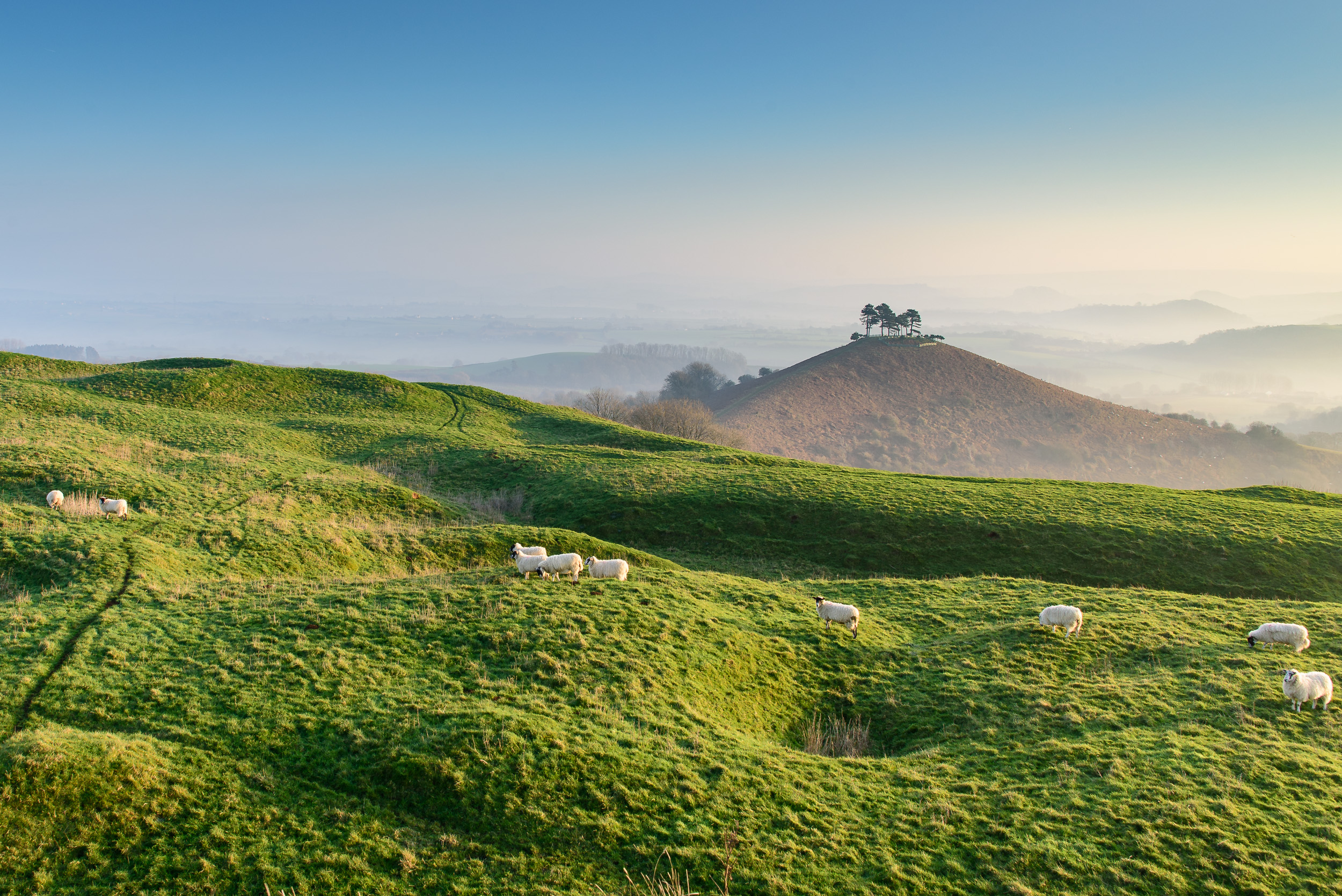
A slightly different view of Colmer's Hill.
Based on the advice from Mark's book I took a little walk northwards to find some undulating ground which again, given the right light, would make for some interesting foreground for a wide angle composition.
Though the sun was quite high by the time I set my shot up at this location I could see how it might work on another day. I would just some higher cloud and possibly a few less sheep!
I'll Be Back
It's not been the greatest of starts to the year for my photography. It's starting to feel like it's been a long time since I managed to capture a great image. However, I do need to remember that I can really only go out shooting when I have time, not when the conditions are optimal, so I can't expect great results every trip out with the camera.
As always, I will look for the positives from each trip out with the camera. Firstly I learnt not to get too focused on one composition using one lens. Getting the mobile phone out really helped me to see a different view! I've also learnt more about a location that I will probably visit a lot in 2017. It's good to have multiple spots from one location so you can move about a bit to suit the conditions.
Have you had a good start to your photography this year? Have you got some new locations you want to visit this year? Let me know in the comments below.

Saying Goodbye to 2016 in Dorset
For my last shoot and blog post of 2016 I head out to Dorset to shoot some new locations with a couple of different cameras.
Wishful Thinking
For my last shoot of 2016 I was hoping it was going to be a special one. However, hope and reality are rarely the same thing. Inspired by the images I had seen in Mark Bauer's new book Photographing Dorset, I thought I might try and capture a misty Colmer's Hill. It's a location which I've visited but never photographed and given that there was a lot of fog about and it was close to home it seemed like an ideal location.
The weather forecast was predicting some fog but also a lot of cloud. My concern was that though I might have the fog or mist, without some decent light from the rising sun the image might be a little flat. Filled with optimism and eagerness I decided it would be worth a punt though!
Colmer's Hill
Arriving at Colmer's Hill around 07:15 I had arrived in plenty of time. Sunrise wasn't for another hour, but there was still just enough light to walk up the hill opposite Colmer's Hill without the need for a head torch.

Plenty of mist but with flat light and invading sheep it's not the image I was hoping for.
At the top I got all my gear setup and tried a few compositions. Though there was plenty of fog around the surrounding hills, it soon became apparent that the low level cloud was going to block the light from the rising sun. So while I was happy with the compositions I was finding the flat light wasn't giving me results I craved and no amount of post processing was going to fix that.
Still feeling slightly optimistic I stayed around a bit longer. I've left a location too early before and regretted it so I didn't want to be too keen to depart. In this case things didn't get any better. In fact a herd of sheep decided they were going to play Pacman on Colmer's Hill putting an end to my hopes of a good image.
However, as I knew the risks of coming to Colmer's Hill based on the previous nights weather forecast, I had a plan B!
Golden Cap
While researching Colmer's Hill in Mark's book I also took note of a nearby location called Golden Cap. I thought this might make a good backup location should things not pan out at Colmer's Hill. It was only a short drive from my previous location so I had little to loose.
For this location though I was going for a change of camera. I switched from my trusty Nikon D750 to my DJI Phantom 3 4K with a view of taking some aerial shots of the coastline. I've shot coastal images with the drone before and I've really enjoyed the experience. You can see my first video on drone photography below.

A brief appearance from the sun provided some nice light on the land.
It was another hill climb up to Golden Cap, but given all the luxuries of Christmas, it was one I welcomed! After catching my breath at the top of the hill I soon got to work with capturing some images of the coastline.
One of the benefits of shooting the coastline with a drone is the ability to point the camera straight down. This often provides a unique and interesting perspective. However, for a brief time the sun did produce some interesting light on the land so I had to change the position of the camera and drone the get the shot.
I had a lot of fun flying the drone along the coastline looking for compositions but this is my favourite of the day:
The coastline around Golden Cap
Goodbye 2016, Hello 2017
So while my morning out in Dorset wasn't the big success I was looking to end 2016 with, it's always good to get out with the camera and practice. One thing is for sure I will be visiting Colmer's Hill again in 2017. Maybe it will be my new Bowerman's Nose!
So how was your 2016? Did you get out for one last shoot? What are your photography plans for 2017? Let me know in the comments below. Happy New Year to you all!

Using the Super Stopper in Sidmouth
The Lee Filters Super Stopper isn't exactly a filter you would use every day but it does have its uses. Read about how and why I used for a shoot in Sidmouth in my this blog post.
Free At Last
In my last couple of blog posts I may have mentioned that I'm finding it difficult to adjust to the short winter days. Opportunities to get out with the camera seem to be few and far between. Last weekend was different though. I didn't have too much on and the weather was looking favourable for some landscape photography.
Sidmouth Inspiration
My first challenge was to find a suitable location that I could shoot. In reality it didn't take too long. My decision to shoot the coast at Sidmouth in South Devon was driven by two things. Firstly I was inspired to shoot there. I've spoken about the importance of inspiration before on my blog before and how useful it can be.
My inspiration to shoot Sidmouth came from two photographers, atmoorehead and Neil Burnell.. Both of them had been shooting the curling stone groyne at the east end of the beach. I liked the images they had created so I wanted to go there and put my own spin on the location.
Super Stopper Time
The 2nd reason for choosing Sidmouth was that it was a coastal location that would be ideal for testing out my recently purchased Lee Filters Super Stopper. I'm a big fan of Lee Filters and use the Little Stopper and Big Stoppers in a lot of my images. When the Super Stopper was first announced I have to admit that I didn't really see the point but after seeing some of the images produced by Mark Bauer with the Super Stopper I pulled the trigger and picked one up.
My original plan was to shoot some midday long exposures during a recent Lake District trip but given the challenging weather it wasn't really the best time to try out this 15 stop monster. However, as I was planning my trip to Sidmouth it soon became apparent that this could be the perfect time to give the Super Stopper a go. I would be arriving around 2.30pm when there is still plenty of light, the tide would be coming in, and the light from the west would be illuminating the groyne. My only slight concern was the lack of cloud in the sky. It was apparently going to be very clear but I could live without the perfect conditions!
Setting Up For a Very Long Exposure
When I arrived at my location in Sidmouth things were looking favourable. The sun, which was already relatively low in the sky, was illuminating the inward curve of the groyne rather nicely and the tide, which was due be high at 16:08, was already a good way up the beach. I was glad I had got there early as the area was busy with people and where I was going to shoot from was a bit of a one tripod only location.

Base image with no filters. (Image unprocessed).
So with my tripod out I got to work on my composition. I had originally thought I would go for a vertical composition but it soon became apparent to me that a horizontal composition would work best as it provided more room for the groyne to curl out into the sea and into some empty space. With my composition locked in I took my base image. My base image is the image I take with no filters so I can easily check it for sharpness and exposure. Being a coastal location I reached for my Lee Filters Polariser as this would not only take off some reflections from the surface of the sea but it also removed all the reflections from the groyne where the water had been splashing.

The addition of the polariser reduces the reflections on the groyne and brings out a little more detail in the sky. (Image unprocessed).
However, the addition of the polariser always lengthens the exposure by a few stops so I had lengthen my shutter speed from around 1/80 sec (at f//11) to 1/25. Though I was happy with the effect the polariser was giving I was already concerned about how long the exposure was going to be when I added the Super Stopper. Using the Lee Filters app on my phone I worked out that a 1/25 second base exposure with a Super Stopper would require a 21 minute exposure. For my first use of the filter I felt this might be too long, but a Big Stopper would only give me 40 second exposure (which was not long enough for the image I wanted)
I had two options. I could either open up the aperture or increase my ISO. While opening up the aperture would have decreased my exposure time, I would have lost the depth of field I was looking for so I increased my ISO to 400. This effectively gave me a Super Stopper exposure time of around 8 mins. Much more manageable.
The Results
With everything set I got to taking some really long exposures. I modified my composition a couple of times which meant going through the whole setup process again but using the Super Stopper was never going to be a fast process. I also had to gradually increase my exposure length as the amount of light decreased. However there is a certain sense of excitement with really long exposures. I was investing 8 to 10 minutes for each exposure and the sense of not knowing exactly how the image would look was exciting.
Final image (processed in Lightroom). Nikon D750, Nikkor 16-35mm f/4 at 26mm. 641 seconds at f/11, ISO 400.
A Small Critique
I'm very happy with the end result and it's the image I had envisioned when I started planning this shoot. However, it's not perfect. Though I was shooting at a time very close to high tide, it wasn't quite high enough. I would have liked there to have been no beach visible in the lower right side of the image. There was a high tide of 4.06m so on my next visit I will try and plan it for when it's a little higher.
However, tide height aside, all the other elements came together nicely. The time of day and time of year were perfect to allow the golden light of the sun to reflect of the west side of the groyne. It's very rare that everything is perfect so for a Sunday afternoon shoot I'm still very happy.
Why Not Just Use a Big Stopper?
You might be asking yourself why I didn't just wait for sunset and then use a Big Stopper. Why purposely shoot earlier so you can use a Super Stopper? Well, it all had to do with the light. As the sun set the quality of the light reflecting off the groyne was nowhere near as nice as it was 45 minutes before. In order to realise my vision of a long exposure I need to have that 15 stop ND filter. So yes, while it was a specific set of conditions that required the use of the Super Stopper, it would have been an image that would have either not been possible to get or would have been more difficult. The Super Stopper is probably never going to be a filter that I use a lot, but now that I have it and have seen how I can put it to use, I'm glad I have it.
So are you a fan of long exposures? Do you own the Super Stopper? Are your creative ideas driven by the location you are visiting or by a vision of the image you want to create? Let me know in the comments below.

Not All Shoots Are Successful Shoots
In this blog I discuss the challenges of shooting on a beach and I give my own image a critique.
The Best Laid Plans
As a photographer you always want to put your best images out there. If you practice enough your technique will improve and your style develop, hopefully resulting in a gradual but noticeable improvement to your images. While this is generally true, it doesn't necessarily mean that every trip out with the camera will result in an image that was better than the last one. When I started this blog one of my key goals was to discuss my success and my failures. As I said in my first blog post, landscape photography isn't all about 5 star images captured on epic international trips.
In this blog post I'm going to take you through one of my less successful trips out with the camera. I had it all planned out. I would finish work bang on time, drive to West Bay in Dorset, and photograph the sea and evening light as it gloriously reflected off sea and cliffs. Well, that was my vision anyway. I went through all my normal planning steps, weather, cloud, tide, bearing of sunset and it all looked good.
Challenging Conditions
I've visited West Bay a couple of times, but never to photograph it. The east beach there, recently made more famous by the TV series Broadchurch, is long and sandy with dramatic cliffs running as far as the eye can see. However, when I arrived the reality of actually shooting there became apparent.
Firstly was the tide. After checking the tide tables I knew it was coming in, but what you can't tell from the tables is how long of a reach those waves have. The waves weren't tall, but their reach up the beach was long. Now I don't mind getting my feet wet, but it becomes really difficult to frame your shot if your camera sinks a little with each wave. If I moved further away from the waves I lost a lot of the sea in the frame. Normally this would be less of an issue if the beach has a natural curve.
The other challenge was the weather. While it wasn't raining nor the wind as strong as I expected it to be, the light was very flat. The forecast had indicated lots of high cloud and no low cloud. This I hoped would give me a spectacular evening sky to add to my composition. However, there was a lot of low cloud and the chances of there being any evening light bouncing off the cliff seemed very unlikely.
Change of Plan
Spare time to do photography is at a premium for me. While I like to do some location scouting when I can, it's not always possible, and so sometimes I just have to wing it. So with the very real sense that I might have just wasted a 2 hour round trip in the car, I put my thinking hat on and tried to think of a different composition. This approach of looking around and not getting focused on one thing had worked well on a recent trip to Dartmoor, so I picked up my tripod and got walking.
It wasn't long before I had the idea of doing a long exposure of the beach, looking straight out to see, and including a few well-placed rocks or stones in the foreground. This composition would probably deliver better results. I would have better visibility of the waves and the quality of the light was less of a dependency.
An Ever Changing Beach
Though I had a new vision on what my photograph would be my challenges weren't over. I would find an interesting composition, setup, grab a frame, maybe two at the most, and then a wave would come in wash my composition away! Even some of the larger stones in my composition weren't big enough to resist the pull of the waves. So this left me with very little time to grab a frame for each composition I found along the beach. I had to make sure the camera was level, focused, and correctly exposed in very short time or I might not get another go at it.
After only a few compositions the light had faded and I decided to take my very sandy tripod and wet feet back home for a nice meal and glass of wine.
Critiquing My Own Image
I only took a handful of frames that evening but here is the image that I think turned out the best.
Nikon D750 with Nikon 16-35mm f/4, 1.3 secs, f11 at 20mm, Lee Filters Polariser and 3 Stop ND
Now I'll be the first to admit this isn't an image for my portfolio. Though I like the mood and style of the image it does have a number of issues. If I'd had more time at the location I might have worked out these issues but as I said at the start of the blog, not all shoots are successful shoots.
The main issues I have with the image are around the rocks I have used in the foreground. The rock in the lower right of the frame for me is just a little too close to the edge of frame. I would like to have had just a little bit more space as there is with the rock on the left.. Given a bit more time between waves, I might have setup my tripod in a slightly different location to give me that space.
While the image roughly follows the rule of thirds, it doesn't follow the rule of odds. Now, I know that these rules are more like guidelines, but quite often they do make sense and I do think following the rule of odds in this scene would have helped with the overall composition.
Rocks at Porth Nanven - Nikon D750, Nikon 16-34 f/4 at f/16, 1.6 secs at 20mm.
I learnt about the rule of odds in the book, The Art of Landscape Photography by Mark Bauer and Ross Hoddinott (it's a fantastic book and well worth picking up). In the book Ross and Mark discuss how having an odd number of objects helps create visual stability or symmetry.
In this image I took of Porth Naven a couple of years ago you can see how I've composed with three rocks in the foreground. The balance and implied triangle in this image is something I would have liked to have seen in my West Bay image.
Always Good to Be Out With The Camera
Despite the fact that my shoes are still drying off and I had to strip down my tripod to get rid of the sand, I still felt it was time well spent with the camera. I'm also not going to win any awards for the image, but that really isn't the point. I was outdoors with my camera on a beautiful beach taking images and for a person that spends most his time sitting at a desk it's just nice be outside. Yes, conditions were challenging but it's through these challenges that you learn to progress as a photographer.
Actually I'm going to change my mind, it was a successful shoot. Just successful in a different way.
So what do you think of the image? How would you have shot the scene? Have you got any tips for photographing beach scenes? Please let me know in the comments.