

Glencoe Adventure - Part 1, The Workshop
In this first of two special Glencoe blog posts I'll share with you my images and stories from the Dawn 2 Dusk Glencoe workshop that I attended recently. It was a fantastic few days of photography. Though the weather was typically Scottish at times, the variable conditions resulted in some awesome images.
The Importance of Adventure
I have talked about the importance of practising the art of photography on this blog a number of times. For me, and I expect this is the same for many photographers, most of this practice will take place in your own back yard. Not literally of course, but most of the time you are out with a camera it will be in your local area. For me, this is Devon with the occasional visit across the border to Cornwall or Dorset.
While there are many benefits to shooting locally, such as time and familiarity, there is nothing quite like the challenge of pushing the boundaries of your photography by going on an adventure! Adventure means different things to different people, but for me, it's the excitement of travel, of meeting new people and of course photographing something new. All these elements can really push your photography in a way that you sometimes just can't get locally.
Though I have visited Glencoe a number of times and even grew up not far away, this will be my first time in the area as a dedicated photographer. So while the area might be familiar, the prospect of photographing it was exciting, to say the least. Well worth the 3 days off work (plus the weekend) and the 10 hours drive each way!
This week, in the first of two Glencoe blog posts, I will be sharing my memories, thoughts and photographs of the Dawn 2 Dusk Photography Glencoe photography workshop that I attended. Next week, in part 2, I will be sharing the images and video that I took with some of the extra time I had in Glencoe.
Why Workshops are Important
So why didn't I just spend all the time I had in Glencoe doing my own thing? Well, for me at least, workshops provide a number of unique benefits that I can't get by shooting on my own:
Practical and Artistic Development - Tuition is still a big part of my development as a landscape photographer and for the Glencoe workshop, I had access to two of the UK's leading landscape photographers, Ross Hoddinott and Adam Burton. Having access to this level of photographer not only helps with the artistic side of my photography but also with some of the more practical aspects of photography (read how later in the blog post).
Being Social - The life of a landscape photographer can be a solitary existence, especially if you favour early mornings like me. However, every now and again it's just good to be around like-minded individuals. Just by chatting during the day you can not only learn about how your photography looks to others, but also learn from their photography. At night, normally around the bar, it is a great chance to share those funny, odd, or disastrous trips out with the camera.
Local Knowledge - There is only so much planning and preparation you can do on the computer. In order to maximise time with the camera when you arrive at a new location, it's sometimes useful to have access to some local knowledge. For me, workshops provide me with an introduction to the photographic possibilities of an area and while I could do this myself I don't always have the extra time.
So now that we've talked about the importance of adventure and the value in workshops, let's get into the most important aspects of this adventure, the photographs!
Day 1: Castle Stalker
The 2.5-day workshop started with a briefing at our base of the Clachaig Inn just outside Glencoe village. Adam and Ross managed to suitably embarrass me by remembering my birthday with a chocolate cake and singing happy birthday! After the very sociable start of coffee and cake, we all headed down for a sunset shoot at Castle Stalker on Loch Linnhe.
Nikon D750, Nikkor 70-200mm f/2.8, @ 200mm, f/8, 1/60th second, ISO 100, Lee Filters ND Grad, 16:9 crop.
As you can see from the shot above, the descending sun illuminates the side of the castle rather nicely. I was hoping to get a similar shot to this with water surrounding the island, but as the tide came in the light became flat thanks to some heavy cloud where the sun was setting.
It was still a good start to the workshop and we all headed back to the hotel for some well-earned food and drinks.
Day 2: Lochan na Fola and Stob nan Cabar
As you might expect with a landscape photography workshop it was an early start to the 2nd day. Fortunately, the drive to our next location of Lochan na Fola wasn't far from our hotel so the alarm call wasn't too early.
When we arrived at Lochan na Fola the water was beautifully still giving us some wonderful reflections of Stob nan Cabar. Just as we setup though some cloud rolled in blocking the view of the mountain. As we waited I decided to try out my new drone the DJI Mavic Pro. The arrival of the drone caused a bit of excitement amongst the group as I demonstrated some of its capabilities. While I couldn't get find a gap in the cloud to fly a little higher, I did get the chance to grab a quick group shot.
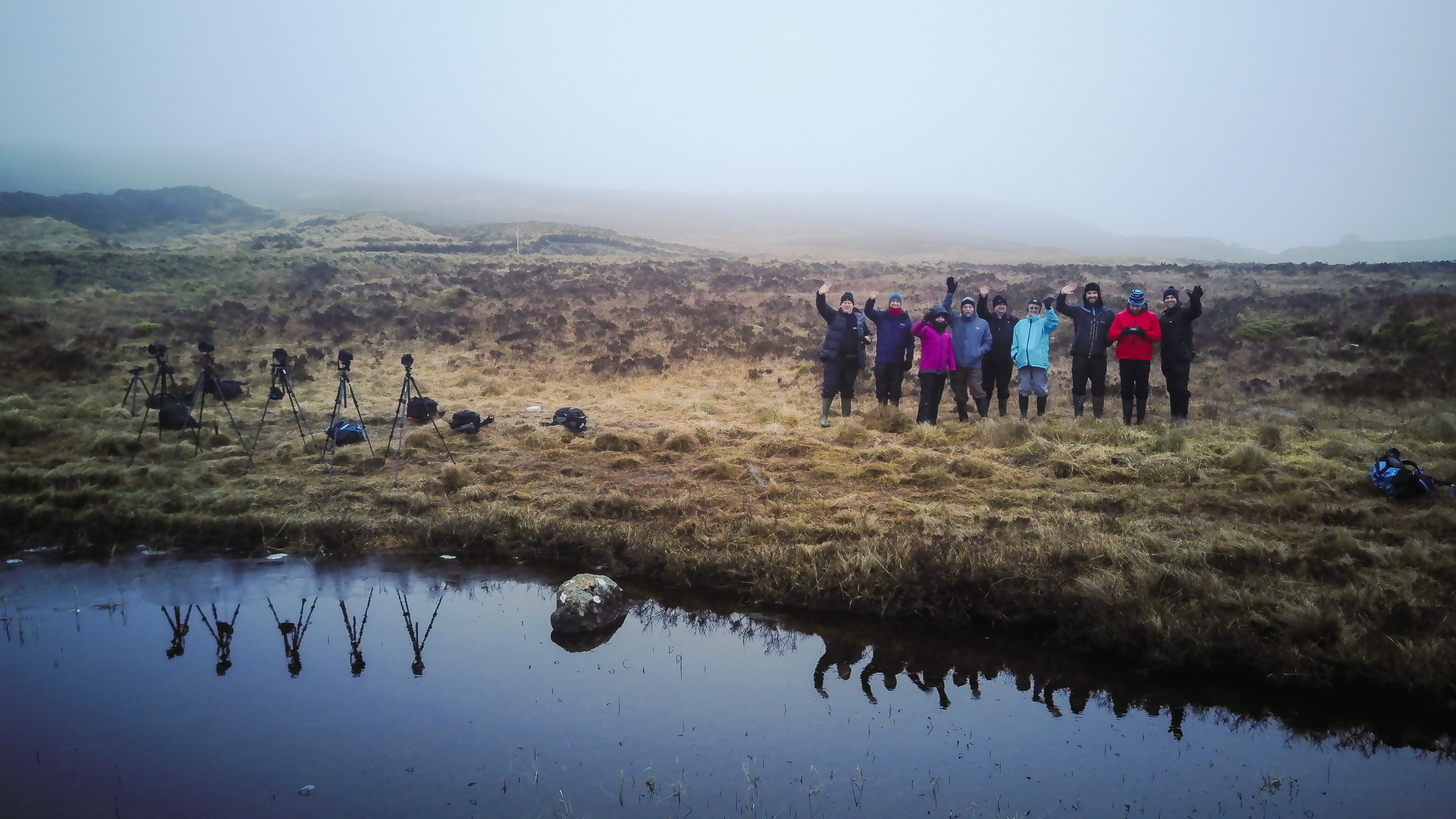
We didn't have to wait to long for the cloud to clear though and all of sudden it was battle stations as we were presented with some truly epic scenes!
Nikon D750, Nikkor 16-35mm f/4 @ 18mm, f/11, 1/20th second, ISO 100, Lee Filters Circular Polariser.
Nikon D750, Nikkor 16-35mm f/4 @ 26mm, f/11, 1/20th second, ISO 100, Lee Filters Circular Polariser.
I can't decide which of the two images above I like the most. Both of them greatly appeal to me with their near perfect reflections and frosty reeds in the chilly lochan. It would have been so easy just to go back to the hotel and have an early breakfast when the cloud came in, but everyone was glad they stuck it out.
Day 2: Lochan na h-Achlaise and Loch Ba
After a very successful morning and a big Scottish breakfast, we headed up to Lochan na h-Achlaise. Shooting around midday is always challenging though and coupled with the bright blue sky I did struggle a little bit to get some images.
However, by exploring along the shore line of Lochan na h-Achlaise I did find this interesting composition.
Nikon D750, Nikkor 24-70 f/2.8 @ 34mm, f/13, 30 seconds, ISO 100, Lee Filters Circular Polariser and Big Stopper.
Exploring just a little further I found this scene just off the road at Loch Ba. This is a more pleasing image thanks to the horseshoe arrangement of the foreground rocks and the reflection of the mountain in the water.
Nikon D750, Nikkor 24-70 f/2.8 @ 40mm, f/13, 2.5 seconds, ISO 100, Lee Filters Circular Polariser and Little Stopper.
I also had just enough time to try and capture a panorama of the area using my DJI Mavic Pro.
DJI Mavic Pro - 7 images stitched and processed in Lightroom.
Day 2: Blackrock Cottage
Blackrock Cottage is probably one of the most photographed locations on Glencoe, but it would have somehow seemed rude not to photograph it. After all, we were passing it on our way to get coffee from the cafe at the ski centre.
I rarely convert to black and white but in this case, the image seemed to work better without colour. The texture on the mountain (Buachaille Etive Mor) really stands out.
Nikon D750, Nikkor 24-70mm f/2.8 @ 62mm, f/11, 1/25th second, ISO 100.
Day 2: Glen Etive
Towards the end of day 2, we headed down the long and windy road of Glen Etive towards the head of Loch Etive. Here the stunning mountains reach right down into the sea loch and it's an ideal location for capturing the last light as it touches the tops of the mountains.
As I waited for the light I was still able to capture some striking images of the north east shore of Loch Etive.
Nikon D750, Nikkor 24-70mm f/2.8 @ 26mm, f/11, 198 seconds, ISO 100, Lee Filters Big Stopper, ND Grad and Circular Polariser.
As I've written on this blog before it's always important to see what is going on behind you. It appeared that the sun was shining on the mountains diretly behind me!
Nikon D750, Nikkor 70-200mm f/2.8 @ 150mm, f/8, 1/5th second, ISO 100, Lee Filters Big ND Grad.
In my hurry to get to the head of the loch to capture last night on the mountains I completely missed another great composition. It wasn't until I was heading back to the car that I found a few of my fellow photographers shooting this interesting scene.
Nikon D750, Nikkor 16-35mm f/4 @ 19mm, f/11, 20 seconds, ISO 100, Lee Filters Circular Polariser and ND Grad.
I had actually walked by this location in my hurry to get to the head of the loch. Perhaps I should have taken just a little more time to explore this area before settling into my chosen location.
Day 2 was certainly a busy one. Would day 3 be just as good?
Day 3: The Study
After the successes of day 2, the weather had a change of heart and went typically Scottish. Lots of low clouds, and lots of rain. Our initial plan was to do a pre-breakfast shoot of Buachaille Etive Mor. We would go down to the river Coupall to shoot the waterfalls with the mountain in the background. Only trouble was you couldn't see the mountain or anything really. Reluctantly we headed back for an early breakfast and discuss our next move.
With the weather forecast predicting a stop to the rain, our tutors suggested we shoot from The Study, a slightly elevated viewpoint with excellent views of the mountains (The Three Sisters). Sure enough, the rain stopped and we were back in business.
I don't often shoot panoramas but this viewpoint seemed like the ideal location to do so. Fortunately, Adam Burton was on hand to give me some excellent tuition on how to setup the tripod correctly and the best way to rotate the camera. Taking my new found knowledge I managed to capture this image of The Three Sisters.
Nikon D750, Nikkor 24-70mm f/2.8 @ 24mm, f/11, 1/100th second, 10 vertical images stiched and processed in Lightroom CC.
I then decided to opt for a much tighter composition giving me one of my favourite images from the workshop.
Nikon D750, Nikkor 70-200mm f/2.8 @ 90mm, f/11, 1/40th second, ISO 100, Lee Filters ND Grad.
Day 3: Stob Dearg and the River Coupall
There is no doubt that this location has been photographed a lot. However, that doesn't make it any less worth shooting. There are always new compositions to be had, different weather conditions to manage and personal style to put into an image.
The key element for this location is a visible Stob Dearg (Buachaille Etive Mor), something that was missing that afternoon. This made my decision a couple of days earlier not to photograph this very scene because "I'll be back in a couple of days", even more heartbreaking.
However, with probably an unjustified amount of optimism, I put on my wellington boots, got into the river and set up my shot. All I needed was for the cloud to clear from the mountain. So I waited, and waited, and waited. It came so very close to being completely clear, but as the sky darkened I knew it wasn't going to happen.
Though you can't see the whole of the mountain in this image, I still like the end result.
Nikon D750, Nikkor 16-35mm f/4 @ 19mm, f/13, 0.8 seconds, ISO 100, Lee Filters Circular Polariser and 0.3 ND Grad.
Though it had been a challenging day with the weather, it was still a successful day out with the camera.
Workshop Summary
At the start of this blog post, I mentioned the three things that I look for on a workshop; personal development as a photographer, social interaction, and local knowledge.
There is no doubt that my artistic eye has developed a little bit more and that I'm now better prepared to shoot panoramas. I also got to spend a couple of days with a great group of people who shared my passion for landscape photography. We all shared some great stories in the bar! And finally, thanks to some excellent planning and local knowledge, the weather and conditions rarely caused a problem with the flexible itinerary.
I've come away with some great images and some even better memories, so it was definitely worth a few days off work and a very long drive!
In Part 2...
In part 2 of my Glencoe Adventure blog post, I will tell you about the images I took during the spare 24 hrs I had before the workshop started, including a video of my very early and snowy ascent of Beinn a'Chrulaiste!

A Positive Start to 2017
On my first trip out with the camera for 2017, I visited one of my favourite locations, Dawlish Warren beach. While the conditions didn't produce inspiring results it was still an important trip out with the camera. Read why in this blog post.
Stay at Home or Risk It?
For me, 2016 was a good year for photography. I got out a lot with the camera and when I reviewed My 5 Favourite Images of 2016 I was very pleased with the results. However, when I went out and Said Goodbye to 2016 in Dorset, the results from my final shoot of the year weren't exactly epic.
One thing I don't do is the let the disappointment of the last shoot put me off the next. Especially when it was the weather or conditions that stifled my creativity. When 2017 came around I was soon looking for the next available slot to get out there with the camera. To say that I was keen would have been an understatement.
It was this keenness to get out there that largely overrode my better judgement of the weather forecast and just risk it. After all, weather forecasts can sometimes be pessimistic, and Dawlish Warren beach is just down the road. What else was I going to do? Sleep?
Being Optimistic
Despite the dubious weather forecast I headed off to Dawlish Warren beach, one of My 5 Favourite Landscape Photography Locations in Devon. Sunrise on the coast can often yield dramatic results, despite weather forecasts, so I drove there feeling optimistic.
However, even the strongest sense of optimism isn't enough to change the weather or light available. I did take a number of frames, adjusting composition and exposure times, but sometimes the magic just isn't there. I feel this image is probably the best of the morning.
Nikon D750, Nikkor 16-35 f/4 at 29mm, f/8, 205 seconds, ISO 100, Lee Filters polariser, Little Stopper and ND Grad. Processed in Lightroom CC (including 4:5 crop).
A Wasted Trip?
So you may ask me if it was a wasted trip? Should have I stayed in the warmth of my bed for an extra hour? Well, no, of course not. Regular readers of my blog will know often I talk about the value in Practising The Craft of Photography. Though the conditions weren't what I hoped for, I want to make sure that when the conditions are amazing I'm prepared!
Being prepared means a couple of things to me. Firstly, I need to know my equipment. Can I set up my camera correctly and even more importantly, can I adjust the settings quickly to support changes in light and conditions? I also need to have my "photographic brain" fully engaged and exercised. I took a small break from landscape photography last year and it was amazing how quickly I had become rusty with finding and setting up compositions.
So while the image isn't going to win me any awards, my time at Dawlish Warren was still time well spent. The camera was out of the bag and I was pushing buttons, moving dials, checking histograms and using filters. I was also thinking a lot about compositions. What will my image look like if I move up, or left a bit, what if I change my lens? I was exercising my brain in preparation for the day when I do get those epic conditions.
So how has your 2017 started? Have you been out with the camera? Let me know in the comments below.

Saying Goodbye to 2016 in Dorset
For my last shoot and blog post of 2016 I head out to Dorset to shoot some new locations with a couple of different cameras.
Wishful Thinking
For my last shoot of 2016 I was hoping it was going to be a special one. However, hope and reality are rarely the same thing. Inspired by the images I had seen in Mark Bauer's new book Photographing Dorset, I thought I might try and capture a misty Colmer's Hill. It's a location which I've visited but never photographed and given that there was a lot of fog about and it was close to home it seemed like an ideal location.
The weather forecast was predicting some fog but also a lot of cloud. My concern was that though I might have the fog or mist, without some decent light from the rising sun the image might be a little flat. Filled with optimism and eagerness I decided it would be worth a punt though!
Colmer's Hill
Arriving at Colmer's Hill around 07:15 I had arrived in plenty of time. Sunrise wasn't for another hour, but there was still just enough light to walk up the hill opposite Colmer's Hill without the need for a head torch.

Plenty of mist but with flat light and invading sheep it's not the image I was hoping for.
At the top I got all my gear setup and tried a few compositions. Though there was plenty of fog around the surrounding hills, it soon became apparent that the low level cloud was going to block the light from the rising sun. So while I was happy with the compositions I was finding the flat light wasn't giving me results I craved and no amount of post processing was going to fix that.
Still feeling slightly optimistic I stayed around a bit longer. I've left a location too early before and regretted it so I didn't want to be too keen to depart. In this case things didn't get any better. In fact a herd of sheep decided they were going to play Pacman on Colmer's Hill putting an end to my hopes of a good image.
However, as I knew the risks of coming to Colmer's Hill based on the previous nights weather forecast, I had a plan B!
Golden Cap
While researching Colmer's Hill in Mark's book I also took note of a nearby location called Golden Cap. I thought this might make a good backup location should things not pan out at Colmer's Hill. It was only a short drive from my previous location so I had little to loose.
For this location though I was going for a change of camera. I switched from my trusty Nikon D750 to my DJI Phantom 3 4K with a view of taking some aerial shots of the coastline. I've shot coastal images with the drone before and I've really enjoyed the experience. You can see my first video on drone photography below.

A brief appearance from the sun provided some nice light on the land.
It was another hill climb up to Golden Cap, but given all the luxuries of Christmas, it was one I welcomed! After catching my breath at the top of the hill I soon got to work with capturing some images of the coastline.
One of the benefits of shooting the coastline with a drone is the ability to point the camera straight down. This often provides a unique and interesting perspective. However, for a brief time the sun did produce some interesting light on the land so I had to change the position of the camera and drone the get the shot.
I had a lot of fun flying the drone along the coastline looking for compositions but this is my favourite of the day:
The coastline around Golden Cap
Goodbye 2016, Hello 2017
So while my morning out in Dorset wasn't the big success I was looking to end 2016 with, it's always good to get out with the camera and practice. One thing is for sure I will be visiting Colmer's Hill again in 2017. Maybe it will be my new Bowerman's Nose!
So how was your 2016? Did you get out for one last shoot? What are your photography plans for 2017? Let me know in the comments below. Happy New Year to you all!

My Favourite / Top 5 / Best Landscape Photography Locations in Devon
In this special blog post and video I take you on a mini tour of my 5 favourite landscape photography locations in Devon.
A Personal Selection
As a landscape photographer living in Devon I am spoilt for choice when it comes to shooting locations. I have access to Dartmoor National Park, large areas of the South West Coast Path, and everything in between. I shouldn't really ever run out of places to shoot.
Even though I have all this variety I can't help but have a few favourite locations. So in this video I'm going to take you on a mini tour of my five favourite locations to shoot landscapes in Devon. I've chosen a mixture of coastal and inland locations as well as choosing to shoot at dawn and dusk. Some shoots were more successful than others but I'm hoping the video will give you some ideas and inspire you to visit and photograph those locations yourself.
So why not check out the video below and let me take you on a tour of Devon...
If you need a little more information on the locations I have visited or just want to see the images in a bit more detail then please do read on!
Dawlish Warren
The groynes along the beach at Dawlish Warren offer some great lines for your composition. Long exposures often work well at this location as well, especially in poor light.
Don't forget to shoot the beach huts.
Venford Falls
Venford Falls as shot on the video. A polariser is very handy to control the reflections.
Spring is my favourite time to visit as all the moss is at its best.
Emsworthy
Both the rocks and the tree are great elements to include in your composition. This location is good to shoot at both dawn and dusk.
Turn 90 degrees and you'll find a few other compositions to shoot.
Froward Point
Shooting at sunset will typically provide the best light but what ever time you visit please be careful on the rocks!


If you've got good light shoot Daymark Tower as well.
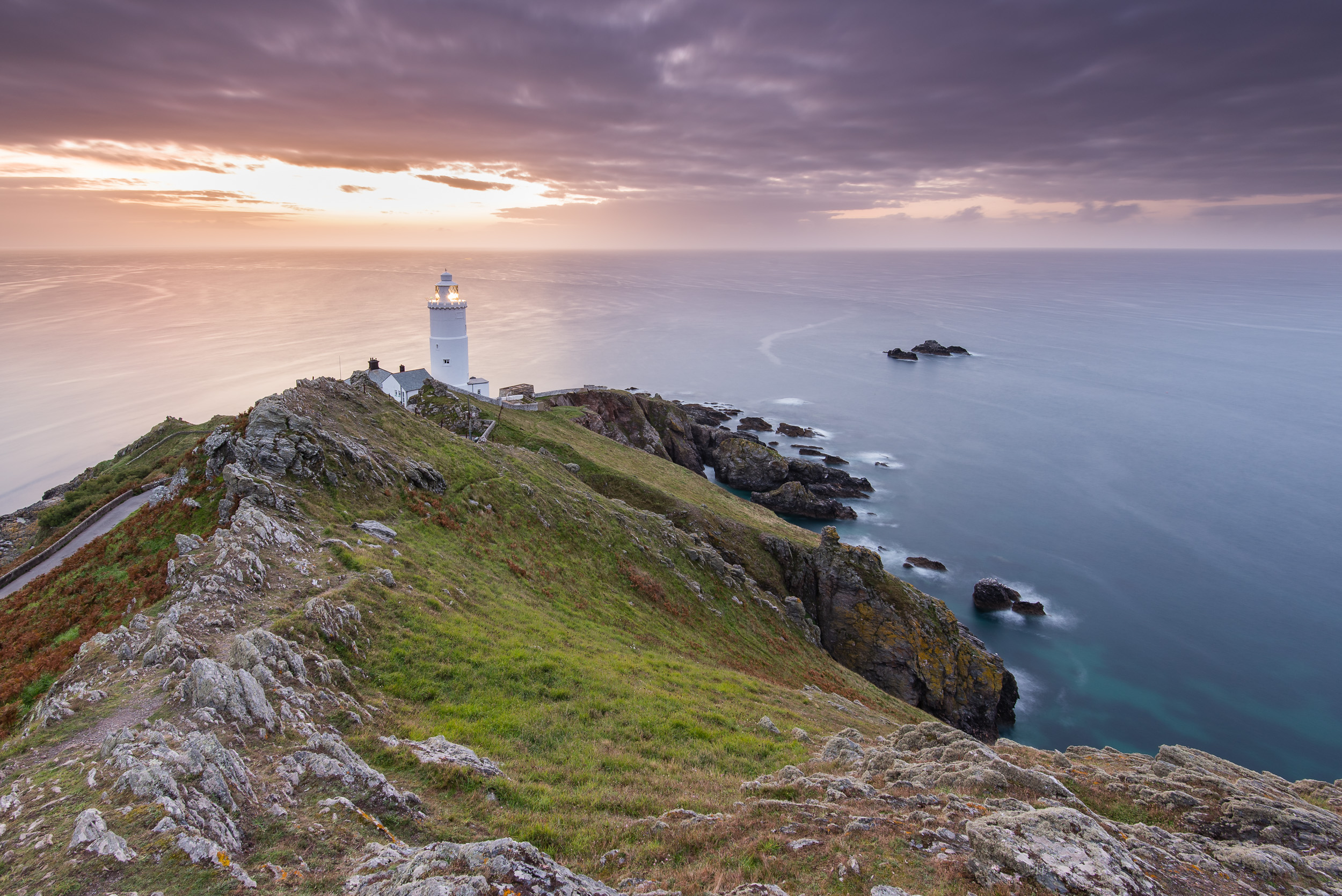
Start Point
The classic Start Point composition. Shame about the weather!
Sometimes it pays to hang around a little longer. There is just a splash of colour in the sky in this image.



In Summary
Hopefully this video and blog post has given you a little inspiration to not only shoot these locations, but also the wider Devon. It really is a fantastic part of the country with huge variety in locations and conditions.
So what are you favourite locations either in Devon or further afield? Did you find this video useful or inspiring? Is there a location in Devon or the south west that you recommend I visit? As always let me know if the comments, and remember to like and share this post! See you next time.

Not All Shoots Are Successful Shoots
In this blog I discuss the challenges of shooting on a beach and I give my own image a critique.
The Best Laid Plans
As a photographer you always want to put your best images out there. If you practice enough your technique will improve and your style develop, hopefully resulting in a gradual but noticeable improvement to your images. While this is generally true, it doesn't necessarily mean that every trip out with the camera will result in an image that was better than the last one. When I started this blog one of my key goals was to discuss my success and my failures. As I said in my first blog post, landscape photography isn't all about 5 star images captured on epic international trips.
In this blog post I'm going to take you through one of my less successful trips out with the camera. I had it all planned out. I would finish work bang on time, drive to West Bay in Dorset, and photograph the sea and evening light as it gloriously reflected off sea and cliffs. Well, that was my vision anyway. I went through all my normal planning steps, weather, cloud, tide, bearing of sunset and it all looked good.
Challenging Conditions
I've visited West Bay a couple of times, but never to photograph it. The east beach there, recently made more famous by the TV series Broadchurch, is long and sandy with dramatic cliffs running as far as the eye can see. However, when I arrived the reality of actually shooting there became apparent.
Firstly was the tide. After checking the tide tables I knew it was coming in, but what you can't tell from the tables is how long of a reach those waves have. The waves weren't tall, but their reach up the beach was long. Now I don't mind getting my feet wet, but it becomes really difficult to frame your shot if your camera sinks a little with each wave. If I moved further away from the waves I lost a lot of the sea in the frame. Normally this would be less of an issue if the beach has a natural curve.
The other challenge was the weather. While it wasn't raining nor the wind as strong as I expected it to be, the light was very flat. The forecast had indicated lots of high cloud and no low cloud. This I hoped would give me a spectacular evening sky to add to my composition. However, there was a lot of low cloud and the chances of there being any evening light bouncing off the cliff seemed very unlikely.
Change of Plan
Spare time to do photography is at a premium for me. While I like to do some location scouting when I can, it's not always possible, and so sometimes I just have to wing it. So with the very real sense that I might have just wasted a 2 hour round trip in the car, I put my thinking hat on and tried to think of a different composition. This approach of looking around and not getting focused on one thing had worked well on a recent trip to Dartmoor, so I picked up my tripod and got walking.
It wasn't long before I had the idea of doing a long exposure of the beach, looking straight out to see, and including a few well-placed rocks or stones in the foreground. This composition would probably deliver better results. I would have better visibility of the waves and the quality of the light was less of a dependency.
An Ever Changing Beach
Though I had a new vision on what my photograph would be my challenges weren't over. I would find an interesting composition, setup, grab a frame, maybe two at the most, and then a wave would come in wash my composition away! Even some of the larger stones in my composition weren't big enough to resist the pull of the waves. So this left me with very little time to grab a frame for each composition I found along the beach. I had to make sure the camera was level, focused, and correctly exposed in very short time or I might not get another go at it.
After only a few compositions the light had faded and I decided to take my very sandy tripod and wet feet back home for a nice meal and glass of wine.
Critiquing My Own Image
I only took a handful of frames that evening but here is the image that I think turned out the best.
Nikon D750 with Nikon 16-35mm f/4, 1.3 secs, f11 at 20mm, Lee Filters Polariser and 3 Stop ND
Now I'll be the first to admit this isn't an image for my portfolio. Though I like the mood and style of the image it does have a number of issues. If I'd had more time at the location I might have worked out these issues but as I said at the start of the blog, not all shoots are successful shoots.
The main issues I have with the image are around the rocks I have used in the foreground. The rock in the lower right of the frame for me is just a little too close to the edge of frame. I would like to have had just a little bit more space as there is with the rock on the left.. Given a bit more time between waves, I might have setup my tripod in a slightly different location to give me that space.
While the image roughly follows the rule of thirds, it doesn't follow the rule of odds. Now, I know that these rules are more like guidelines, but quite often they do make sense and I do think following the rule of odds in this scene would have helped with the overall composition.
Rocks at Porth Nanven - Nikon D750, Nikon 16-34 f/4 at f/16, 1.6 secs at 20mm.
I learnt about the rule of odds in the book, The Art of Landscape Photography by Mark Bauer and Ross Hoddinott (it's a fantastic book and well worth picking up). In the book Ross and Mark discuss how having an odd number of objects helps create visual stability or symmetry.
In this image I took of Porth Naven a couple of years ago you can see how I've composed with three rocks in the foreground. The balance and implied triangle in this image is something I would have liked to have seen in my West Bay image.
Always Good to Be Out With The Camera
Despite the fact that my shoes are still drying off and I had to strip down my tripod to get rid of the sand, I still felt it was time well spent with the camera. I'm also not going to win any awards for the image, but that really isn't the point. I was outdoors with my camera on a beautiful beach taking images and for a person that spends most his time sitting at a desk it's just nice be outside. Yes, conditions were challenging but it's through these challenges that you learn to progress as a photographer.
Actually I'm going to change my mind, it was a successful shoot. Just successful in a different way.
So what do you think of the image? How would you have shot the scene? Have you got any tips for photographing beach scenes? Please let me know in the comments.

1 Location, 2 Cameras, 3 Photographers and Force 4 Wind
In this blog post I write about a recent trip to The Valley of the Rocks where I nervously flew my drone in strong winds and shared a cliff top perch with two other photographers to photograph Ragged Jack.
Last of the Midweek Shoots
Autumn is open us and though the amazing autumnal colours haven't reached their peak yet in Devon, the nights are closing in rapidly. During the spring and summer months my photography benefits greatly from the long evenings. Photography during the week becomes practical as I can grab my camera and head out straight after work and travel all over Devon and Cornwall and still make sunset.
Over the last few weeks though that window of opportunity has been shrinking and my ability to travel long distances before sunset reduced. So when I was looking at my location map and decided to go to The Valley of the Rocks, I knew this could be one of the last of my longer mid-week trips for a while.
1 Location, 2 Cameras
With my one location locked in for the evening I got to checking out the conditions and planning my shoot locations (see my blog post on Planning). On my last visit to The Valley of the Rocks I took some time to have a walk about to see if I was missing anything. (Check out my blog post on Location Scouting to read why I do this). Well, I was glad I did as I discovered a whole new aspect to The Valley of the Rocks and was inspired with some new ideas!
My plan was to not only take out the big guns (Nikon D750) but to also take out my DJI Phantom 3 4K so that I could get some aerial shots of the dramatic coastline and rock formations. I've recently been discovering the joys of drone photography and I thought this would be an ideal opportunity to do some more work in that area (see blog post on Drone Photography). My plan was to shoot with the drone while the light was good, and then switch to the DSLR for last night. So with my one location locked in and my two camera's packed I set of for the north coast of Devon.
Force 4 Wind


The drive to my location wasn't exactly inspiring as the rain continued to come down and as I reached some of the higher parts of the route the fast moving cloud got lower and lower. However, I had checked the weather forecast and it had promised to clear up around sunset so I was remaining optimistic. By the time I had got there things had much improved so with a sense of excitement I got to my first spot and got the drone out.
It was at this point that I did get a little nervous. If anyone has been to the north Devon coast will testify it can get a little windy. I've had to extend my planning routine recently to take into account flying the drone, particularly along the coast. I now check the coastal weather forecast to see how strong the wind will be. The drone does have a maximum horizontal speed and flying in wind speeds that exceed that could see my drone drift out to sea!
I had done a number of calculations and worked out that I could safely fly it in the predicated conditions of a force 4 wind. However, what is OK on paper may not actually be OK in real life. So while perched on a cliff side with a very long drop I cautiously started up the drone. Hovering at 1.5m I could see the drone working hard to stay in one place. Putting caution to the wind (excuse the pun), I decided to fly it away from the cliff side as I thought it might be a bit less blustery. Though the drone was still working hard, it had settled down a bit and my confidence grew. I still had a worry that it was going to get caught by a gust of wind and go out to see or crash into a cliff, but I was feeling bold (or daft) and managed to capture some dramatic images.


3 Photographers
After about 45 minutes with the drone I had got the images I had come for. Well, most of them anyway. There were a few shots of some rock arches that I wanted but I really wasn't brave enough to get them given the conditions! So with sunset approaching rapidly I headed off to a spot that I had noticed earlier with the plan of shooting Ragged Jack with my DSLR. As it was a Tuesday evening in late September I thought I might have the place to myself but as I turned the corner I found another photographer setting up on the cliff side.
The spot we had both picked to shot was relatively small but Steve (the other photographer), kindly let me share it and we got chatting. It was the normal stuff, gear, technique, processing, but all very enjoyable! Just as we got shooting another photographer turned up. So two became three and we all waited for that magical sunset moment….which to be honest never actually happened. I took a handful of frames trying different combinations of filters but sometimes the conditions just aren't quite right. The third photographer soon walked on and I continued to enjoy my chat with Steve. We both continued to take a few frames but soon we were packing up also.
Time Well Spent
Though my final image taken with my DSLR isn't one for the portfolio I still count my trip to The Valley of the Rocks as a success. Firstly I managed to capture some nice images of the location with the drone. I really like the extra dimension that the drone has brought to my photography. I try and take the same approach to composition with the drone as I do with the DSLR, but this doesn't always work so I'm still learning how to compose when shooting at 200 ft!
It's also good to just get out and practice the art of photography (see my blog post on Practicing). Sure the conditions didn't turn out to be perfect but just getting out with the camera is always a pleasure.
It is the unexpected that can also make these trips worthwhile. It was great to meet and chat to a fellow photographer. Landscape photography can be a solitary pastime, and while I greatly value the solitude, it's also great to meet people, especially other photographers.
So overall it was time well spent. Any time with the camera is time well spent! I might still squeeze in a couple of mid-week evening shoots but I'm already starting to plan out my dawn shoot locations for the next few months. During autumn and winter my opportunities for photography are limited to weekends and sunrise shoots minimise any impact to my family commitments. But do you know what, I kind of like those cold mornings perched on top of a tor on Dartmoor, freezing cold, drinking coffee, waiting for the sun to rise and bath the world in light.

Planning a Landscape Shoot at Dawlish Warren
In this video blog post I show you some of the planning tools I use to help increase the chances of a succesfull trip out with the camera. After that I take you on a trip to shoot seascapes at Dawlish Warren to see if all the planning was worth it!
Plan, Plan, Plan
I like a plan. Plans are good. Plans don't always go to plan, but I like having one none the less. As a private pilot I definitely like to have a plan when I head out to the skies. And though photography is arguably less risky than flying I still want my trips out with the camera to be worthwhile and successful. After all, there is no point in heading out for sunrise only to arrive at your location as the sun comes up. This has happened to me before and trust me, after the hour and half it took me to get there it was a painful lesson.
So to prevent missed sunrises, badly timed tides, and gale force winds, I like to plan my shoots so I can maximise my chances of success. In this video I will use:
These are the tools I use the most and I've found them to be very effective and accurate in the past. So let's see them in action along with my shoot down at Dawlish Warren beach:
Success
As you can see from the video, I had a successful trip and I've come away with an image I was very happy with. By checking out what the conditions were going to be like before I headed out I could be reasonably confident that my image would meet my vision for that location.
Not as calm as it looks. Nikon D750, Nikon 24-70 f/2.8 VR, 195 secs at f/11, Lee Filters ND Grad, Polariser, and Big Stopper. Processed in Lightroom CC.
Audio Quality
As I mentioned in the video, though the photography went well I had a few problems with the video. When I had the camera facing into the wind I lost all the audio of my voice over the wind noise so I had to ditch a lot of the clips. Being a landscape photographer this won't be the last time I will have to deal with this issue so I have purchased a Rode smartLav+ external mic (and some added furs for extra noise reduction). Though I will have to sync up the audio in post using Premiere Pro CC (my Sony RX100 M4 doesn't have a mic input), the improvement in audio quality will be worth it. So expect to hear my dulcet tones much improved in the next video!
Do you plan?
So do you plan your trips out with the camera? Or do you chuck the camera in the car and go for it? Let me know in the comments. And if you have a couple of minutes please like and share this blog post. Till next time....