

Snow, Glorious Snow!
In this blog post, I tell you about a recent visit to photograph Dartmoor in the snow, how I learnt a little more about a favourite location, and how I can plan my shoots more effectively.
Weather Forecast Addict
Though I do whinge about winter with its short days and fewer opportunities for landscape photography, it is also the season for snow. Snow down here in the south-west of England is rare, especially at lower elevations, but every now and again some of the higher ground will get a coating of the white stuff.
All it took was the rumour of a possible snowfall to get me excited and straight onto regularly checking the snow forecast for Dartmoor. As the weekend approached the number of times I was hitting refresh on my browser steadily increased. The "snow risk" percentage went up, then down, then up again. Towards the end of the week I was also checking the Dartmoor Webcam desperately hoping to see a dusting of snow on the ground.
Do You Wanna Build a Snowman?
When I finally saw a little snow on the Dartmoor Webcam I decided that I was going to get up early the next morning and head to Dartmoor. Even without snow, the conditions up on Dartmoor can be arctic so the first step in getting organised was to get out all my winter layers. I know from bitter experience that if I found myself freezing cold that my enthusiasm for photography would be short lived and I would be home with a cup of coffee and bacon roll before sunrise.
When I left in the morning there was no sign of snow but I already knew that I would have to go to higher ground. My planned location of Emsworthy (one of My 5 Favourite Locations for Landscape Photography in Devon) would probably be high enough so I wasn't overly worried. Sure enough just as I passed Haytor everything started to turn white. There wasn't a huge amount of snow, but I was sure there was enough to work with (or at least build a snowman).
Waiting for the Light

The signs looked good early on.
Naturally, snow on Dartmoor attracted a fair few photographers to come out so I wasn't overly surprised to be sharing my Emsworthy location with a couple of other local photographers. There's plenty of room at Emsworthy for three photographers so there were no issues over who was where and it was nice as always to have a chat and a coffee while waiting for the sun to come up.
My vision for the image I was hoping to get was relatively straight forward. In the foreground are small clumps of ground, which when illuminated by the rising sun would hopefully turn the snow a nice golden colour. This coupled with the tree and the tor in the foreground, and some dramatic clouds would make a good image. All I had to do was wait for the sun to rise and bathe the ground, tree and tor in golden light.
Always Learning
Landscape photography is rarely easy and conditions can change rapidly, for the better or for the worse. As I patiently waited for the sun to rise the cloud started to clear. Those nice big pink clouds that I thought would be a key feature of the image cleared from the sky leaving it almost clear. Not to be put off though I continued to wait.
Another problem was that when the sun had risen over the horizon, it wasn't high enough to shine over the hill behind me. What I hadn't taken into account was that during the winter months the direction of the sunrise meant it would be around 30 minutes before the sunlight would hit the foreground at my location. The problem with the sunlight 30 minutes later is it can be a bit harsh and will have lost some of its morning warmth as you can see with the image that I took below.
Nikon D750, Nikkor 24-70 f/2.8 VR at 38mm, F/11, 1/40 sec, Lee Filters ND Grad, post processed in Lightroom CC.
So while my first image lacks the punch I was hoping for I did learn something from the experience. I've shot Emsworthy a few times in the morning, but that doesn't necessarily mean that it's a good sunrise location all year round. Though I use The Photographer's Ephemeris to plan my shoots I've learnt that not only do I need to pay attention to the direction of sunrise, but the height of the surrounding ground.
Alyn Wallace has actually produced an excellent video on how he uses The Photographer's Ephemeris to plan around changes in ground elevation. I shall be watching his video a few more times! Also, be sure to check out Alyn's work, it's inspiring stuff.
Goodbye Snow
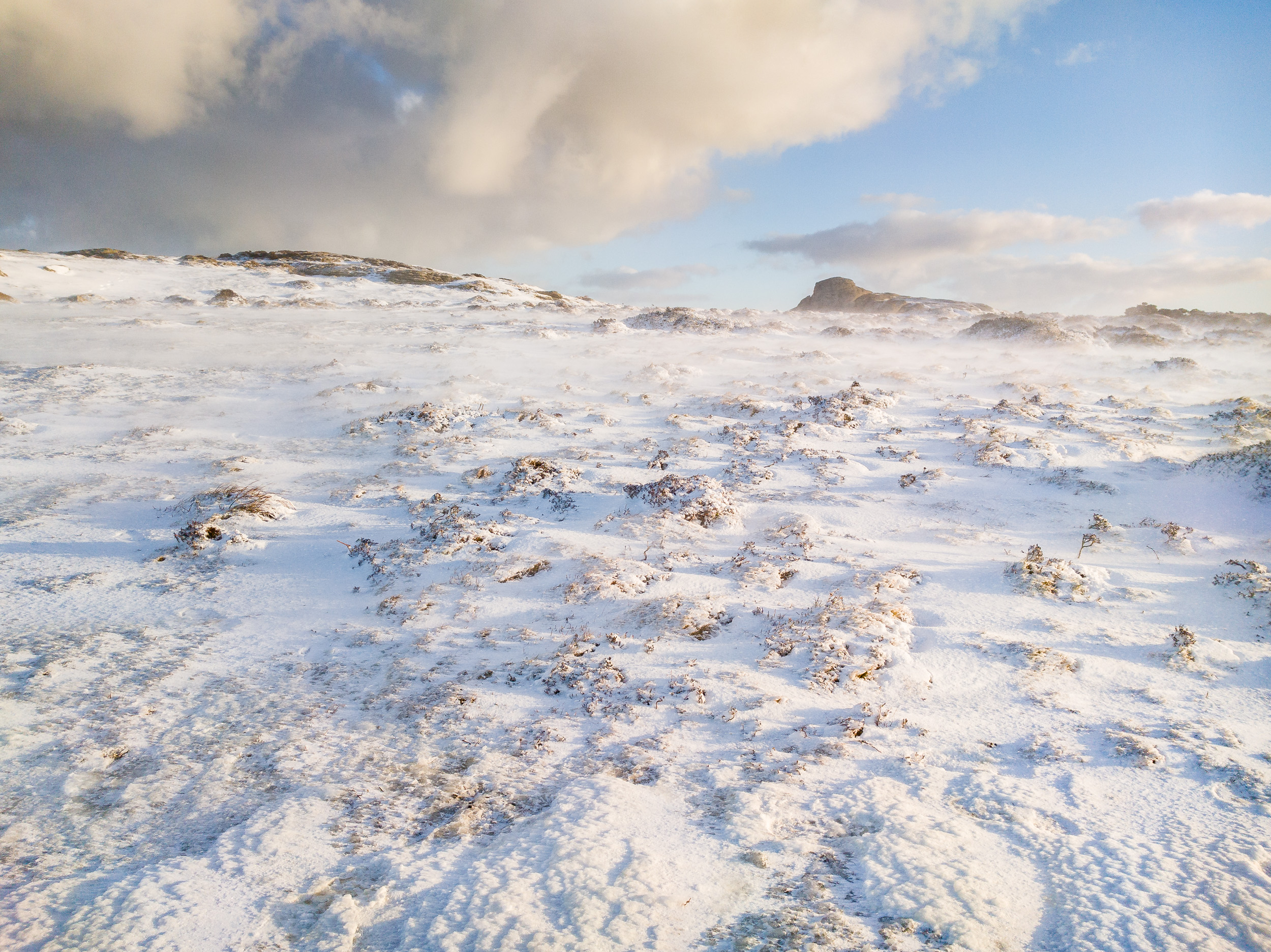
Unfortunately the arctic conditions didn't last the weekend.
The snow on Dartmoor didn't really last past that weekend so I was unable to go back out and try again. So while I was unable to get the image I was hoping for it was great, as always, to get out with the camera and practice the craft of photography. I also learnt something new about one of my favourite locations and how to plan a little bit better. So overall I call that shoot a success!
So have you been out with your camera in the snow recently? Do you use The Photographer's Ephemeris to plan your shoots? Let me know in the comments below.
Creating a Locations Map with Google Maps
In this video I take you through process of creating your own custom Google map so you can record, track and visualise your landscape photography locations
Location Planning
Back in September I posted a blog article on planning for a landscape shoot. In the blog post and associated YouTube video I talked about a number of planning tools that I use for weather, tides, sunset / sunset timings etc. However, it was my use of a custom Google Map to record locations that I have either visited or plan to visit that seems to have generated the most interest from my readers / viewers.
Using Google Maps
Given the level interest I thought I'd produce a brief tutorial to tell you how to create your own map. So in this video I take you through the steps of:
Creating a map
Adding locations
Using colours, icons, and layers
Modifying locations with comments
Accessing your maps on a mobile device
I find it a really useful tool and I'm sure you will to. Check out the video below:
Hopefully you found this video useful. If so, please do subscribe to my YouTube channel! Don't worry if you don't, I always post a blog article here with the video embedded so you won't miss out.
Do you use Google Maps for any of your location planning? Do you have any tools that you recommend? If so, please let me know in the comments.
Not All Shoots Are Successful Shoots
In this blog I discuss the challenges of shooting on a beach and I give my own image a critique.
The Best Laid Plans
As a photographer you always want to put your best images out there. If you practice enough your technique will improve and your style develop, hopefully resulting in a gradual but noticeable improvement to your images. While this is generally true, it doesn't necessarily mean that every trip out with the camera will result in an image that was better than the last one. When I started this blog one of my key goals was to discuss my success and my failures. As I said in my first blog post, landscape photography isn't all about 5 star images captured on epic international trips.
In this blog post I'm going to take you through one of my less successful trips out with the camera. I had it all planned out. I would finish work bang on time, drive to West Bay in Dorset, and photograph the sea and evening light as it gloriously reflected off sea and cliffs. Well, that was my vision anyway. I went through all my normal planning steps, weather, cloud, tide, bearing of sunset and it all looked good.
Challenging Conditions
I've visited West Bay a couple of times, but never to photograph it. The east beach there, recently made more famous by the TV series Broadchurch, is long and sandy with dramatic cliffs running as far as the eye can see. However, when I arrived the reality of actually shooting there became apparent.
Firstly was the tide. After checking the tide tables I knew it was coming in, but what you can't tell from the tables is how long of a reach those waves have. The waves weren't tall, but their reach up the beach was long. Now I don't mind getting my feet wet, but it becomes really difficult to frame your shot if your camera sinks a little with each wave. If I moved further away from the waves I lost a lot of the sea in the frame. Normally this would be less of an issue if the beach has a natural curve.
The other challenge was the weather. While it wasn't raining nor the wind as strong as I expected it to be, the light was very flat. The forecast had indicated lots of high cloud and no low cloud. This I hoped would give me a spectacular evening sky to add to my composition. However, there was a lot of low cloud and the chances of there being any evening light bouncing off the cliff seemed very unlikely.
Change of Plan
Spare time to do photography is at a premium for me. While I like to do some location scouting when I can, it's not always possible, and so sometimes I just have to wing it. So with the very real sense that I might have just wasted a 2 hour round trip in the car, I put my thinking hat on and tried to think of a different composition. This approach of looking around and not getting focused on one thing had worked well on a recent trip to Dartmoor, so I picked up my tripod and got walking.
It wasn't long before I had the idea of doing a long exposure of the beach, looking straight out to see, and including a few well-placed rocks or stones in the foreground. This composition would probably deliver better results. I would have better visibility of the waves and the quality of the light was less of a dependency.
An Ever Changing Beach
Though I had a new vision on what my photograph would be my challenges weren't over. I would find an interesting composition, setup, grab a frame, maybe two at the most, and then a wave would come in wash my composition away! Even some of the larger stones in my composition weren't big enough to resist the pull of the waves. So this left me with very little time to grab a frame for each composition I found along the beach. I had to make sure the camera was level, focused, and correctly exposed in very short time or I might not get another go at it.
After only a few compositions the light had faded and I decided to take my very sandy tripod and wet feet back home for a nice meal and glass of wine.
Critiquing My Own Image
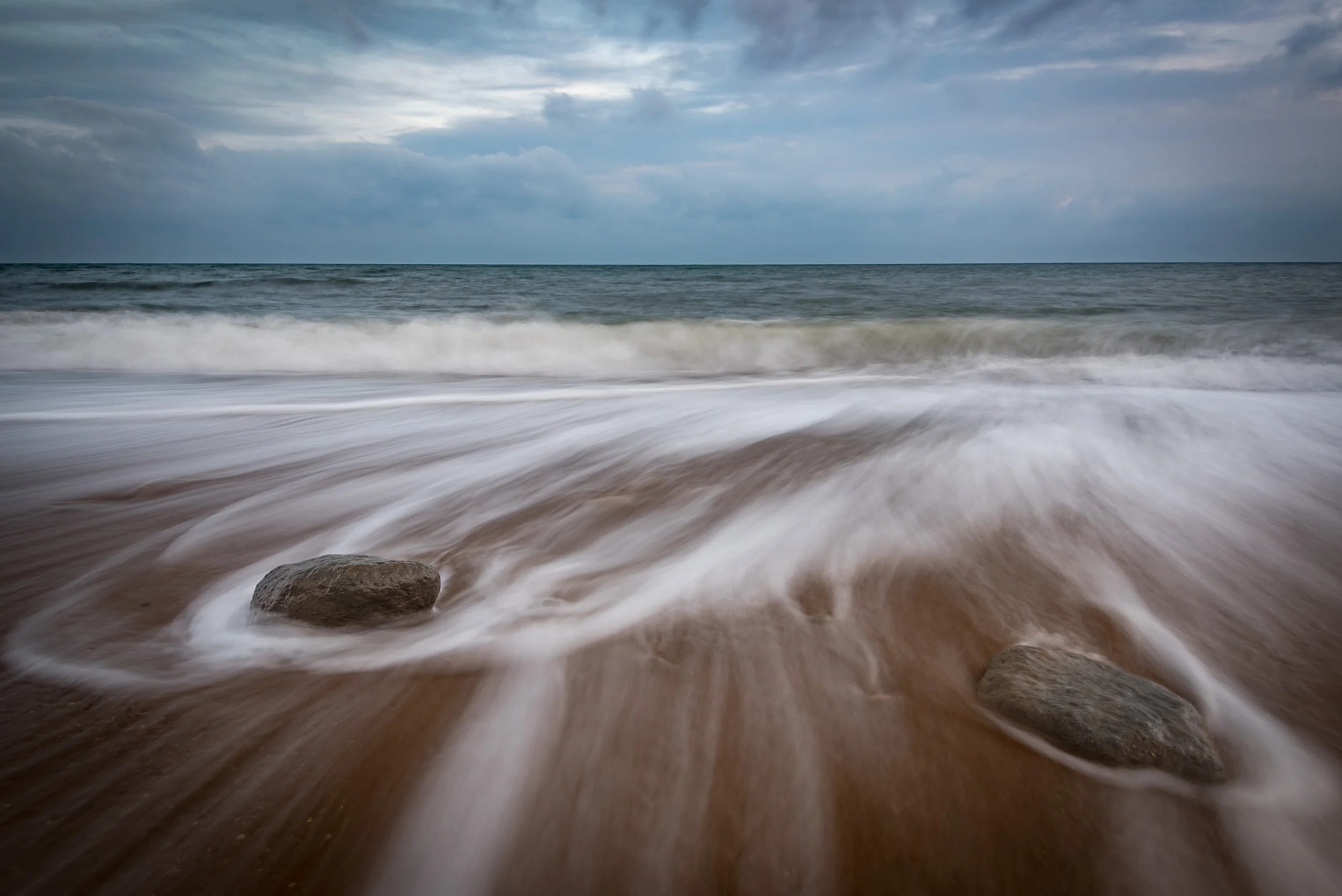
I only took a handful of frames that evening but here is the image that I think turned out the best.
Nikon D750 with Nikon 16-35mm f/4, 1.3 secs, f11 at 20mm, Lee Filters Polariser and 3 Stop ND
Now I'll be the first to admit this isn't an image for my portfolio. Though I like the mood and style of the image it does have a number of issues. If I'd had more time at the location I might have worked out these issues but as I said at the start of the blog, not all shoots are successful shoots.
The main issues I have with the image are around the rocks I have used in the foreground. The rock in the lower right of the frame for me is just a little too close to the edge of frame. I would like to have had just a little bit more space as there is with the rock on the left.. Given a bit more time between waves, I might have setup my tripod in a slightly different location to give me that space.
While the image roughly follows the rule of thirds, it doesn't follow the rule of odds. Now, I know that these rules are more like guidelines, but quite often they do make sense and I do think following the rule of odds in this scene would have helped with the overall composition.
Rocks at Porth Nanven - Nikon D750, Nikon 16-34 f/4 at f/16, 1.6 secs at 20mm.
I learnt about the rule of odds in the book, The Art of Landscape Photography by Mark Bauer and Ross Hoddinott (it's a fantastic book and well worth picking up). In the book Ross and Mark discuss how having an odd number of objects helps create visual stability or symmetry.
In this image I took of Porth Naven a couple of years ago you can see how I've composed with three rocks in the foreground. The balance and implied triangle in this image is something I would have liked to have seen in my West Bay image.
Always Good to Be Out With The Camera
Despite the fact that my shoes are still drying off and I had to strip down my tripod to get rid of the sand, I still felt it was time well spent with the camera. I'm also not going to win any awards for the image, but that really isn't the point. I was outdoors with my camera on a beautiful beach taking images and for a person that spends most his time sitting at a desk it's just nice be outside. Yes, conditions were challenging but it's through these challenges that you learn to progress as a photographer.
Actually I'm going to change my mind, it was a successful shoot. Just successful in a different way.
So what do you think of the image? How would you have shot the scene? Have you got any tips for photographing beach scenes? Please let me know in the comments.

1 Location, 2 Cameras, 3 Photographers and Force 4 Wind
In this blog post I write about a recent trip to The Valley of the Rocks where I nervously flew my drone in strong winds and shared a cliff top perch with two other photographers to photograph Ragged Jack.
Last of the Midweek Shoots
Autumn is open us and though the amazing autumnal colours haven't reached their peak yet in Devon, the nights are closing in rapidly. During the spring and summer months my photography benefits greatly from the long evenings. Photography during the week becomes practical as I can grab my camera and head out straight after work and travel all over Devon and Cornwall and still make sunset.
Over the last few weeks though that window of opportunity has been shrinking and my ability to travel long distances before sunset reduced. So when I was looking at my location map and decided to go to The Valley of the Rocks, I knew this could be one of the last of my longer mid-week trips for a while.
1 Location, 2 Cameras
With my one location locked in for the evening I got to checking out the conditions and planning my shoot locations (see my blog post on Planning). On my last visit to The Valley of the Rocks I took some time to have a walk about to see if I was missing anything. (Check out my blog post on Location Scouting to read why I do this). Well, I was glad I did as I discovered a whole new aspect to The Valley of the Rocks and was inspired with some new ideas!
My plan was to not only take out the big guns (Nikon D750) but to also take out my DJI Phantom 3 4K so that I could get some aerial shots of the dramatic coastline and rock formations. I've recently been discovering the joys of drone photography and I thought this would be an ideal opportunity to do some more work in that area (see blog post on Drone Photography). My plan was to shoot with the drone while the light was good, and then switch to the DSLR for last night. So with my one location locked in and my two camera's packed I set of for the north coast of Devon.
Force 4 Wind


The drive to my location wasn't exactly inspiring as the rain continued to come down and as I reached some of the higher parts of the route the fast moving cloud got lower and lower. However, I had checked the weather forecast and it had promised to clear up around sunset so I was remaining optimistic. By the time I had got there things had much improved so with a sense of excitement I got to my first spot and got the drone out.
It was at this point that I did get a little nervous. If anyone has been to the north Devon coast will testify it can get a little windy. I've had to extend my planning routine recently to take into account flying the drone, particularly along the coast. I now check the coastal weather forecast to see how strong the wind will be. The drone does have a maximum horizontal speed and flying in wind speeds that exceed that could see my drone drift out to sea!
I had done a number of calculations and worked out that I could safely fly it in the predicated conditions of a force 4 wind. However, what is OK on paper may not actually be OK in real life. So while perched on a cliff side with a very long drop I cautiously started up the drone. Hovering at 1.5m I could see the drone working hard to stay in one place. Putting caution to the wind (excuse the pun), I decided to fly it away from the cliff side as I thought it might be a bit less blustery. Though the drone was still working hard, it had settled down a bit and my confidence grew. I still had a worry that it was going to get caught by a gust of wind and go out to see or crash into a cliff, but I was feeling bold (or daft) and managed to capture some dramatic images.


3 Photographers
After about 45 minutes with the drone I had got the images I had come for. Well, most of them anyway. There were a few shots of some rock arches that I wanted but I really wasn't brave enough to get them given the conditions! So with sunset approaching rapidly I headed off to a spot that I had noticed earlier with the plan of shooting Ragged Jack with my DSLR. As it was a Tuesday evening in late September I thought I might have the place to myself but as I turned the corner I found another photographer setting up on the cliff side.
The spot we had both picked to shot was relatively small but Steve (the other photographer), kindly let me share it and we got chatting. It was the normal stuff, gear, technique, processing, but all very enjoyable! Just as we got shooting another photographer turned up. So two became three and we all waited for that magical sunset moment….which to be honest never actually happened. I took a handful of frames trying different combinations of filters but sometimes the conditions just aren't quite right. The third photographer soon walked on and I continued to enjoy my chat with Steve. We both continued to take a few frames but soon we were packing up also.
Time Well Spent
Though my final image taken with my DSLR isn't one for the portfolio I still count my trip to The Valley of the Rocks as a success. Firstly I managed to capture some nice images of the location with the drone. I really like the extra dimension that the drone has brought to my photography. I try and take the same approach to composition with the drone as I do with the DSLR, but this doesn't always work so I'm still learning how to compose when shooting at 200 ft!
It's also good to just get out and practice the art of photography (see my blog post on Practicing). Sure the conditions didn't turn out to be perfect but just getting out with the camera is always a pleasure.
It is the unexpected that can also make these trips worthwhile. It was great to meet and chat to a fellow photographer. Landscape photography can be a solitary pastime, and while I greatly value the solitude, it's also great to meet people, especially other photographers.
So overall it was time well spent. Any time with the camera is time well spent! I might still squeeze in a couple of mid-week evening shoots but I'm already starting to plan out my dawn shoot locations for the next few months. During autumn and winter my opportunities for photography are limited to weekends and sunrise shoots minimise any impact to my family commitments. But do you know what, I kind of like those cold mornings perched on top of a tor on Dartmoor, freezing cold, drinking coffee, waiting for the sun to rise and bath the world in light.
Location Scouting in the Teign Valley
In this video blog post I head out to Fingle Bridge and the Teign valley to scout out some locations for an autumn themed shoot.
The Importance of Scouting
The time I spend with the camera is precious. I have a full time job and a family that keeps me really busy so when I do get out I like to make the most of it. Sometimes I just go out to practice with my camera (see my blog post on practicing) or I'll go out to scout out a location. For me scouting out a location can be a really good use of time. For locations such as the upper Teign valley near Fingle Bridge in Devon, having a number of spots already picked out means that when the golden hour comes I'm only worrying about composition and not finding a good location.
In this short video I take you on a recent trip to the upper Teign Valley where I spend some time walking the path looking for locations that I can use for some autumnal shots that I want to take there. I'm travelling light with my Sony RX100M4 and a Manfrotto BeFree Carbon tripod but it allows me to quickly take shots from locations as I move along the valley.
Here's the video:
Mission Successful?
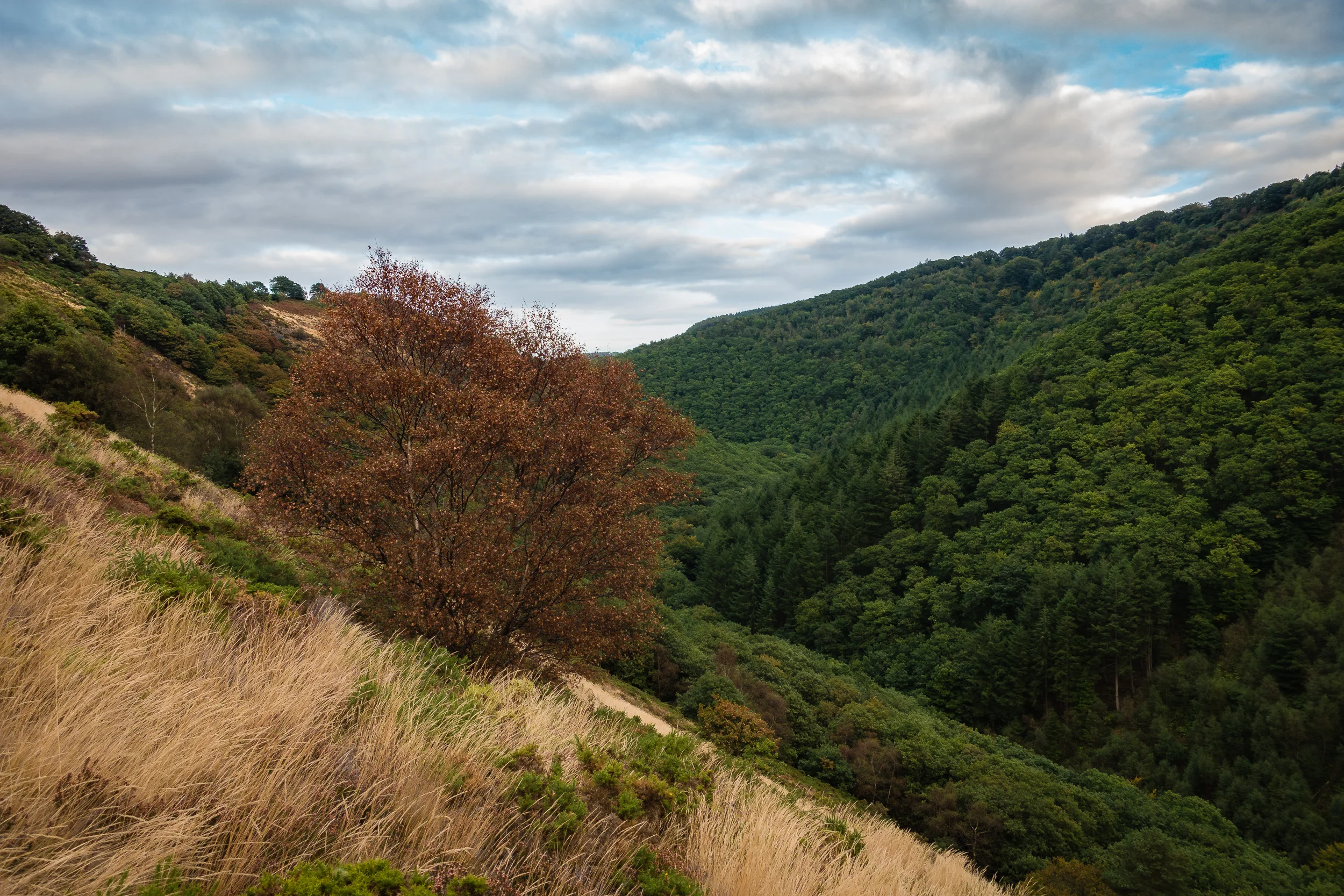
Here are the images that I took from the locations I scouted:


Now I'll be the first to admit that these aren't award winning images. The composition was setup up quickly and the light not exactly at its best but it does give me some really good ideas on where I want to shoot when I do go up there when the autumnal colours are in there full glory.
I also originally had this location down as a sunrise only location but because of this scouting exercise I'm fairly sure I could get images at either end of the day. So was it worth while? Well yes. Anytime with the camera is good but I feel more prepared to shoot this particular location now.
Do You Scout?
Do you spend time scouting out the locations you want to shoot? Or do you just turn up and see what takes your eye? Let me know in the comments.

Remember to Look Around
It's all to easy to concentrate on the scene in front of you, but as I discovered there can be a lot going on just behind you.
Photographing An Old Friend
I don't know about you but I have a few places on my location map that are easy to get to and provide a variety of angles to shoot from. So when the weather forecast for last Tuesday was a bit 50/50 for a good sunset I thought I'd go somewhere I know so that if it fails to be spectacular I won't have spent a significant amount of effort getting there.
How I saw the scene last year.
Heading down to my target location of Emsworthy Rocks just down from Haytor I was still confident that I was going to get a good shot. I decided to shoot the rocks and tree from a position that I hadn't used before. My plan was to have my back to the setting sun so that the tree and rocks would be bathed in golden light. There wasn't going to be much going on in the sky so I positioned the main elements higher up in the frame leaving some of the ground rock formations in the foreground.
Playing the Waiting Game
I went through all my normal checks for exposure and sharpness and then waited with the remote release for that magic moment where the colour would bath my subject in glorious golden light.
This is the scene I came to shoot but the light and sky just weren't what I wanted.
Well some time passed and I had shot a few frames but the scene just lacked a bit of punch. In my focus on the scene in front of me I'd failed to look to see what else was going on. It's all too easy to go out with a singular focus on what you want to achieve but this can sometimes mean you'll miss something a bit more special. I was convinced that my target scene would come good. However I casually turned 90 degrees to my right and was presented with a much more interesting scene. The light on the rocks was much more pleasing and the sky had a bit more interest about it.
Change of Plans
On the same spot as the last image but 90 degrees to the right.
I pondered if I should go to the hassle of changing my composition and moving my tripod (which had taken bit of setup to balance on the rock I was perched on). I knew I would regret it if I didn't at least try so I repositioned the tripod, got a Lee Filters ND 0.9 medium grad out and shot a few frames of this new scene.
I did go back to shooting a few frames of my original composition but I already knew that I'd grabbed the best shot I was going to get that night. So what did I learn from this particular adventure? Don't get too focused on one scene or shooting a particular direction. The landscape, particularly the wilds of Dartmoor, are wide open spaces and the light can look very different simply by looking a different direction from the same point. I was committed to getting the image in my head but I almost missed a much better one.
Have you had a similar experience? Have you looked round to find a much better shot or do you remain focused on what is in front of you? Let me know in the comments.