
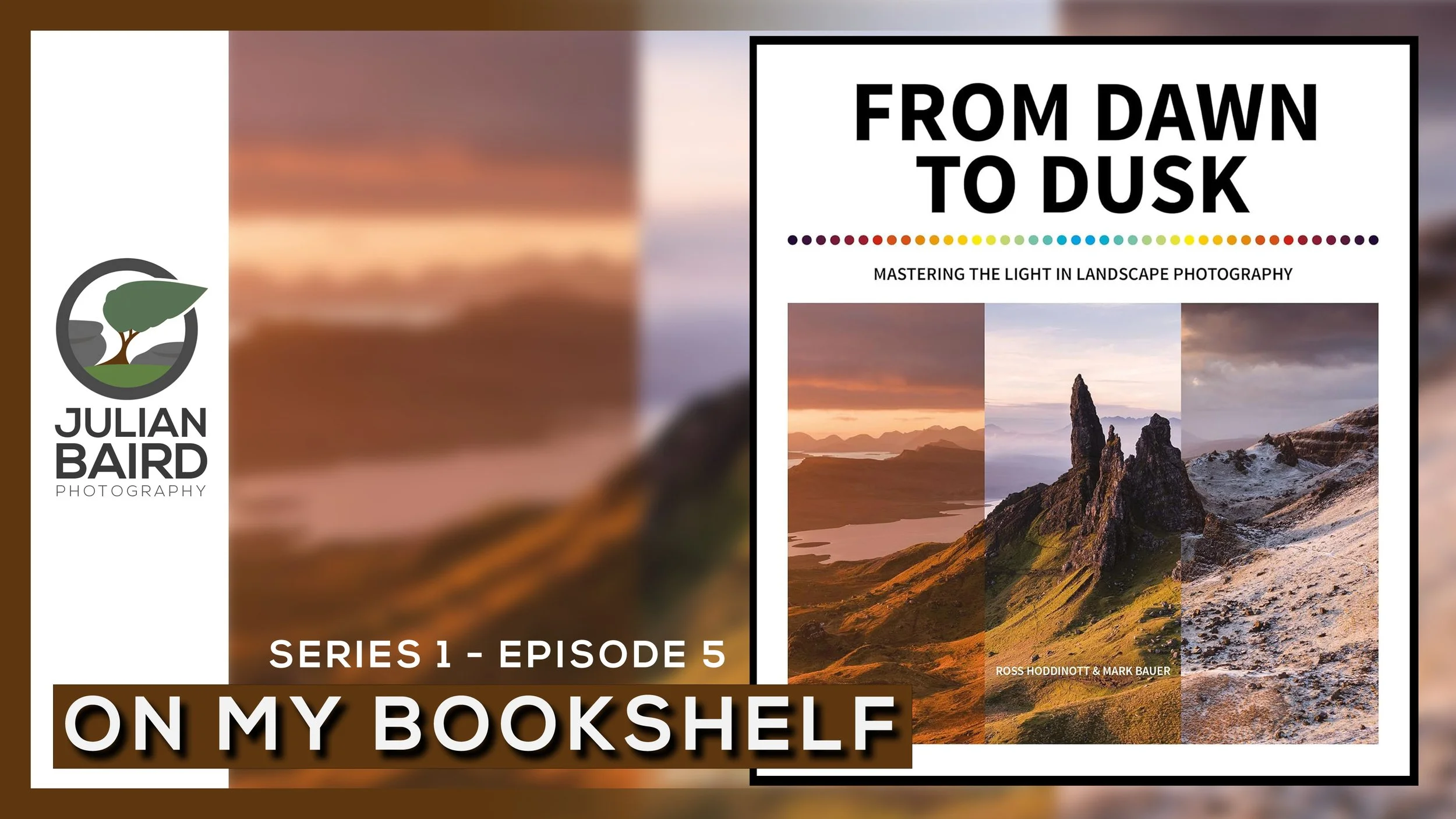
From Dawn to Dusk - Mastering the Light in Landscape Photography - On My Bookshelf S01E05
In this very special blog post I share with you the latest episode of On My Bookshelf. In the episode I interview Mark Bauer and Ross Hoddinott about their latest book on landscape photography, From Dawn to Dusk. I also tell you about a giveaway where you can win all three of their books.
On My Bookshelf
Over the last few months, I've been sharing with you the On My Bookshelf series of videos. Even though my photography life is predominately digital, I still believe the printed book is an important part of my development and enjoyment of photography. So in each episode of On My Bookshelf, I've told you about a book that I've enjoyed reading in the hope that it will also inspire you.
From Dawn to Dusk
When I first heard that two of my favourite landscape photographers were writing another book I knew straight away that I would need to get myself a copy. After all, their last book, The Art of Landscape Photography, had a big impact on my development as a photography and I read it many times.
As the publication date got closer I reached out to Ross Hoddinott and Mark Bauer and asked if they would like to appear on an episode of On My Bookshelf. I was delighted when they both agreed and they invited me along to see them sign and dispatch the first batch of orders of From Dawn to Dusk - Mastering the Light in Landscape Photography.
They also kindly agreed to an interview where I got the chance to ask them about their latest book, what's in it, who's it for, and how it differs from their previous 2 titles. You can see the full interview in the video below.
Book Giveaway!
After the interview, Mark and Ross offered me a signed copy of their latest book to give away to one lucky viewer. Not only that, they also gave me two signed copies of their previous two titles The Art of Landscape Photography and The Landscape Photography Workshop.
There are two ways in which to gain an entry to win all 3 books:
Watch this episode of On My Bookshelf: From Dawn to Dusk on YouTube and then leave a comment in the YouTube comments section for the video. Comments are welcome here, but to enter you need to leave a comment on the video itself.
Share the Facebook post for this video. You can find it here: <insert URL>
You a free to enter using one, either, or both of the above ways. If you do both though, you will be entered into the giveaway twice!
Entries for the giveaway close 12 pm (GMT) 28th May 2018.
If you can't wait to get a copy of From Dawn to Dusk - Mastering the Light in Landscape Photography you can still order a signed copy straight from the authors at http://www.dawn2duskphotography.co.uk/books/
Finally, I just want to say a big thanks to Mark and Ross for the interview! It was a real pleasure talking to you both and judging by the number of pre-orders you were signing and sending out it looks like From Dawn to Dusk - Mastering the Light in Landscape Photography is going to be a big success!
Some of the links used in this article are Amazon affiliate links. By buying through the links I may receive a commission for the sale. This has no effect on the price for you.
Not All Shoots Are Successful Shoots
In this blog I discuss the challenges of shooting on a beach and I give my own image a critique.
The Best Laid Plans
As a photographer you always want to put your best images out there. If you practice enough your technique will improve and your style develop, hopefully resulting in a gradual but noticeable improvement to your images. While this is generally true, it doesn't necessarily mean that every trip out with the camera will result in an image that was better than the last one. When I started this blog one of my key goals was to discuss my success and my failures. As I said in my first blog post, landscape photography isn't all about 5 star images captured on epic international trips.
In this blog post I'm going to take you through one of my less successful trips out with the camera. I had it all planned out. I would finish work bang on time, drive to West Bay in Dorset, and photograph the sea and evening light as it gloriously reflected off sea and cliffs. Well, that was my vision anyway. I went through all my normal planning steps, weather, cloud, tide, bearing of sunset and it all looked good.
Challenging Conditions
I've visited West Bay a couple of times, but never to photograph it. The east beach there, recently made more famous by the TV series Broadchurch, is long and sandy with dramatic cliffs running as far as the eye can see. However, when I arrived the reality of actually shooting there became apparent.
Firstly was the tide. After checking the tide tables I knew it was coming in, but what you can't tell from the tables is how long of a reach those waves have. The waves weren't tall, but their reach up the beach was long. Now I don't mind getting my feet wet, but it becomes really difficult to frame your shot if your camera sinks a little with each wave. If I moved further away from the waves I lost a lot of the sea in the frame. Normally this would be less of an issue if the beach has a natural curve.
The other challenge was the weather. While it wasn't raining nor the wind as strong as I expected it to be, the light was very flat. The forecast had indicated lots of high cloud and no low cloud. This I hoped would give me a spectacular evening sky to add to my composition. However, there was a lot of low cloud and the chances of there being any evening light bouncing off the cliff seemed very unlikely.
Change of Plan
Spare time to do photography is at a premium for me. While I like to do some location scouting when I can, it's not always possible, and so sometimes I just have to wing it. So with the very real sense that I might have just wasted a 2 hour round trip in the car, I put my thinking hat on and tried to think of a different composition. This approach of looking around and not getting focused on one thing had worked well on a recent trip to Dartmoor, so I picked up my tripod and got walking.
It wasn't long before I had the idea of doing a long exposure of the beach, looking straight out to see, and including a few well-placed rocks or stones in the foreground. This composition would probably deliver better results. I would have better visibility of the waves and the quality of the light was less of a dependency.
An Ever Changing Beach
Though I had a new vision on what my photograph would be my challenges weren't over. I would find an interesting composition, setup, grab a frame, maybe two at the most, and then a wave would come in wash my composition away! Even some of the larger stones in my composition weren't big enough to resist the pull of the waves. So this left me with very little time to grab a frame for each composition I found along the beach. I had to make sure the camera was level, focused, and correctly exposed in very short time or I might not get another go at it.
After only a few compositions the light had faded and I decided to take my very sandy tripod and wet feet back home for a nice meal and glass of wine.
Critiquing My Own Image
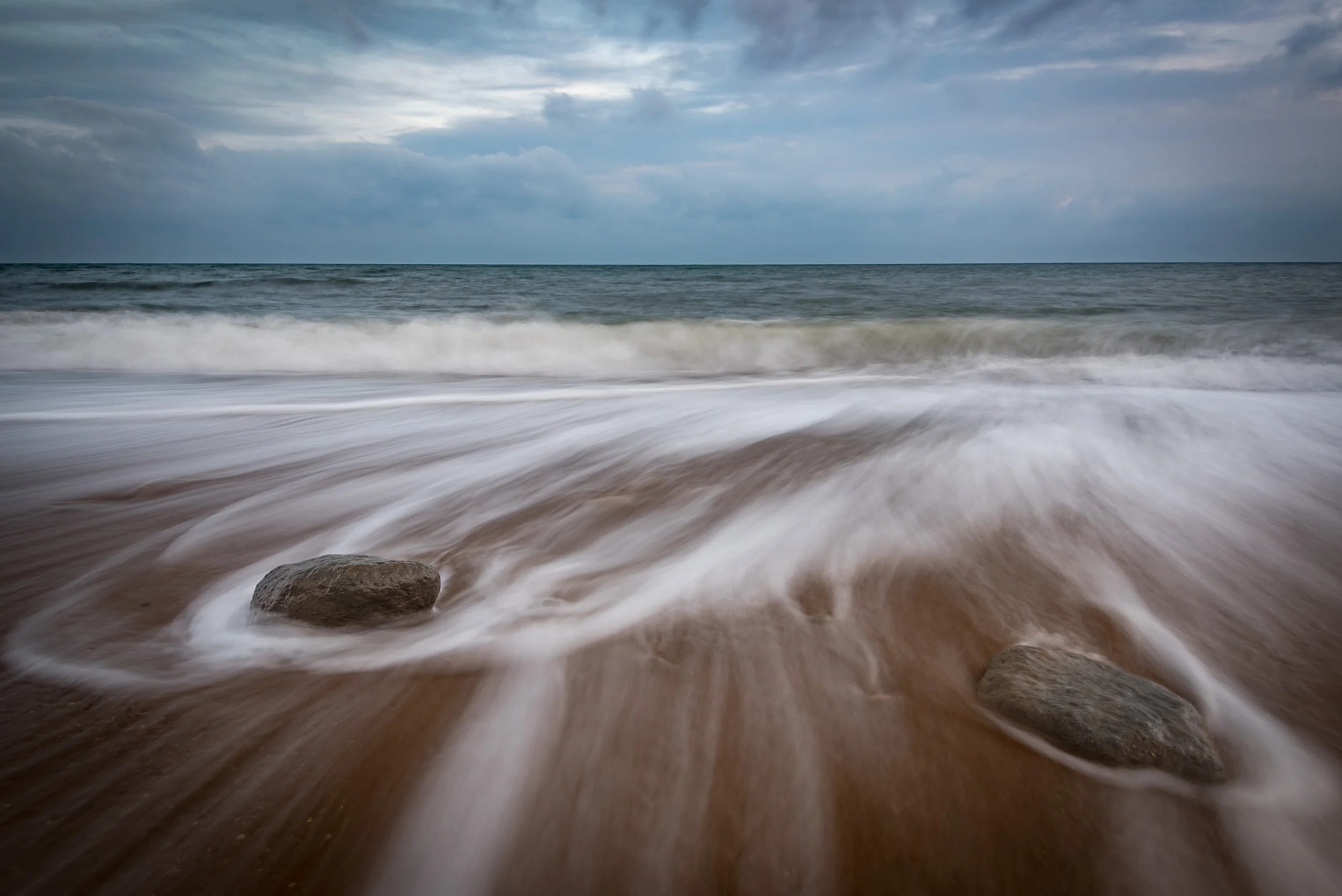
I only took a handful of frames that evening but here is the image that I think turned out the best.
Nikon D750 with Nikon 16-35mm f/4, 1.3 secs, f11 at 20mm, Lee Filters Polariser and 3 Stop ND
Now I'll be the first to admit this isn't an image for my portfolio. Though I like the mood and style of the image it does have a number of issues. If I'd had more time at the location I might have worked out these issues but as I said at the start of the blog, not all shoots are successful shoots.
The main issues I have with the image are around the rocks I have used in the foreground. The rock in the lower right of the frame for me is just a little too close to the edge of frame. I would like to have had just a little bit more space as there is with the rock on the left.. Given a bit more time between waves, I might have setup my tripod in a slightly different location to give me that space.
While the image roughly follows the rule of thirds, it doesn't follow the rule of odds. Now, I know that these rules are more like guidelines, but quite often they do make sense and I do think following the rule of odds in this scene would have helped with the overall composition.
Rocks at Porth Nanven - Nikon D750, Nikon 16-34 f/4 at f/16, 1.6 secs at 20mm.
I learnt about the rule of odds in the book, The Art of Landscape Photography by Mark Bauer and Ross Hoddinott (it's a fantastic book and well worth picking up). In the book Ross and Mark discuss how having an odd number of objects helps create visual stability or symmetry.
In this image I took of Porth Naven a couple of years ago you can see how I've composed with three rocks in the foreground. The balance and implied triangle in this image is something I would have liked to have seen in my West Bay image.
Always Good to Be Out With The Camera
Despite the fact that my shoes are still drying off and I had to strip down my tripod to get rid of the sand, I still felt it was time well spent with the camera. I'm also not going to win any awards for the image, but that really isn't the point. I was outdoors with my camera on a beautiful beach taking images and for a person that spends most his time sitting at a desk it's just nice be outside. Yes, conditions were challenging but it's through these challenges that you learn to progress as a photographer.
Actually I'm going to change my mind, it was a successful shoot. Just successful in a different way.
So what do you think of the image? How would you have shot the scene? Have you got any tips for photographing beach scenes? Please let me know in the comments.