
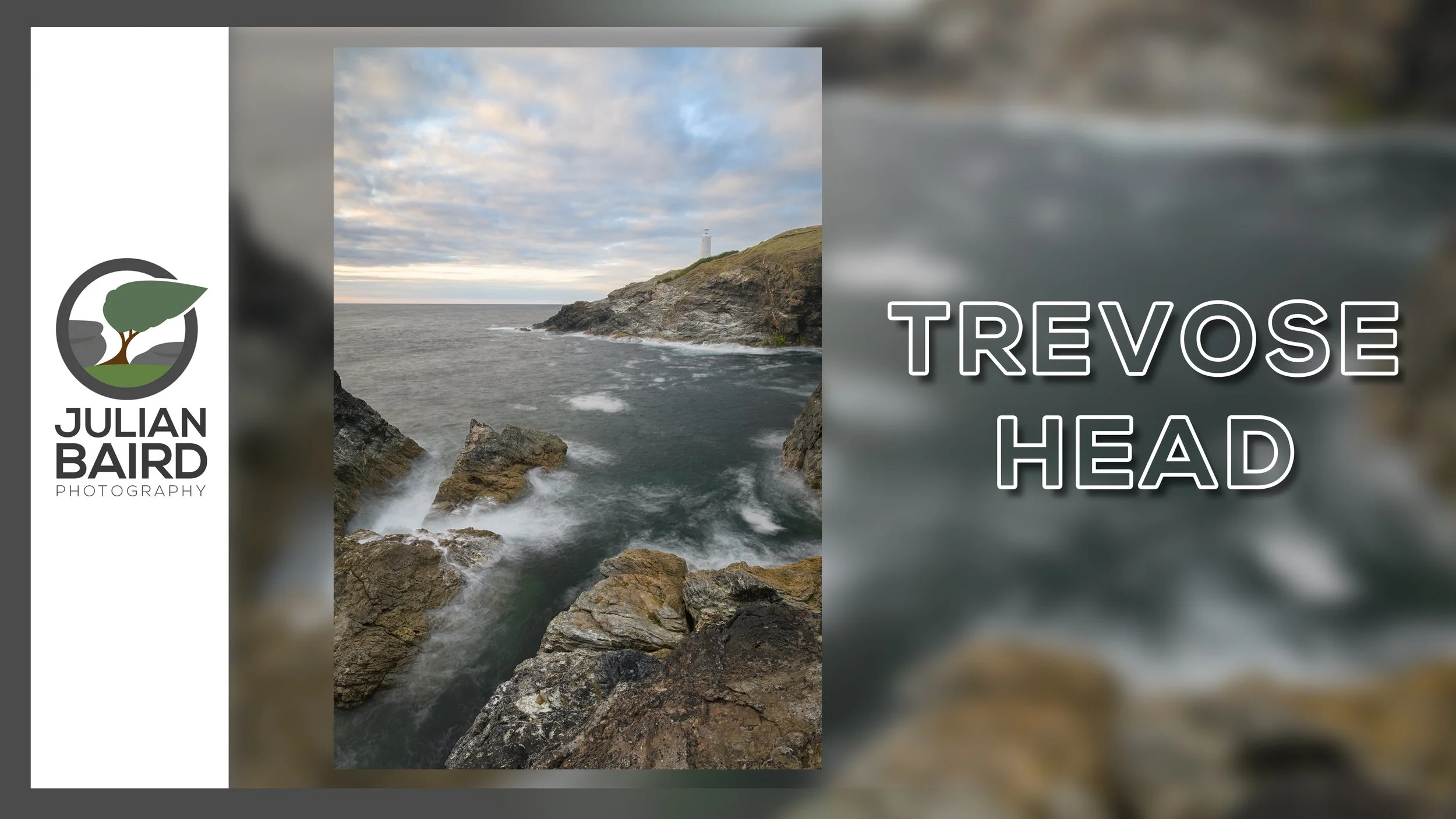
Trevose Head - An Iconic South West Coast Path Location on the North Cornwall Coast
If there's one place to get light from the setting sun, it's the coast. With such a small gap between the clouds and the horizon, will my trusty friend Trevose Head give me the light I'm looking for?
Trevose Head - I Just Keep Going Back
In my last blog post I talked about how I was going to spend a bit less time on Dartmoor and start reconnecting with the South West Coast Path. Just after writing that though I started a new mini project on Dartmoor! What can I say. When you are inspired, you’re inspired!
The start of a new Dartmoor project however does not mean I’ve decided not to spend more time photographing the coast. Far from it. I’ve just decided to give up on a little sleep!
When I was considering which coastal locations to photograph while I reconnect with the South West Coast Path, one location stood out as one that I must revisit. Trevose Head is probably one of my favourite locations on the South West Coast Path. It’s a dramatic bit of coastline with crashing waves, sharp rocks, cliffs, and a lighthouse. It also shoots well at sunset just about all year round!
With that all said, it wasn’t my original plan to go there, but the weather conditions weren’t favouring my original choice of The Rumps. While I was eating my fish and chips (a mandatory treat when visiting Cornwall), I was trying to think of a location that might work even when the sky was heavy with cloud. It didn’t take long. There was only one choice and that was Trevose Head.
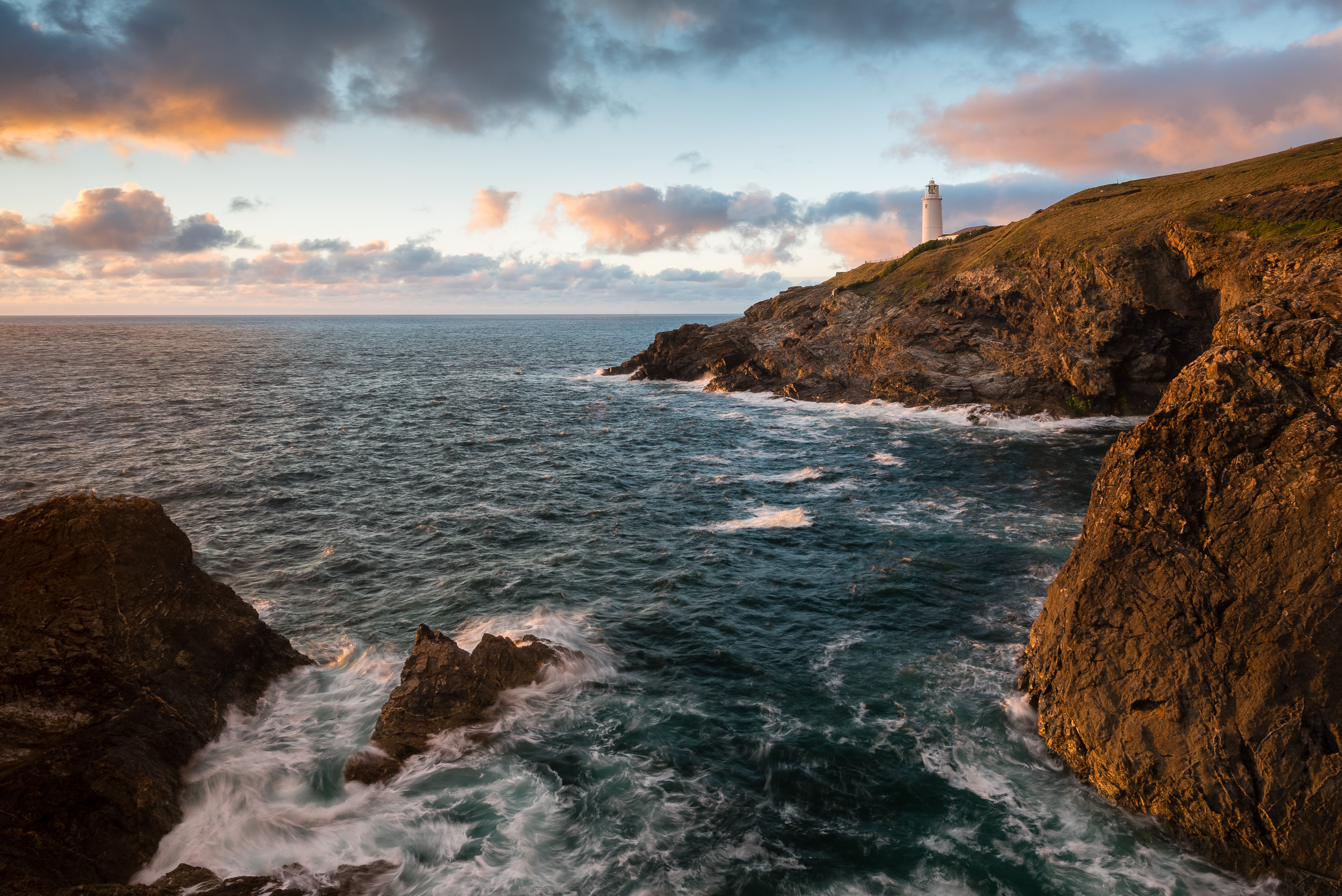
Photographs on Trevose Head on the South West Coast Path
Trevose Head #1, South West Coast Path, North Cornwall - Nikon Z8 with Nikkor Z 14-30mm f/4 S at 24mm, f/13, 0.4 sec at ISO 64, Kase Filters CPL.
Trevose Head #2, South West Coast Path, North Cornwall - Nikon Z8 with Nikkor Z 14-30mm f/4 S at 19mm, f/11, 5 sec at ISO 64, Kase Filters CPL and ND.
Trevose Head #3, South West Coast Path, North Cornwall - Nikon Z8 with Nikkor Z 14-30mm f/4 S at 21mm, f/11, 6 sec at ISO 64, Kase Filters CPL and ND.

Bite-Size Blog Post #36 - Trevose Head
Does anyone get nervous sometimes about processing their photos? Do you get worried that the feeling of joy you had taking the photographs doesn't carry on into the edit? Learn why I'd been putting off editing these images of Trevose Head in this blog post.
If in Doubt, Trust an Old Friend
Living in the south west of England I am spoilt for choice when it comes to locations to capture landscape photographs. I have Dartmoor National Park, Exmoor National Park and 600 miles or so of the South West Coast Path to photograph. There’s a lifetime worth of locations to visit.
So why is it some locations keep calling you back again and again? Even when you already have a fine portfolio of photographs from that location, you still feel the need to return. Is it because you know you can capture good images there? Or because it’s just a beautiful place to be?
There is one such place in Cornwall that falls into that category for me, and that’s Trevose Head. Looking at my free landscape photography locations map, I can see that I’ve written about Trevose Head at least 6 times here on the blog. But why do I keep going back? Is it because I consistently capture photographs that I like at Trevose Head? Or maybe because it’s a dramatic and stunning section of coastline? Whatever the reason, I like it there.
I built up a bit of a back log of blog posts so the photographs you see in this post are a few months old now, but I’ll be honest with you, I can’t remember the real reason I went back to Trevose Head. It might have been that the weather conditions and tide were going to suit Trevose Head, or I was in a bit of a creative rut, and I felt safe going there, or maybe I just drove there subconsciously! I don’t know, and maybe it doesn’t matter, because the evening I took these photographs was special.

Trevose Head Sunset #1, South West Coast Path, Cornwall - Nikon Z8 with Nikkor Z 14-30mm f/4 S at 18mm, f/13, 0.5 secs at ISO 640, Kase Filters CPL
I could tell just standing there on the cliffs that the conditions were good for photography and that feeling continued as I captured the photographs. On the long drive home, I knew I had captured some photographs that I would be happy with. When I imported them into Lightroom I could see the raw files had promise.
So why has it taken so long to share them? Yes, I had a backlog of blog posts to write, but the main reason I’ve left it this long to write about them is that I was nervous about processing them. What if I found they weren’t that good after all? I wanted to hold onto to magical time at Trevose Head and I didn’t want it to be spoilt by disappointing photographs. Maybe that’s missing the point of enjoying my time there. Perhaps I should just enjoy the memory of that experience.
As it turns out though, I needn’t have worried. I’m very happy with the photographs I captured that evening. So much so, I want to go back. But that’s no bad thing.

Trevose Head Sunset #1, South West Coast Path, Cornwall - Nikon Z8 with Nikkor Z 14-30mm f/4 S at 18mm, f/13, 6 secs at ISO 64, Kase Filters CPL

A Return to Coastal Photography in Cornwall
After a long break, I return to Cornwall for some seascape photography. It’s also an excellent opportunity to catch up with a mate.
A Day Out in Cornwall
Looking through my Lightroom catalogue I was surprised to see that I hadn’t been to Cornwall or done any seascape photography since June. As part of my long-term photography project, I have been focusing my efforts on capturing images of Dartmoor. While there’s no doubt that this focus has paid dividends for my project, it has left me missing the coast.
There is also the cost of driving to Cornwall to consider. With fuel being so expensive it can be hard to justify burning through £25 of fuel on the off chance you might capture something new, unique, or special. However, there is one reason I will always head to Cornwall no matter what the cost of fuel is and that is to spend the day with my mate (who is also a photographer).
We hadn’t seen each other since my last trip in June and despite trying to organise something we found it impossible to align our availability and a half-decent weather forecast. Finally, when things did align, we just decided that we would make it a proper day out. Dawn to dusk.
Padstow Lifeboat Station
The first stop on our day out was Padstow Lifeboat Station near Trevose Head. When we arrived, we could sense the conditions might be favourable for us. Our first viewpoint was what you might call the classic viewpoint, close, and looking down on the lifeboat station. It’s a photograph we’ve both taken before and given that access is even more restricted these days, we decided to head along the coast to see if we could find a different angle.

Padstow Lifeboat Station at Trevose #1, Cornwall, South West Coast Path - Nikon Z7, Nikkor Z 14-30mm f/4 S at 21mm, f/11, 30 sec at ISO 64.
As we approached our alternative viewpoint the warm light from the rising sun started to illuminate the scene. While the sky lacked some contrast in the clouds, the rest of the view was a joy to shoot. I spent a bit of time wandering from one rocky outcrop to another and adjusting my focal length trying to decide whether to include the beach or not.

Padstow Lifeboat Station at Trevose #2, Cornwall, South West Coast Path - Nikon Z7, Nikkor Z 14-30mm f/4 S at 18mm, f/13, 10 sec at ISO 64.

Padstow Lifeboat Station at Trevose #3, Cornwall, South West Coast Path - Nikon Z7, Nikkor Z 14-30mm f/4 S at 18mm, f/13, 10 sec at ISO 64.

Padstow Lifeboat Station at Trevose #4, Cornwall, South West Coast Path - Nikon Z7, Nikkor Z 14-30mm f/4 S at 25mm, f/13, 3 sec at ISO 64.

Padstow Lifeboat Station at Trevose #5, Cornwall, South West Coast Path - Nikon Z7, Nikkor Z 14-30mm f/4 S at 24mm, f/13, 13 sec at ISO 64.
In the end, I think both the wider and slightly tighter shots work well. I think we were both happy with our efforts. However, not happy enough that we didn’t think we ought to shoot those viewpoints again!
Snacks, Chat and Walking
I’ve never been much for capturing landscape photographs during the day unless the conditions are particularly special. Unfortunately for us, the conditions were less than special. So, what do you do then to fill the time until sunset? Easy! Eat, chat, and walk.
Things started with a cooked breakfast and coffee. This was followed by a bit of a walk. As photographers though, our walk still had a purpose. We used this valuable time to scope out new locations and discuss ideas for compositions. It wasn’t all photography chat though. We also covered other life critical issues such as the various Star Wars TV series and the new GoT show. Much was said on those two items.
It was then time for a cake stop, another walk, lunch somewhere, an ice cream, and another walk looking for new locations and viewpoints. Despite not taking any photos since sunrise, it was a most enjoyable way to spend the day.
Holywell Bay
The weather forecast for sunrise is what I might have called, inconclusive. It was hard to tell what was going to happen when comparing what we could see in the sky, and what the forecast was telling us. We ultimately decided to go to Holywell Bay. While my mate has shot this location many times, this was my first visit.
Arriving at Holywell Bay we wandered up and down the beach for a while, looking for compositions. Because of the settled conditions, the outgoing tide hadn’t created as many ripples and textures in the sand as we might have liked, but we did eventually find a composition we thought might work.
It had some of the elements we were looking for. Rippled sand, a pool of water, and a view directly out to Gull Rocks. There was even a chance that the sun might set between the two islands that make up Gull Rocks.
The only problem with shooting Cornwall’s beaches in peak season is that they are busy. Naturally, a calm, somewhat sunny evening means that the beaches can be full of people, even near sunset. There’s not a lot you can do about that, and people wandering in front of your beautifully crafted composition is just part of sharing the beach. I don’t get upset about it I just get the clone tool out!

Holywell Bay #1, Cornwall - Nikon Z7, Nikkor Z 24-120mm f/4 S at 27mm, f/13, 1/6 sec at ISO 64, Kase Filters CPL.

Holywell Bay #2, Cornwall - Nikon Z7, Nikkor Z 24-120mm f/4 S at 27mm, f/13, 3 sec at ISO 64, Kase Filters CPL.
With our day coming to an end, we looked back and concluded it was a successful day out. Though we’d captured some photographs, our primary goal, the highlight of day was catching up with a mate. Well, almost the highlight. We did get some chips on the way home from our favourite chippy. After all, we’d barely eaten anything all day!

Bite-Size Blog Post #18 - Trevose Head
Sometimes the weather forecast changes for the better and the gamble to stay out pays off!
The Need to Be Flexible and Positive
The ability to be flexible in landscape photography is an important skill. I had made plans with my mate to shoot the thrift along the Cornish coast, but a worsening forecast was making that prospect less and less likely. Our desire to eat chips and catch up overrode any concerns we had about the forecast, and we decided to meet up regardless.
After a good chat and some excellent chips, we headed to our first location. We were only there a few minutes before we came to the rapid conclusion that shooting thrift was not going to work. The wind was strong, the cloud heavy and getting a soaking was a real possibility.
We could have just given up and gone home, but with a positive attitude and a bit of local knowledge, we decided that Trevose Head might be a good bet. We’d both shot Trevose Head many times before, but with good reason. It’s one of those dramatic coastal locations that can work well in unsettled conditions.
When we got to our regular viewpoint though there was a nasty area of seafoam. Not something that could be avoided or cloned out in post-processing. Too late to try another location we started to explore the area. As we did the clouds started to break a little and for the briefest of moments, we got some half-decent light.
Trevose Head Lighthouse #1, Cornwall - Nikon Z7, Nikkor 14-30mm f/4 at 18mm, f/13, 13 seconds at ISO 64, Kase Filters K9 CPL.
I wasn’t in the best spot for my first shot. While the light is good, I feel the composition doesn’t work as well as I thought it did when I took the shot. In retrospect, the foreground area dominates the photograph.
Trevose Head Lighthouse #2, Cornwall - Nikon Z7, Nikkor 14-30mm f/4 at 19mm, f/13, 20 seconds at ISO 64, Kase Filters K9 CPL.
The 2nd shot addresses that problem and there is a better balance between the two areas of land. However, the light isn’t as good.
Trevose Head Lighthouse #3, Cornwall - Nikon Z7, Nikkor 14-30mm f/4 at 49mm, f/11, 15 seconds at ISO 64, Kase Filters K9 CPL.
My final shot was a bit of a salvage shot. This is a vertical crop from a horizontal frame. Though I took a few vertical shots of this composition, I had failed to clean my polariser and those frames were ruined by some unsightly water droplets! This version gives you an idea of what I was aiming to capture, but I much prefer the water patterns in those original vertical frames.
Image critique aside, given the last 12 months, it was just good to be out again on the Cornish coast. I’ll be going back again soon.

A Trip to Trevose
I learnt a valuable lesson last week when I visited one of my favourite Cornish coastal locations!
Not a Guarantee of Success
I often find myself being lured back to locations where I’ve created photographs that I’m pleased with. This lure is often intensified if I’ve not only captured one great image there but several them. I will hear the voice in my head telling to return to the location rather than go somewhere new because “you always get a good shot there!”. The simple fact is that this isn’t true. While I may well have a higher number of keepers from certain locations, there is always a whole stack of failures from that location as well
Last week I decided that I would make a trip to the north Cornish coast for a spot of seascape photography. I decided to wait until I got to Cornwall before making a final decision on where to go. The weather forecast wasn’t offering up the answers I was looking for so I decided that I would assess the situation when I got there.
Sitting in a park near Camelford, eating some nice chips, I pondered where to go. Looking up at the sky it was looking a bit overcast and grey. I had a few locations I was considering but they would all require some good light to make the most of them. I therefore, decided it was a good time to embrace the grey!
As I wasn’t too far from Trevose Head I decided that would be a good place to go. I’ve photographed that location many times before and I’ve captured some of my favourite images there. Some of those favourite images have been in grey overcast conditions. Given all my previous success at Trevose, I was confident I’d be able to capture something I’d be happy with.
There are a couple of spots worth photographing at Trevose Head. There is, of course the lighthouse itself but if you wander just around the headland it is well worth taking the time to photograph the lifeboat station as well. If you are interested in seeing these locations in a bit more detail then why not check out the 5 Minute Photo Adventure, I filmed there a couple of years ago.
Back to my most recent trip and things weren’t exactly going as I hoped. I started at the lifeboat station and while I managed to find a different composition from my previous visit, the photographs weren’t any better than some of my previous efforts. I can’t decide if I like the vertical or horizontal composition best. Perhaps you can let me know in the comments which one you prefer.
Padstow Lifeboat Station #1, Cornwall - Nikon Z7, Nikkor 24-70mm f/4 @ 27mm, f/11, 240 seconds at ISO 64, Kase Filters circular polariser and 10 stop ND.
Padstow Lifeboat Station #2, Cornwall - Nikon Z7, Nikkor 24-70mm f/4 @ 27mm, f/11, 201 seconds at ISO 64, Kase Filters circular polariser and 10 stop ND.
I then moved back along the path to my favourite viewpoint featuring the lighthouse. My first instinct was to go for an exposure of several minutes. This would not only smooth out the water, but it was also smooth out the sky. This is an approach I’ve used a few times when dealing with poor weather on the coast, but in this instance, it simply didn’t work (from a creative point of view). There was enough white water to create interesting lines in the composition and the grey sky just went even more flat and grey.
Trevose Head Lighthouse #1, Cornwall - Nikon Z7, Nikkor 14-30mm f/4 @ 19mm, f/11, 316 seconds at ISO 64, Kase Filters circular polariser and 10 stop ND.
Some of the clouds in the sky that had definition so I decided that I should try and capture the detail of those by going for a much shorter shutter speed. This did work a lot better, but the photograph still didn’t excite me in the way that some of my previous efforts did.
Trevose Head Lighthouse #2, Cornwall - Nikon Z7, Nikkor 14-30mm f/4 @ 22mm, f/11, 1 seconds at ISO 64, Kase Filters circular polariser.
While I very much enjoyed my visit to Trevose Head, I learnt an important lesson. Previous success at a location does not guarantee future success. While I probably wouldn’t have done any better anywhere else that evening, perhaps I should have used the time to explore somewhere new. Hindsight is a wonderful thing, isn’t it!

7 AMAZING Devon and Cornwall Landscape Photography Locations
In this blog post I’m going tell you about 7 AMAZING locations in Devon and Cornwall for landscape photography. This post is PACKED full of photographs and videos to inspire your landscape photography!
Vignettes of Landscape Photography
Over the last week I’ve been publishing videos from my new series Vignettes of Landscape Photography. It’s a series of short videos on the locations that have inspired my landscape photography. Each episode is a mix of still photography and video clips that will hopefully not only show you the natural beauty and variety of the location but also inspire you to visit that location to capture your own photographs.
Now that all 7 episodes from series 1 have been published on YouTube, I thought I would bring them all together in a big blog post. Not only can you choose to play them all from the playlist I have created below, but if you scroll down you will find each individual episode along with a map and the images I captured from that location. I hope you’ll agree that these are indeed 7 AMAZING locations in Devon and Cornwall for landscape photography!
I really hope you enjoy this first series of Vignettes of Landscape Photography. Please leave me a comment below and let me know what you think. Did you have a favourite episode or a favourite image? What would you like to see from series 2? Have you been to any of these locations? Have you been inspired to visit any of the locations featured? Let me know in the comments below.
Bedruthan Steps
A Bedruthan Spring, Bedruthan Steps, Cornwall - Nikon D850, Nikkor 16-35 mm f/4 at 26 mm, f/11, 1/4 sec at ISO 64, Kase CPL and ND grad.
Spring Cliffs at Bedruthan, Bedruthan Steps, Cornwall - Nikon D850, Nikkor 16-35 mm f/4 at 22 mm, f/11, 1/2 sec at ISO 64, Kase CPL and ND grad.
Last Light at Bedruthan, Bedruthan Steps, Cornwall - Nikon D850, Nikkor 24-70 mm f/2.8 at 42 mm, f/8, 136 sec at ISO 64, Kase CPL, ND and ND grad.
Venford Falls
The Twin Falls of Venford, Dartmoor, Devon - Nikon D850, Nikkor 16-35 mm f/4 at 28 mm, f/11, 4 sec at ISO 64, Kase CPL.
The Fall, Dartmoor, Devon - Nikon D850, Nikkor 16-35 mm f/4 at 35 mm, f/11, 2.5 sec at ISO 64, Kase CPL.
The Flow, Dartmoor, Devon - Nikon D850, Nikkor 16-35 mm f/4 at 16 mm, f/11, 2.5 sec at ISO 64, Kase CPL.
Belstone Common
Stormy Belstone #1, Dartmoor, Devon - Nikon D850, Nikkor 16-35 mm f/4 at 16 mm, f/13, 1/3rd sec at ISO 64, Kase CPL and ND grad.
Stormy Belstone #2, Dartmoor, Devon - Nikon D850, Nikkor 16-35 mm f/4 at 16 mm, f/13, 1/3rd sec at ISO 64, Kase CPL and ND grad.
Daymark Tower
The Daymark Tower, Devon - Nikon D850, Nikkor 16-35 mm f/4 at 16 mm, f/13, 1/5th sec at ISO 64, Kase CPL and ND grad.
Tower in the Field, Devon - DJI Mavic Pro, 23 mm, 1/290th sec at f/2.2, ISO 100.
Stormy Belstone #1, Dartmoor, Devon - Nikon D850, Nikkor 24-70 mm f/2.8 at 70 mm, f/2.8, 1/125th sec at ISO 64, Kase CPL.
Trevose Head
Trevose Head #2, Cornwall - Nikon D850, Nikkor 24-70 mm f/2.8 at 26 mm, f/13, 2.5 sec at ISO 64, Kase CPL.
A Long Night Ahead - Trevose Head, Cornwall - Nikon D850, Nikkor 16-35 mm f/4 at 20 mm, f/13, 13 sec at ISO 64, Kase CPL and 6 stop ND.
Botallack
Botallack #1, Cornwall - Nikon D850, Nikkor 16-35 mm f/4 at 16 mm, f/11, 1.6 sec at ISO 64, Kase CPL and 6 stop ND.
Botallack #3, Cornwall - Nikon D850, Nikkor 16-35 mm f/4 at 30 mm, f/13, 90 sec at ISO 64, Kase CPL and 6 stop ND.
Brent Tor
Brent Tor, Dartmoor, Devon - Nikon D850, Nikkor 16-35 mm f/4 at 16 mm, f/14, 1/13th sec at ISO 64, Kase CPL.
Brentor Church Sunset #2, Dartmoor, Devon - Nikon D850, Nikkor 16-35 mm f/4 at 19 mm, f/8, 1/6th sec at ISO 64, Kase CPL. Focus stacked image.

Tricky Trevose
In my blog this week I head out to Trevose Head where I discover that previous success at a location doesn’t guarantee future success.
High Hopes
It’s been a while since I captured an image that I really connected with. Or it at least feels that way. Sometimes when the last few shoots don’t go as planned and you come away with a few OK images it’s all too easy to become negative about your own photography. I was starting to feel that way and what I needed was a really productive session out with the camera.
To get some inspiration I opened up Lightroom and looked through my catalogue of images. I was immediately drawn to my photographs of Trevose Head. It appeared that every visit had resulted in a decent image. In fact, some of my favourite images were taken from this location. With such an apparent high success rate at this location how could I go wrong?
I checked the weather forecast and tide times and decided that conditions were favourable enough to make the 1 hour 45-minute drive there. I had high hopes for this trip and I had visions of me capturing an image like this one I took back in 2016:
Last Light at Trevose Head, Cornwall - Nikon D750, Nikkor 16-35mm f/4 at 22mm, f/11, 97 seconds at ISO 100.
Challenges
When I arrived at Trevose Head, conditions looked as predicted. The majority of the cloud was starting to clear revealing a lovely blue sky. Not great for photography I admit, but if the forecast was right, more cloud would arrive around sunset so I wasn’t too worried. At the car park it was very windy and I thought this might make long exposures a bit tricky, but as I descended to my favourite spot on the rocks it was a lot more sheltered.
I had arrived a couple of hours before sunset so I had plenty of time to work out my compositions. I already had a couple in mind. These were either based on existing shots I had taken or some new ones that I thought might prove interesting. Taking test shots this early on was tricky though due to the contrast of the scene. The sky was very bright and the rocks dark making getting a balanced exposure difficult. It’s a hard scene to grad as well as the horizon is broken by the lighthouse.
As the evening progressed and it got closer to sunset some cloud started to roll in. It was some of that nice high-level cloud you sometimes get so I was feeling optimistic. That feeling didn’t last long though. Though I was happy enough with the compositions I had I was finding it a difficult scene to photograph. The problem was that between the cloud and the horizon there was a very bright band of sky where there was no cloud cover. Even when the sun (which was at 90 degrees to me) was behind the cloud, the band of cloudless sky was very bright.
Tricky Trevose Head, Cornwall - Nikon D850, Nikkor 16-35mm f/4 at 22mm, f/11, 90 seconds at ISO 64.
Unfortunately I couldn’t use an ND grad effectively. The band of bright sky was close the horizon and given that the lighthouse breaks the line of the horizon, I couldn’t get the grad close enough without cutting through the lighthouse. I guess I could have bracketed some exposures, but my post-processing skills in that area aren’t that good, and I wasn’t convinced it would have delivered a natural looking result anyway.
Out to sea I could see a very impressive storm cloud approaching (see image below). This would have really added some drama to my coastal scene but it wasn’t going to get to my location before I lost the light so I decided that I’d had enough and packed my bag.
Isolated, Trevose Head, Cornwall - Nikon D850, Nikkor 24-70mm f/2.8 VR at 50mm, f/8, 1/3rd second at ISO 64.
I was really optimistic and excited about my trip to Trevose Head, but it turned out to be a bit of a disappointment. I don’t think I ever really got into my stride. Yes, the photography was challenging, but I also suspect I was hungry. I hadn’t eaten properly for a few hours and I know from past experience that being hungry really can ruin your creativity!
This hasn’t put me off from shooting Trevose Head again. Far from it. It still remains one of my favourite Cornish coastal locations to photography. If I ever want to be reminded though I’ll just watch the video I made from there.
A Landscape Photographers Basic Guide to Calibration and Profiling
How do I calibrate my monitor? How do I profile my printer? How do I improve the quality of the photographs I print? You don't need to be a colour expert to improve the way your images look on screen and in print. In the blog this week I show you how.
The Science of Colour
A quick search of the internet on the topics of colour management, monitor calibration and printer profiling, and one would be excused in deciding it was all too much effort. However, like many things in photography you can decide to get your head into the science of it, or you can take a more measured approach and make some small changes to your workflow.
Calibration and Profiling
Even though I don't print high volumes of my landscape photographs, I've always strived to make my workflow is as colour accurate as possible. But why? Most people probably won't even view my images on a calibrated monitor. There are a couple of reasons, Firstly, just for my own personal satisfaction. I like to know what I'm looking at is an accurate representation of the colours in my photographs.
The other reason is that when I print one of my images on my Canon Pixma Pro-10s, I want to be confident that what I print matches what I see on screen.
Perhaps the best way to tell you about my workflow is to show you:
In the video, I mentioned a few links that you might want to look at. In case you missed them in the YouTube video description, here they are again:
For me, those extra little steps I take to calibrate and profile my monitor and to also profile my printer are worth a little extra effort in my workflow. I love the satisfaction of watching an image come to life on the screen as I post process it and then watching it turn into something physical when I print it. knowing that the colours remain accurate along each step is an extra bonus.
So does your workflow include calibration and profiling? If not, does this video encourage you to try and implement new workflow? Let me know in the comments below.
That Image of Trevose Head
In case you wanted to see that image of Trevose Head that you saw in the video in a bit more detail, here it is below:
Trevose Head, Cornwall.
If you want a little more information on Trevose Head, then check out my blog post on this fantastic Cornish location.
PS - The product links used in this article are Amazon affiliate links. By buying through the links I may receive a commission for the sale. This has no effect on the price for you.

My 5 Favourite Images of 2017 and How to Find Yours
In the blog this week I take a look at my 5 favourite images from 2017. I also tell you why you should find your 5 favourites and show you how.
The How and Why
At the end of each year, I like to look back at the photographs I have taken. This reminds me not only that I had some challenges with my photography, but also that I had some successes. By putting these successful photographs into an annual collection it helps focus my mind for the following year and gives me plenty of inspiration and encouragement.
In the video below I share with you the process of how I select my 5 favourite images so that you can do the same.
My 5 Favourite Images of 2017
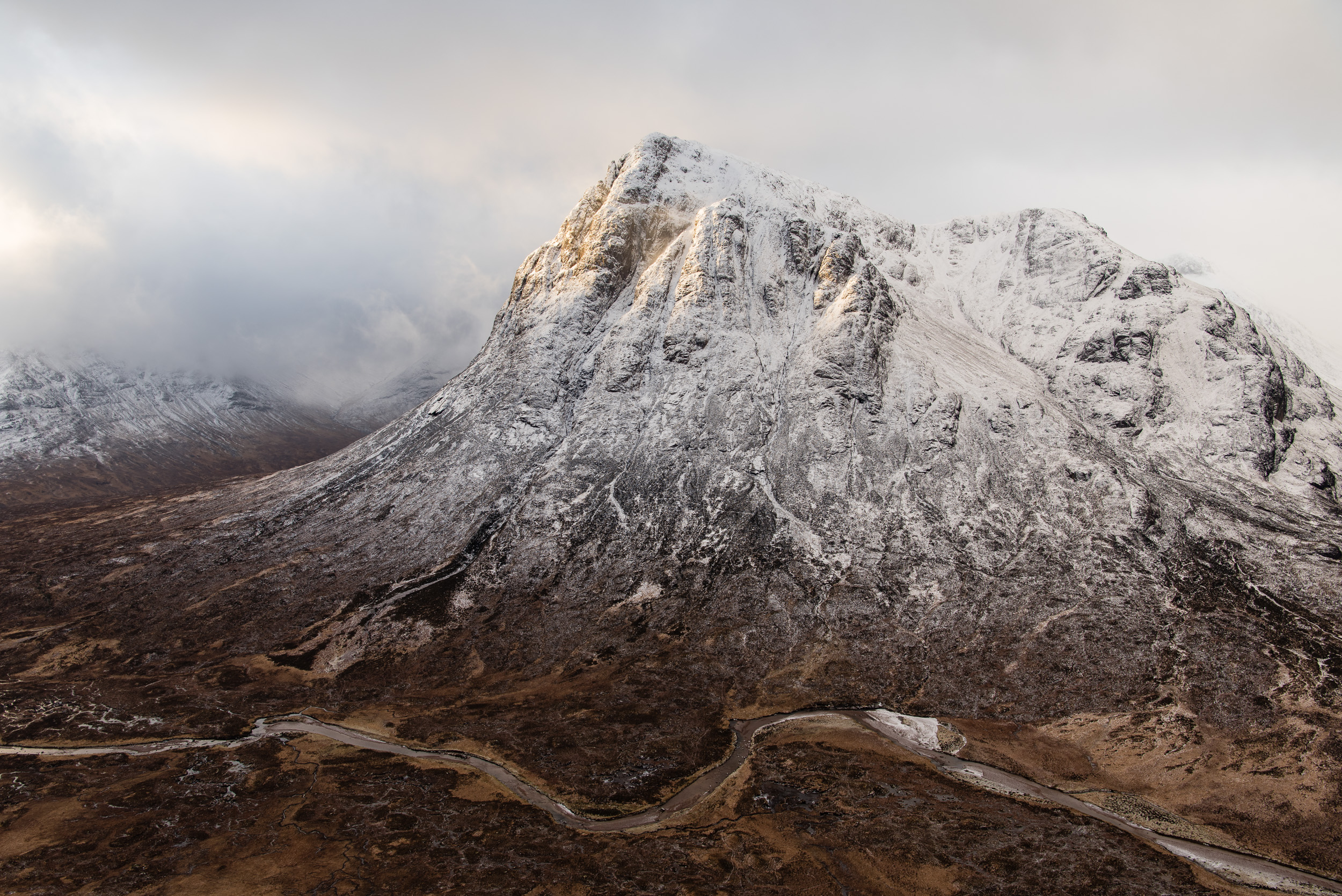
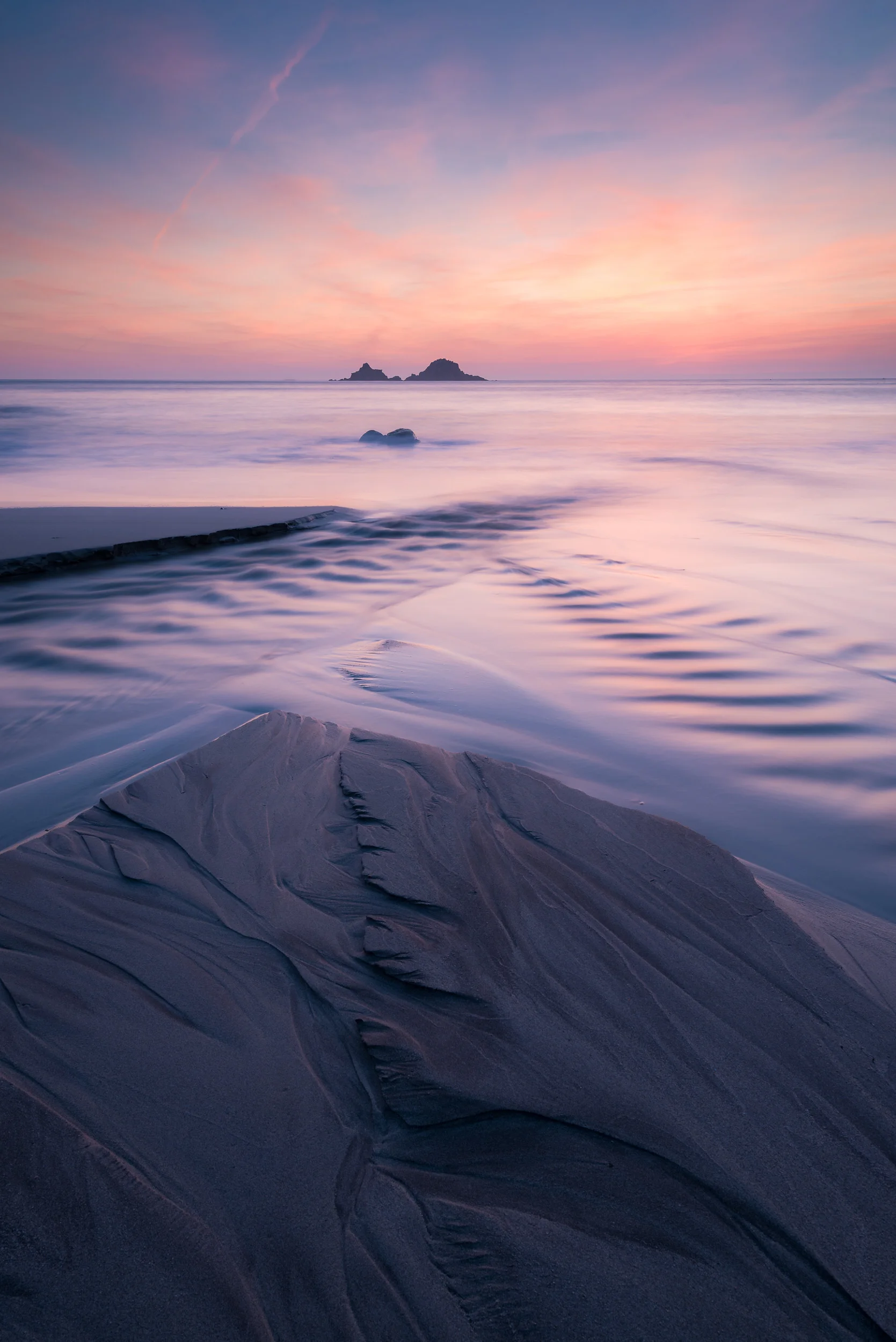
As with my image review from last year, this review has given me a lot of inspiration to take through into 2018. I went out over 50 times with the camera in 2017 and drove over 6000 miles, and it was great to see all that effort wasn't wasted!
So which one of my 5 images was your favourite? Have you gone through a similar process as well? Let me know in the comments below.

Same Spot, Different Photo
In this blog post I discuss why I was back photographing Trevose Head again and how despite putting my tripod legs in almost exactly the same spot as before I ended up with a unique image.
The Perfect Location?
I like shooting at Trevose Head on the north Cornish coast. I never seem to leave that location without having taken a decent photograph. Sometimes I even leave there with a great photograph. I also just enjoy being there. It's an amazing bit of coastline with its lighthouse, rocky cliffs and crashing waves. It can get very windy, and salt spray on your equipment can be a challenge, but just being there and watching the sunset over the coast is a pleasure.
If you want to see what I'm talking about then you should check out my 5 Minute Photo Adventure video from Trevose Head.
But what makes Trevose Head so special? Why do I keep putting my tripod legs in the same spot? I think one of the great appeals with Trevose Head is that it works in a variety of weather conditions. It doesn't seem to matter if the weather is good or bad, overcast, windy, or even what season it is. Don't get me wrong. It's not the perfect location. No location is. However, if you can vary your technique and adjust your style to the conditions then it's one of those locations where you stand a good chance of making a decent image.
Here are some of my previous images from Trevose Head.
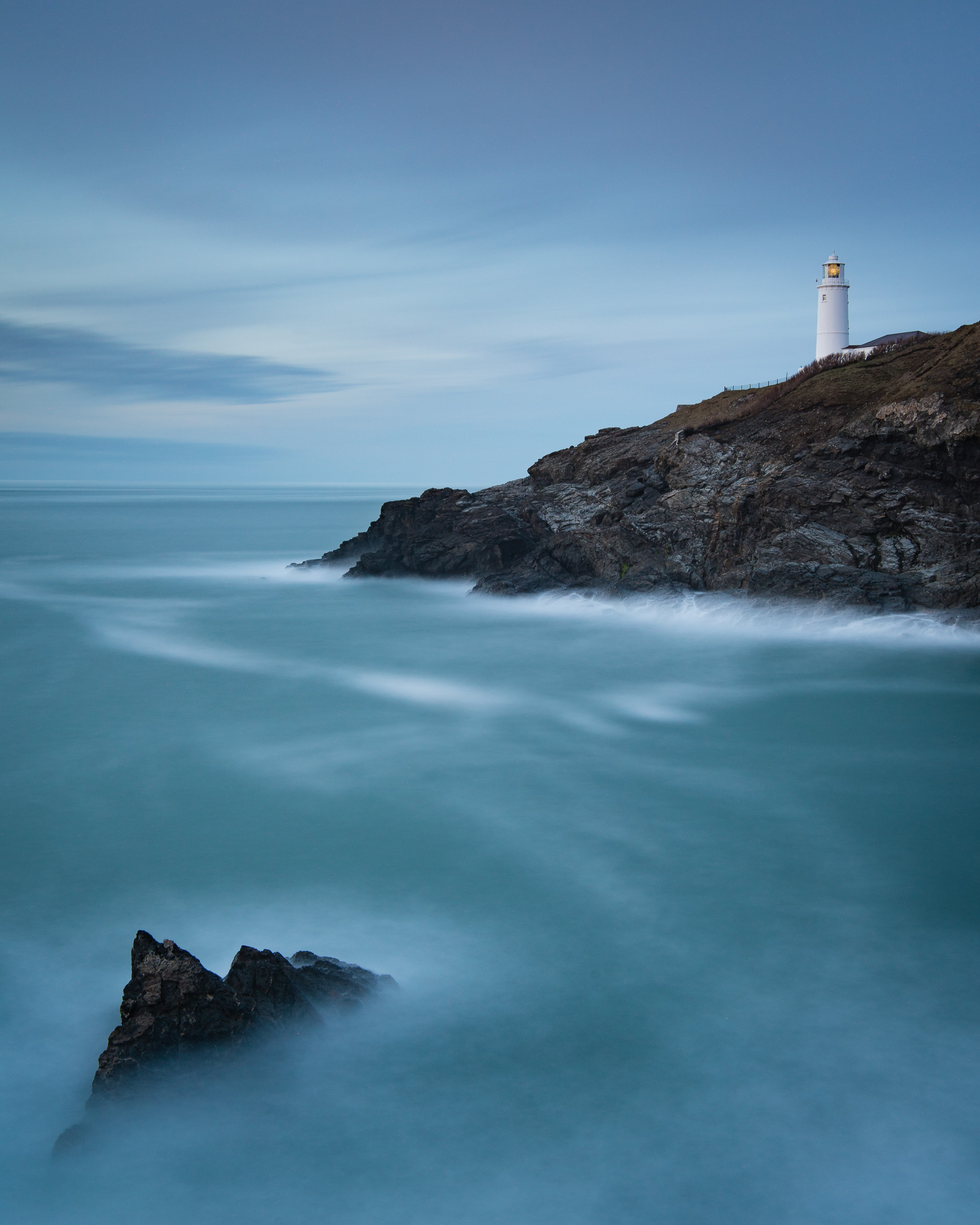
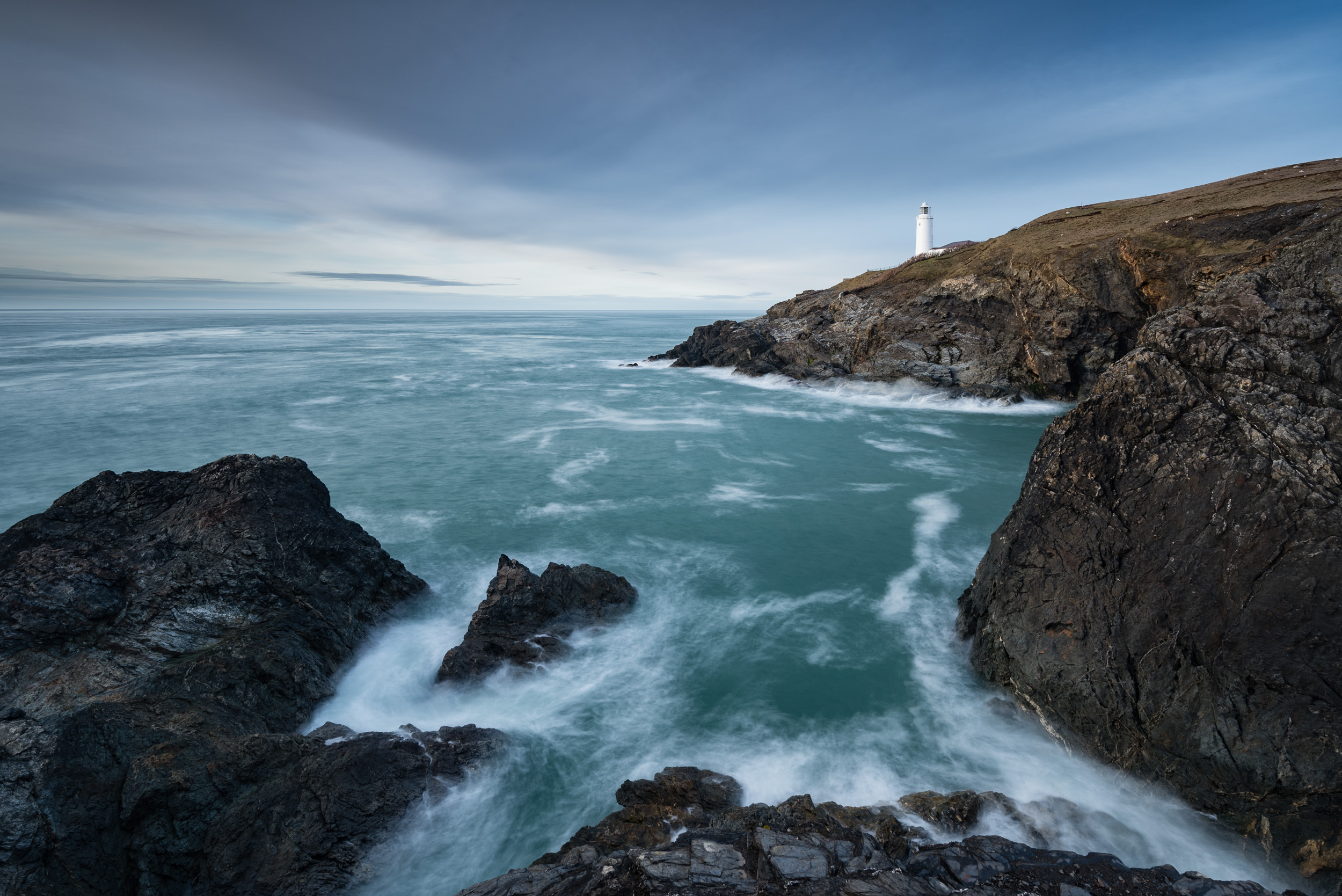
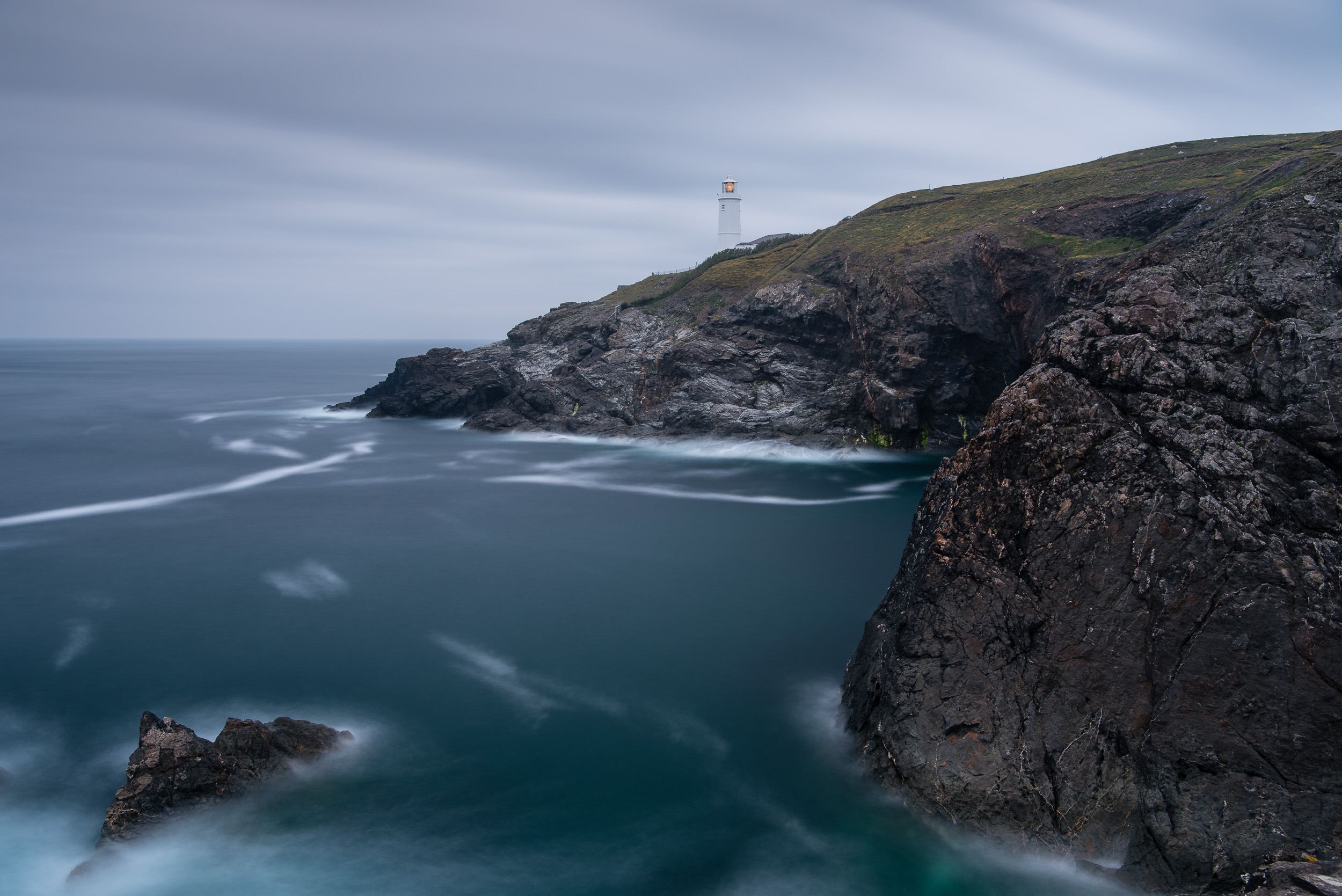
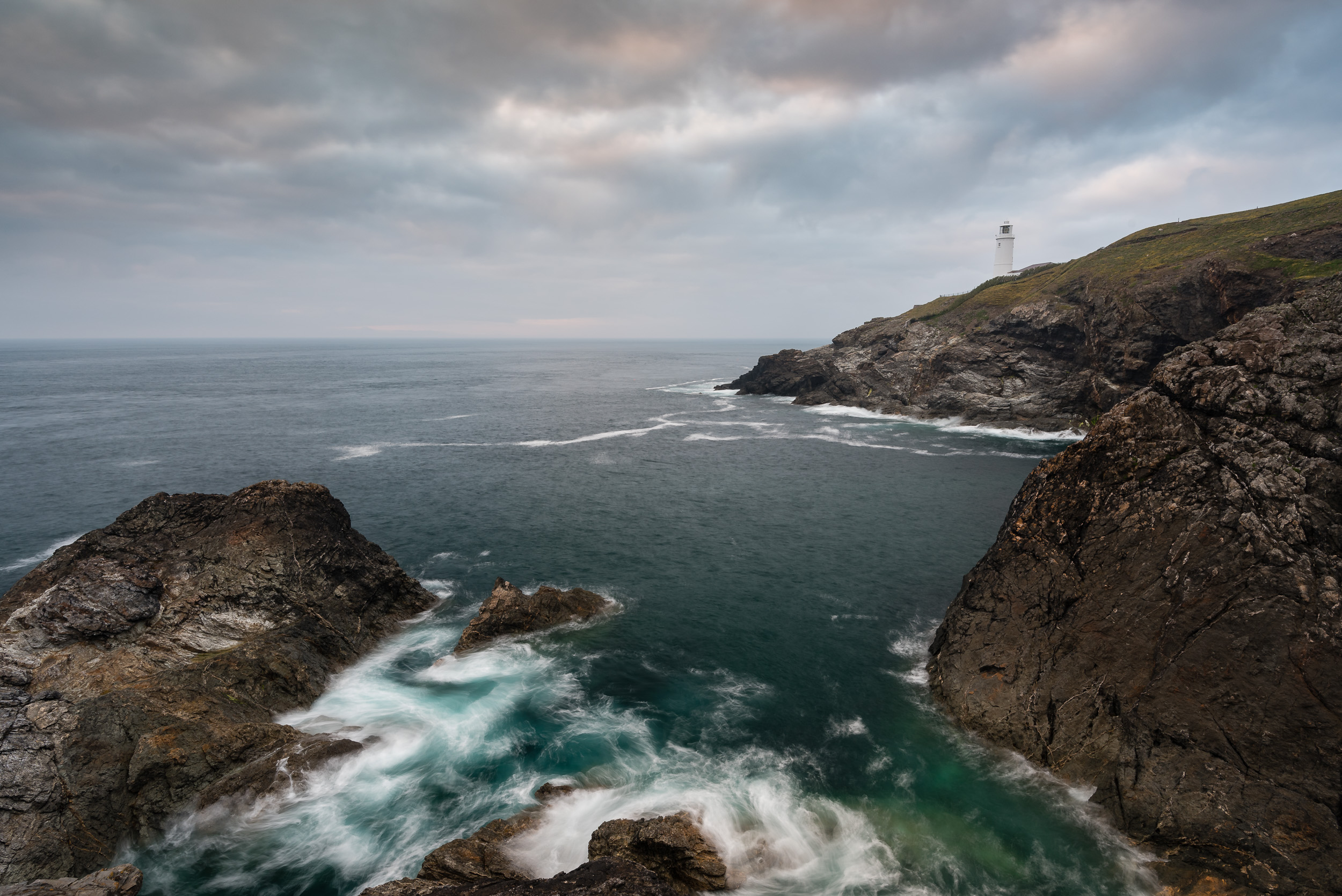
Whose Tripod Holes Are They?
I've just returned from another visit to Trevose Head and the image I captured there inspired me to write this blog post. Though I've previously captured some images that I'm really happy with from Trevose Head, I still thought I could capture something new. So when my friend asked me if I wanted to join him for an evening's shoot at Trevose Head there was only one answer.
It was going to be tough to get there before sunset though. The earliest I could leave home was 7 pm, and given that it is around a 90-minute drive that would only leave me about 40 minutes to jump out the car, make the short walk, setup, and capture something. But the weather forecast looked good and based on my previous experience from that location, I knew the journey would probably be worth it.
When I got there my friend had been shooting for a while and after a quick catch up, I got to work. For me, the best location to shoot Trevose Head is from Stincking Cove looking north east towards the lighthouse. Being a cliff top location there isn't a huge amount of room to move about, so my tripod legs were probably placed in the same spot as they usually are. However, even with my inability to move around a lot there is still plenty of variation to be had by shooting different focal lengths and exposure times.
What made my image different this night was the light. Photographers, including myself, do talk about the "light" an awful lot, but hopefully in this image you can see what a difference the light can make:
Nikon D750, Nikkor 16-35mm f/4 @ 22mm, 0.5 sec, ISO 100, f/16, Lee Filters circular polariser, ND grad.
I'm not saying this image is necessarily any better than some of my other images taken from the same spot, but it is a very different image from my darker, moodier images that I've taken there previously. The light was only there for a few minutes but I love the way it reflects off the sea, the cliffs and the lighthouse. It just shows you that every visit to a location can be unique and therefore produce a unique image.
To ND or Not To ND
I'm a big fan of the ND filter. I use them a lot and you can see how I use them in this video. That doesn't mean I will use them in all my images though. I try to use them creatively if I think the image will benefit from a slightly longer exposure. I do tend to go for longer exposures for my seascapes as I like the resulting smooth water or the patterns that are painted by the moving water. You'll maybe have noticed though that the image I've just shared above isn't a long exposure. At the time I felt that smoothing out the water wouldn't be the right thing to do for the image I wanted to create. I liked the choppy water and the way the light reflected off the tops of the waves.
I did take a long exposure and while I am of course very happy with it, I still very much prefer the shorter exposure.
Nikon D750, Nikkor 16-35mm f/4 @ 22mm, 30 secs, ISO 100, f/16, Lee Filters circular polariser, ND grad.
Ignore Those Who Say...
All this talk of returning to a location to take the "same" picture reminds me of a Twitter post that I saw recently. I can't remember what it said exactly but it seemed to involve a number of photographers talking about a photograph of a few sets of tripod legs all crammed into the same spot. The general gist of the conversation was that these photographers lacked any original thought and were just copying each other or those that were there before them.
Though I didn't reply to the Twitter post, I couldn't have disagreed more for two reasons. Firstly, who's to say that just because a photograph has been taken from a spot before that another photographer can't take a similar image. If you are just starting out in photography I would actively encourage you to visit locations that you've seen in other peoples images. I even don't see any problem with trying to replicate the composition. It's often a good way of learning. If you have been inspired by an image you have seen then why not try your hand at that location.
I bring this topic up now because even though I have visited Trevose Head a few times and taken photos from the same spot, I get different results each time. So I would encourage you to put your tripod legs where my legs were and take the same photo. Your image will be unique and hopefully special to you.
The other reason I disagree with that Twitter post is that if you put two photographers in the same location at the same time you'll likely end up with two different images. An example of this was when I met a very nice photographer called Johnny Baird during a trip up to Scotland to photograph Glencoe. We both stood in the middle of the River Coupall, photographing Buachaille Etive Mor at sunset and despite the close proximity of our tripod legs, we shot very different images. Just because we were in the same location at the same time, how we choose to interpret the scene, choice of equipment and setup all meant we ended up with different images.
Don't let anyone tell you that a location has been overshot or that you must find a unique location for your photograph to be worth anything. So next time you're in Dorset, go to some of its most iconic locations such a Durdle Door and join the dozen other photographers that will be there and get your very own image.
Do you have a location that always delivers results for you? Did you prefer the long or short exposure that I took? What are your thoughts on visiting well shot or iconic locations? Let me know in the comments below.

Trevose Head - 5 Minute Photo Adventure
In this blog post I take you on another 5 Minute Photo Adventure. This time I'm off to Trevose Head on the north Cornish coast. This amazing location has a lot to offer the landscape photographer. Read the blog and watch the video to see why.
As a landscape photographer I'm extremely lucky to live in the south west of the UK. Even if I didn't have Exmoor and Dartmoor, I would still have over 630 miles of the South West Coast Path to photograph. With so much to choose from I couldn't possibly pick a favourite location, but when it comes to Trevose Head, I'd have to say it's up there in my top 10 Cornish coastal locations to photograph.
So what makes Trevose Head so special? Well, for me it's the drama of the location. It's got the lighthouse perched on a cliff edge, the rocky inlet where the waves come crashing in and it makes for a great sunset location just about all year round. And did I mention you can drive within 200m of the best spot to shoot from?
On the downside it is very exposed and getting blasted by rain, wind and sea spray isn't to be unexpected, so sometimes it's nice to have the car nearby after you've been battered by the elements!
If this sounds like the kind of location you might want to photograph, why not check out my 5 Minute Photo Adventure video below:
Padstow Lifeboat Station
As I showed in the video, the lighthouse isn't the only spot to photograph at Trevose Head. Located not farm from the lighthouse is Padstow Lifeboat station. As you can see on the map below both locations are close together and so if you have time it's worth visiting.
This was my first time visiting the lifeboat station. I remembered it after looking at the area on my custom Google Map while I was wondering about. It's not that easy to photograph if you want to include the surrounding elements such as the stairs down to the entrance, but with the right lens and a bit of moving about, a good image can be made.
Nikon D750, Nikkor 16-35mm f/4 at 22mm, ISO 100, 30 seconds, f/13, Lee Filters circular polariser, Little Stopper and ND grad.
Trevose Head Lighthouse
Though the forecast for Trevose Head was to be for relatively clear skies, as you can see from my first image this wasn't exactly the case.
Nikon D750, Nikkor 16-35 f/4 at 19mm, ISO 100, 2 seconds, f/11, Lee Filters circular polariser, 3 stop ND and ND grad.
While I do like this image what I was really hoping for was for some golden light from the setting sun (off to the left) to illuminate the rock faces. This would have really lifted the tone of the image. However, sometimes you just have to work with the light you have so I decided to adopt a slightly different style.
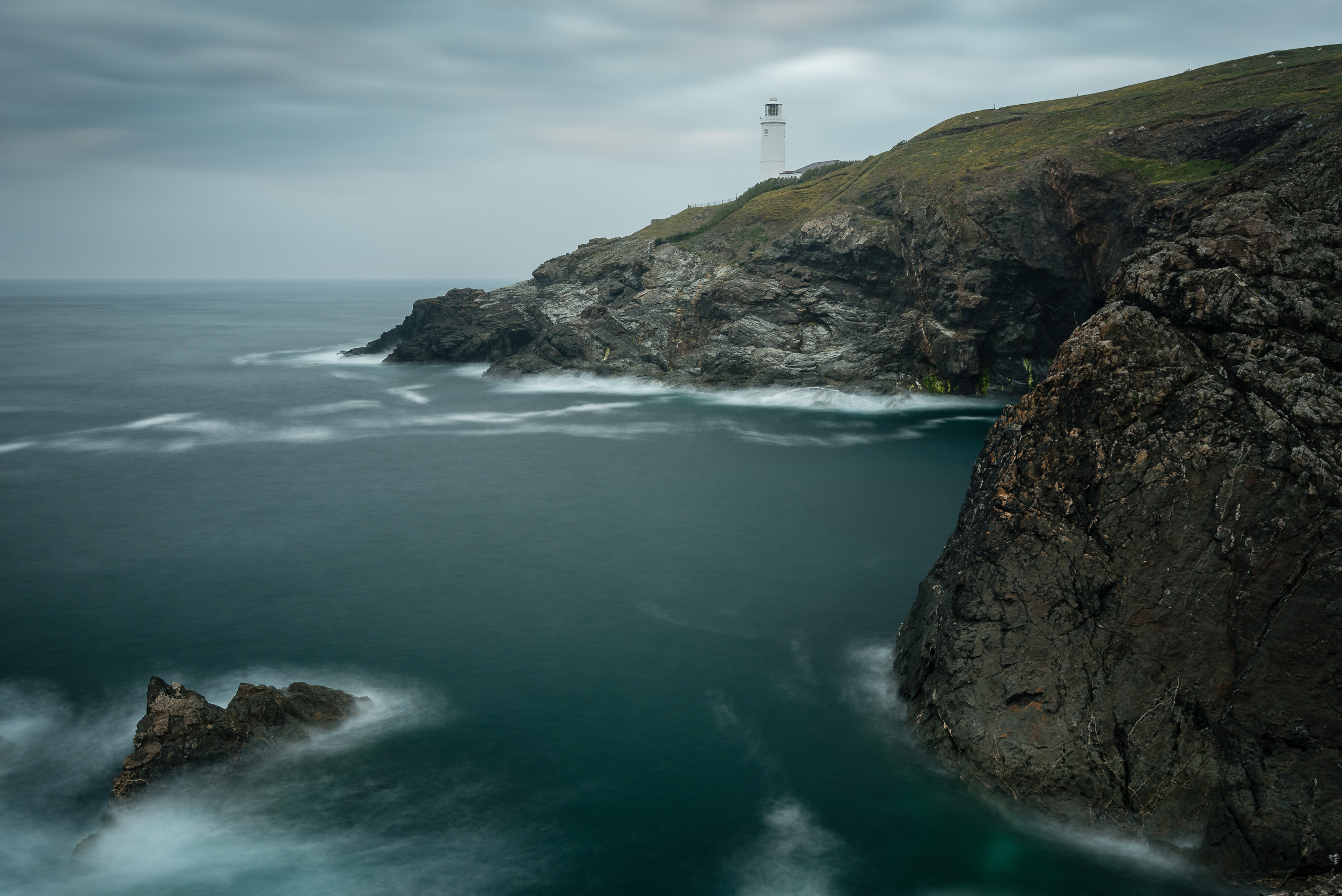
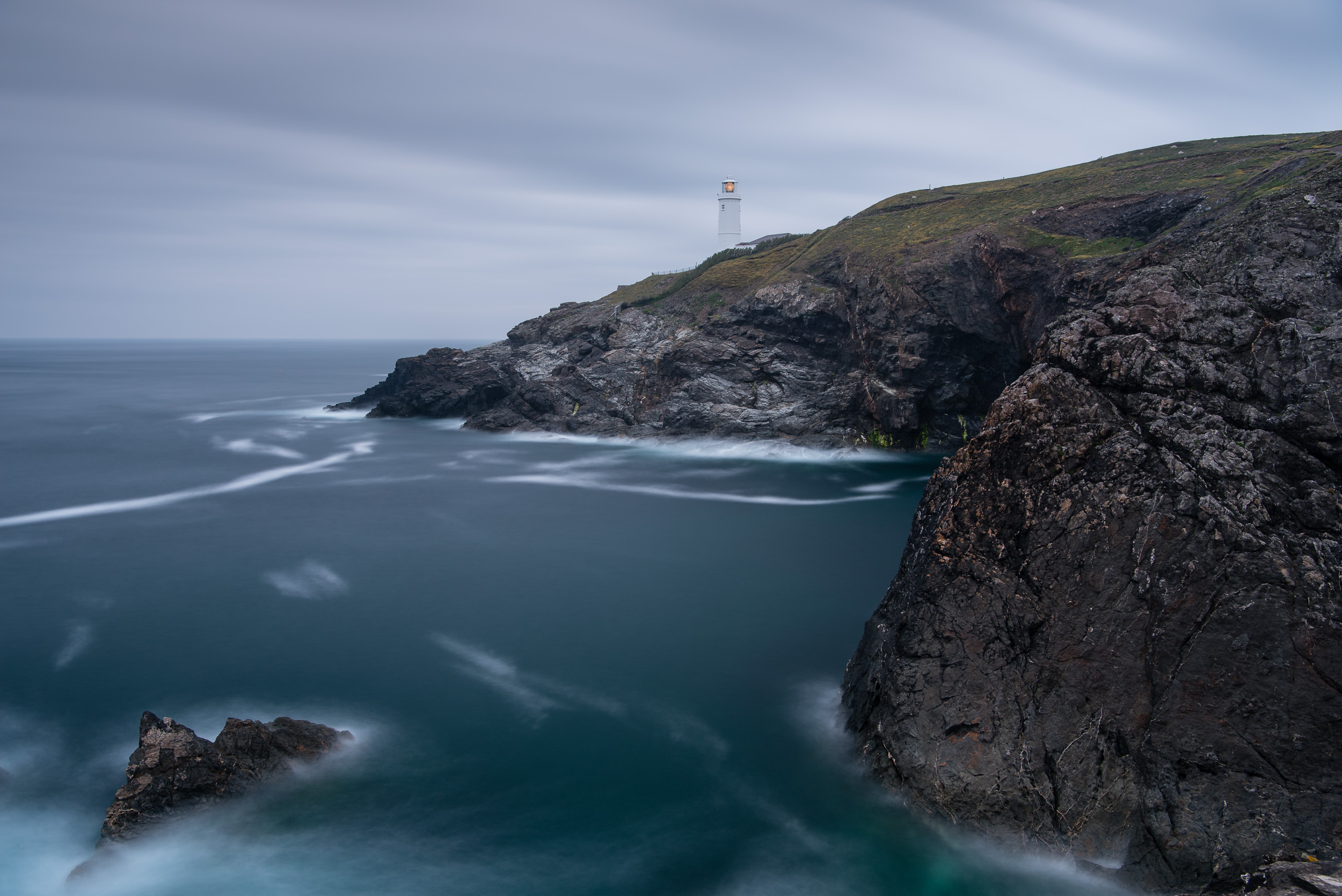
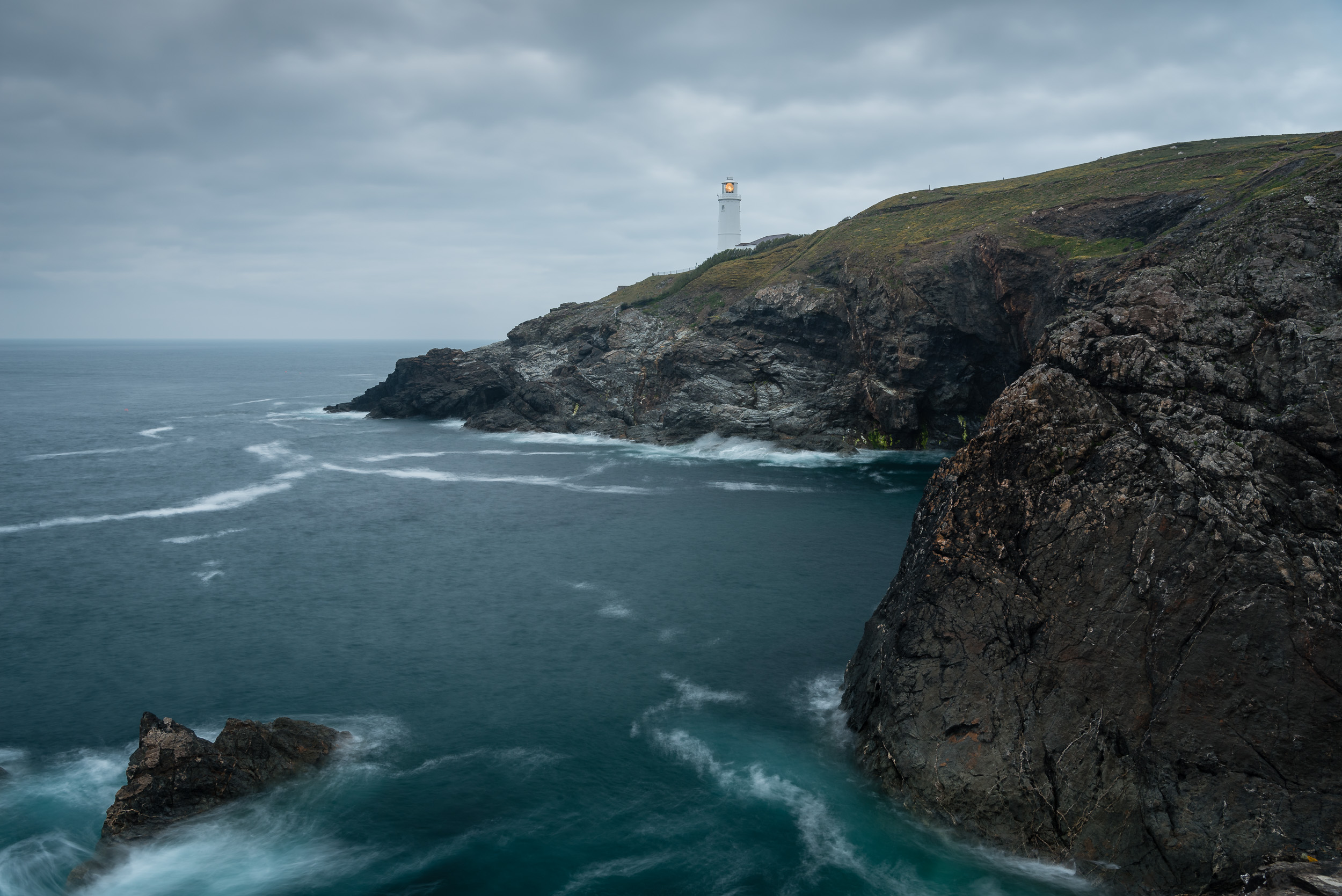
By embracing the grey and opting for longer exposures I was able to create a set of darker and moodier images. I also varied the exposure times by choosing different ND filters. The longer exposures allowed the crashing waves to paint white lines and create shapes on the image.
I'll be back...
Though I didn't manage to create the image I had planned for I still came away with some images that I'm very happy with. I also got a chance to to photograph Padstow Lifeboat station, so it was good to get two locations for the price of one! One thing is for sure, I'll be heading back to Trevose Head again in the near future.
So have you been inspired to visit Trevose Head? Have you photographed this location before? Let me know in the comments below.

My Favourite 5 Images from 2016
As tradition often dictates I'm going to look back and show you my 5 favourite images that I took in 2016.
It's Been a Busy Year
Aside from starting this blog, 2016 has been a very busy year for my landscape photography. I have been out with my camera more this year than any other. In 2015 I went out 34 times to shoot landscapes but in 2016 I went out 46 times. Given that I have to fit my landscape photography in between work and family life I'd say that's not a bad effort. Of course that doesn't include the 20 gigs and music festivals I also shot in 2016. Yes, it's been a busy year.
I've been suitably motivated and inspired this year to get out and practice with my camera. Though I haven't been successful in two of the major landscape photography completions this year, it's still be a successful year for me.
So in a somewhat predictable manner I am going to show you my 5 favourite images I took in 2016. Yes I want to share my images with you but the process of selecting the images makes me look back at my catalogue so I can hopefully see an improvement over the previous year.
The Cobb
I won't easily forget this image. It was taken on a very cold morning in Lyme Regis. I had just about given up and was heading in for coffee and bacon rolls when the sun, which had been up for a little while, started to reflect beautifully off the side of The Cobb. For a magic few moments the light was perfect and I shot several frames, this one being my favourite.
The Cobb - Nikon D750, Nikkor 16-35 f/4 at 22 mm, f/13, 0.6 seconds, ISO 100, Lee Filters ND Grad
Trevose Head
My first visit to Trevose Head happened back in March and it was one of those shoots where everything seems to go well. I was feeling creative and the conditions were perfect for the type of image I wanted to capture. I knew it had been a good day when I got home because I had so many keepers to pick from.
The image below though never originally made the cut and I only recently discovered it while looking for a competition entry. Despite the how much I loved the other three images from that shoot I think this is now my favourite and definately a favourite from 2016.
Trevose Head - Nikon D750, Nikkor 16-35 f/4 at 19 mm, f/11, 8 seconds, ISO 100, Lee Filters Little Stopper, ND Grad.
Venford Falls
As I mentioned in my video My 5 Favourite Landscape Photography Locations in Devon, Venford Falls is one of my favourite locations. Hidden, but not difficult to get to, the twin falls are a bit of a magical location. I had been to the falls a couple times before but it wasn't until I visited in spring of 2016 that I got a shot that I was really happy with.
Though I had tried this composition before it was the lush green spring colour that lifted the image to make it an instant favourite.
Venford Falls - Nikon D750, Nikkor 24-70 f/2.8 VR at 24 mm, f/16, 10 seconds, ISO 100, Lee Filters Polariser.
The Daymark Tower
Though I had tried to photograph the Daymark Tower a couple of times before, I was probably doing so at the wrong time of year. The tower is surrounded by a farmers field so for parts of the year it's just a muddy field. I wanted to go when the field was full of fresh crops.
My vision was clear. I wanted the setting sun to illuminate the tower and I really wanted the fresh crops to be gently swaying in the wind. It's not often you get everything you want but everything came together rather nicely the evening I took this image. The light was beaufitul, the sky was lovely, and there was just enough wind to put a little movement into the crops.
Daymark Tower - Nikon D750, Nikkor 16-35 f/4 at 16 mm, f/13, 1/15 second, ISO 100.
Castlerigg, The Lake District
As I previously wrote in my blog, my trip to The Lake District was challenging. The weather was very wet making creative photography difficult. However, through all that I took an image that not only captures the beautiful Lake District landscape but the dramatic weather that is often present. It reminds that despite how bad the conditions can be, patience can often be rewarded.
Autumn Storm at Castlerigg - Nikon D750, Nikkor 70-200 f/2.8 VR at 78 mm, f/9, 1/60 seconds, ISO 100, Lee Filters Polariser and ND Grad.
So what do you think of my 5 images from 2016? Do you have a favourite? Have you selected your top 5 or top images from 2016? Let me know in the comments.

Finding a Gem in My Back Catalogue
In this blog post I talk about the value of looking back at your catalogue of images and how you might just find a little gem in there.
Super Dad 1, Photography 0
As I mentioned in last weeks blog post the winter months are playing havoc with my ability to get out and take pictures. However, last weekend it wasn't the weather or the short days that stopped me getting out with the camera. My wife was away for a well deserved break so I was left holding the fort with the kids. So unless you count some family snapshots as photography it was a shutter free weekend.
Competition Time
Not one to let the lack of camera action stop me from scratching my photography itch I decided I would get together my entries for this year's South West Coast Path photography competition. This is my first year entering this competition and it looks like a good place to hopefully show case one of my images. It's also good to see that they have respected landscape photographer Adam Burton on the judging panel.
The Power of the Catalogue
Fortunately a lot of my photography takes place along the South West Coast Path so I had a good range of images to work from. It was also really easy to find them. I'm a Lightroom user and I like to keyword my images. I don't keyword all my images on import, but any image that I complete editing on gets a full set of keywords. So when it came to finding all my 4 and 5 star images taken on the South West Coast Path it was a matter of just creating a dynamic collection and there they all were.

Creating a dynamic collection allowed me to find all my images from the South West Coast Path.
Finding A Gem
Winning images from the competition will be published in the South West Coast Path 2018 calendar and while the rules didn't preclude the inclusion of vertical orientation images I thought I'd stick with horizontal orientation. The slight problem was that I had a series of images from Trevose Head that I had taken earlier in the year and while I was very happy with them, they were all of vertical orientation.

I had a couple of options. I could either submit a vertical orientation image or bypass my Trevose Head images all together. I knew I would have taken images in both orientations so I right clicked the one the Trevose Head images and selected the collection it was in. (I add each photo shoot to it's own collection so it was easy to find).
Almost immediately I found what I was looking for. Best of all though the image had been mostly processed to completion. It only needed a bit of dodging and burning in the sky and it was ready to go. At the time I must have done a basic edit on it and then ditched it in favour of the vertical version. With a few clicks I had a new image and the competition entry I was looking for.
This is the image I found in my catalogue and have now entered into the competition.
Check Your Catalogue
Finding this image has made me think about what other images I might have lurking in the depths of my Lightroom catalogue. How many other images were culled during the editing phase in favour of a different composition?
What about you? Do you have a back catalogue of images with some hidden gems? Do you process your images straight away or leave them for a bit and come back to them at a later date? If you cull an image is it culled forever? Let me know in the comments.

Magazine Submissions - Seeing Your Images in Print
Is this blog post I chat about seeing one of my images printed in Outdoor Photography magazine and how this inspires and motivates me to work harder at my photography.
Outdoor Photography Magazine
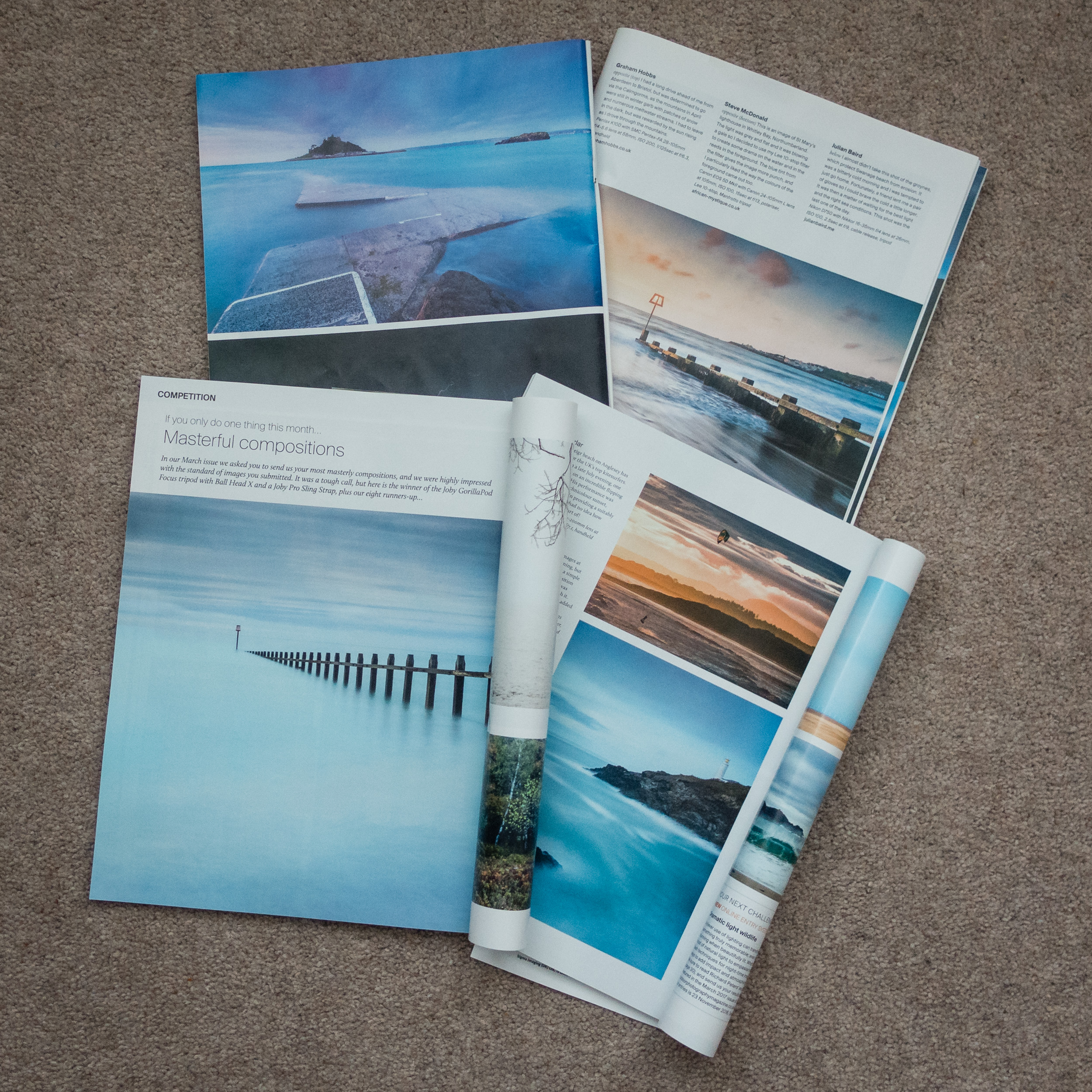
In Outdoor Photography magazine this month (Issue 211, November 2016), on page 110, you will find one of my images :
Without any shame or modesty, this makes me very happy. I'm happy for two reasons. Firstly, Outdoor Photography magazine is my favourite photography magazine. I've been a reader for many years and the quality of the content and the magazine itself is brilliant. Every month I look forward to my issue arriving so I can sit down with a nicecup of coffee and get inspired!
The other reason for my happiness is that it's one of my favourite images of 2016 and it is wonderful to see it in print. I'm ashamed to say that I don't print my work. For some the photographic process isn't complete until you have printed your work. The more I think about it, and the more times I actually see my work in print, the more I'm convinced that this is the truth. I'm going to start printing at home soon, but that story is a tale for another blog post.
Back to magazine though. Seeing one of your favourite images in a well printed magazine like Outdoor Photography is very satisfying. For those that already print their work it's a very tactile experience holding your image in your hand rather than pixel peeping on your monitor.
Inspiration and Motivation
The image above is in the magazines "If you only do one thing this month…" feature. Each month the magazine sets a new challenge and readers submit their best images that meet that brief. I find these monthly themes a great source of motivation and inspiration. So much so that I do try and regularly submit images. Though there is a prize for the monthly winner, I don't enter to win a prize, I enter for the satisfaction of being featured in print. It's much the same motivation that drives me to enter other photographic competitions.
Though I didn't win the competition this month, I did win "Masterful Compositions" in issue 206 (July 2016, page 106) with this image:
I was also featured in issue 194 (August 2015, page 109) with this "Natural Light" image from Swanage:
In issue 192 (June 2015, Page 110) I also had my first image printed in the magazine with this "Low Light Landscapes" image of St Michaels Mount:
St Michael's Mount - Nikon D750, Nikon 16-35mm f/4, 19mm, 30 seconds at f/13, ISO 100
Why Submit?
Now, for some of you this post might all seem very self-congratulatory. And to a certain extent it is. I'm very proud to have a 4th image in Outdoor Photography magazine. What is more to the point though is how seeing that very first image in the magazine has driven me even more to improve my photography. Submitting your images to a competition, even a monthly magazine competition, sets you up with the risk of failure. But I need to take that risk, and no matter the outcome I will use my success and failure to continually drive my desire to improve.
So should you submit your images to magazines? Well that would be up to you. What works or drives me will likely be different for you. All I can say is that seeing my first image in a magazine gave me confidence that I was going in the right direction and made me want to work even harder at the art of photography.
Have you ever had an image published in a magazine or a book? Did it bring you any further success? Do you print your own work? Let me know in the comments.