
Perseverance - Photographing Bowerman's Nose
In this blog post I discuss the power of perseverance and why I keep going back to Bowerman's Nose on Dartmoor.
A Slight Obsession
I can't exactly remember how I found out about Bowerman's Nose. It might have been in a magazine, or a book, or even on Flickr. How I found out about this location is largely irrelevant though. My desire, or maybe obsession, in capturing an image of Bowerman's Nose that meets my artistic vision is more to the point though.
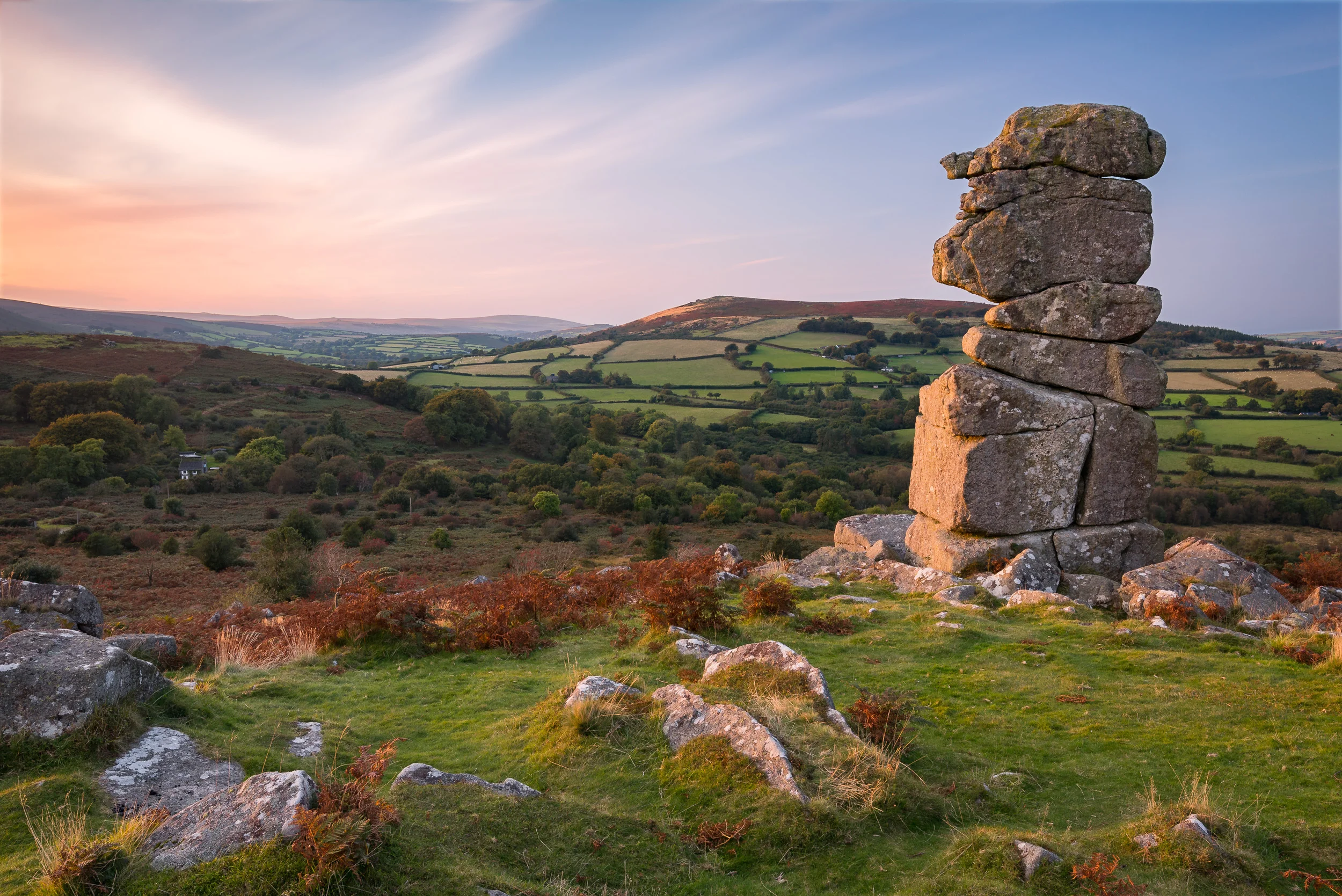
For those of you who haven't heard of Bowerman's Nose, it's a tall pillar of granite on Dartmoor. It's very distinctive and is surrounded by rolling hills. Given the right light and conditions it can make for a beautiful photograph. The problem for me is that I've never really managed to capture an image that does the location justice. Some of my early failings were due to poor technique, but latterly it's more to with poor conditions.
Part of the reason I'm probably so obsessed by this particular location is its close proximity to home. It's less than a 45 min drive and it's reasonably easy to get to (as long as you don't mind opening a gate and getting creative with your parking). This means that it is often my go to location on Dartmoor when the conditions are looking favourable.
Meeting Mr Bowerman
I probably made my first serious attempt at photographing Bowerman's Nose in early 2015. It was January so Dartmoor wasn't at its best, and it was a very grey and flat day. However, I do like to practice my photography so just been able to walk around and look at different compositions was valuable.


I returned in May of 2015 in the hope of better conditions. On this trip the ground was looking spring fresh, and I was getting some nice light reflecting of the edge of Bowerman's Nose from the setting sun. Unfortunately the sky was a bit bland and I wasn't getting the golden light I was looking for. Close, but not quite there. However, this trip did show me the real potential of the location.
A week later I was back again and trying a similar composition. Again, while the image was pleasing, I just felt it lacked something. While I was there I also tried my first panorama - I think Lightroom has just been given the native capability to stitch panorama's so I thought I'd give it a go.
Bowerman's Nose - May 2015
Perseverance
By the time 2016 had rolled around I had committed to myself that I was going to get an image worthy of the splendid Bowerman's Nose. I think it's part of my nature. Once I decide that I need to do something, I'll work at it until I get it done. I was determined that in 2016 all my perseverance would pay off. Obviously with some elements of of my control this would not be easy.


In May 2016 I captured this image of Bowerman's Nose. It had interesting sky (helped by the long exposure), but it lacked the light I was looking for.
Then in June 2016 I tried again, and I have to say I thought I was going get the image that night, but again, there was just something missing that evening. The image I was looking for escaped me again, but I would try, try, try again!
Gotcha!
Then, just the other evening, with only a little time between the end of work and sunset, I did a quick check of forecast and decided that I would attempt Bowerman's Nose again. When I got there the conditions looked good so I literally bounded up the hill and got my tripod setup. Would I finally be lucky?
Bowerman's Nose - October 2016
As you can see, yes I did. Well, it is at least my best image from that location. No it's not perfect and there is always room for improvement, but it is my best and favourite image from there. I finally feel that my perseverance had paid off.
Goodbye Mr Bowerman?
So am I done with Bowerman's Nose? Now that I have the image I wanted will I ever go back? Of course I will! There is always room for improvement. There are many different compositions to be had, different lighting conditions, even snow! It's an amazing location, and being so close to home it's always going to be on my radar to go back to.
So do you have a favourite location that you like going to? Is there a location you keep visiting in the hope that you'll get something special there one day? Do you preserve or just move on? Let me know in the comments.
Not All Shoots Are Successful Shoots
In this blog I discuss the challenges of shooting on a beach and I give my own image a critique.
The Best Laid Plans
As a photographer you always want to put your best images out there. If you practice enough your technique will improve and your style develop, hopefully resulting in a gradual but noticeable improvement to your images. While this is generally true, it doesn't necessarily mean that every trip out with the camera will result in an image that was better than the last one. When I started this blog one of my key goals was to discuss my success and my failures. As I said in my first blog post, landscape photography isn't all about 5 star images captured on epic international trips.
In this blog post I'm going to take you through one of my less successful trips out with the camera. I had it all planned out. I would finish work bang on time, drive to West Bay in Dorset, and photograph the sea and evening light as it gloriously reflected off sea and cliffs. Well, that was my vision anyway. I went through all my normal planning steps, weather, cloud, tide, bearing of sunset and it all looked good.
Challenging Conditions
I've visited West Bay a couple of times, but never to photograph it. The east beach there, recently made more famous by the TV series Broadchurch, is long and sandy with dramatic cliffs running as far as the eye can see. However, when I arrived the reality of actually shooting there became apparent.
Firstly was the tide. After checking the tide tables I knew it was coming in, but what you can't tell from the tables is how long of a reach those waves have. The waves weren't tall, but their reach up the beach was long. Now I don't mind getting my feet wet, but it becomes really difficult to frame your shot if your camera sinks a little with each wave. If I moved further away from the waves I lost a lot of the sea in the frame. Normally this would be less of an issue if the beach has a natural curve.
The other challenge was the weather. While it wasn't raining nor the wind as strong as I expected it to be, the light was very flat. The forecast had indicated lots of high cloud and no low cloud. This I hoped would give me a spectacular evening sky to add to my composition. However, there was a lot of low cloud and the chances of there being any evening light bouncing off the cliff seemed very unlikely.
Change of Plan
Spare time to do photography is at a premium for me. While I like to do some location scouting when I can, it's not always possible, and so sometimes I just have to wing it. So with the very real sense that I might have just wasted a 2 hour round trip in the car, I put my thinking hat on and tried to think of a different composition. This approach of looking around and not getting focused on one thing had worked well on a recent trip to Dartmoor, so I picked up my tripod and got walking.
It wasn't long before I had the idea of doing a long exposure of the beach, looking straight out to see, and including a few well-placed rocks or stones in the foreground. This composition would probably deliver better results. I would have better visibility of the waves and the quality of the light was less of a dependency.
An Ever Changing Beach
Though I had a new vision on what my photograph would be my challenges weren't over. I would find an interesting composition, setup, grab a frame, maybe two at the most, and then a wave would come in wash my composition away! Even some of the larger stones in my composition weren't big enough to resist the pull of the waves. So this left me with very little time to grab a frame for each composition I found along the beach. I had to make sure the camera was level, focused, and correctly exposed in very short time or I might not get another go at it.
After only a few compositions the light had faded and I decided to take my very sandy tripod and wet feet back home for a nice meal and glass of wine.
Critiquing My Own Image
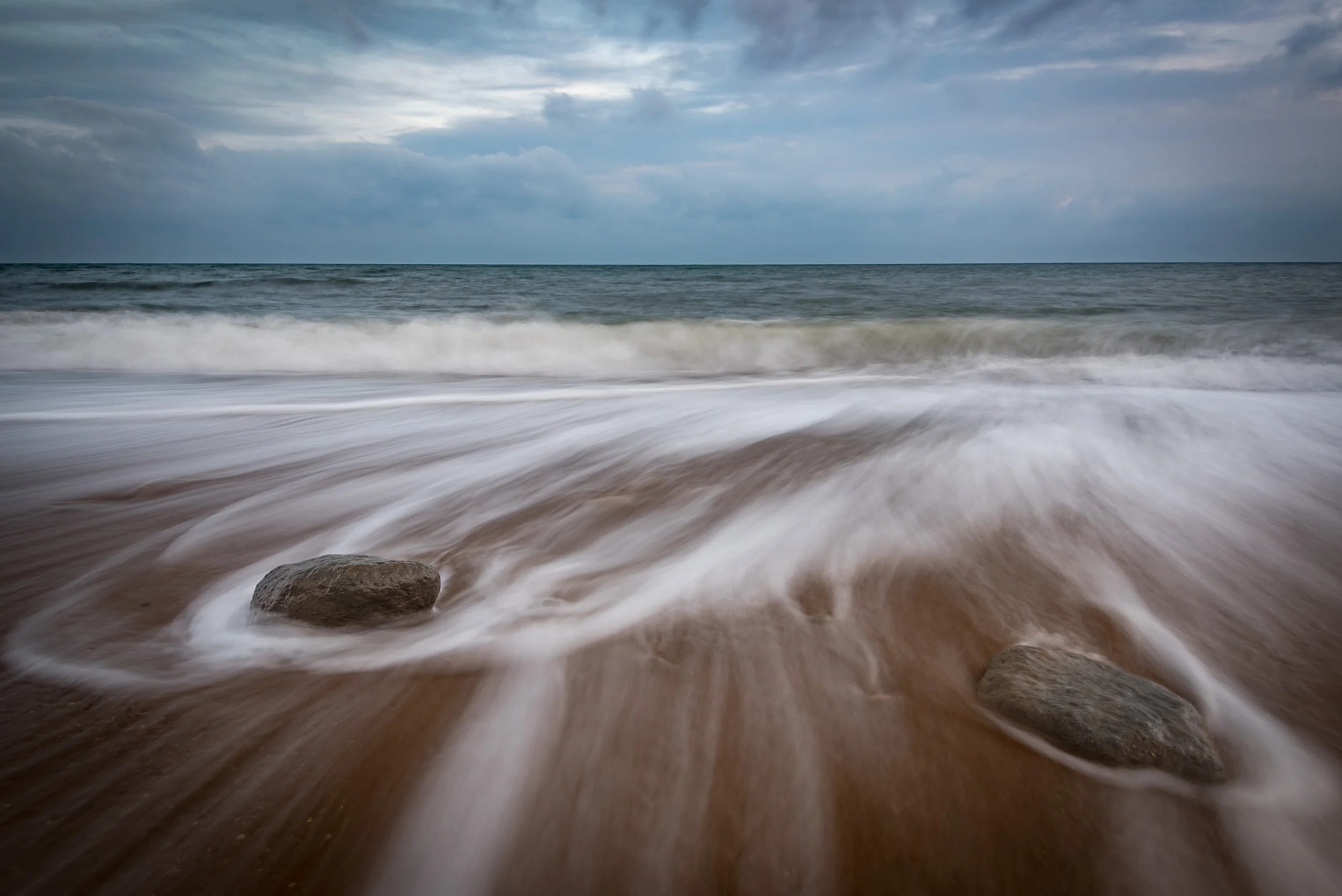
I only took a handful of frames that evening but here is the image that I think turned out the best.
Nikon D750 with Nikon 16-35mm f/4, 1.3 secs, f11 at 20mm, Lee Filters Polariser and 3 Stop ND
Now I'll be the first to admit this isn't an image for my portfolio. Though I like the mood and style of the image it does have a number of issues. If I'd had more time at the location I might have worked out these issues but as I said at the start of the blog, not all shoots are successful shoots.
The main issues I have with the image are around the rocks I have used in the foreground. The rock in the lower right of the frame for me is just a little too close to the edge of frame. I would like to have had just a little bit more space as there is with the rock on the left.. Given a bit more time between waves, I might have setup my tripod in a slightly different location to give me that space.
While the image roughly follows the rule of thirds, it doesn't follow the rule of odds. Now, I know that these rules are more like guidelines, but quite often they do make sense and I do think following the rule of odds in this scene would have helped with the overall composition.
Rocks at Porth Nanven - Nikon D750, Nikon 16-34 f/4 at f/16, 1.6 secs at 20mm.
I learnt about the rule of odds in the book, The Art of Landscape Photography by Mark Bauer and Ross Hoddinott (it's a fantastic book and well worth picking up). In the book Ross and Mark discuss how having an odd number of objects helps create visual stability or symmetry.
In this image I took of Porth Naven a couple of years ago you can see how I've composed with three rocks in the foreground. The balance and implied triangle in this image is something I would have liked to have seen in my West Bay image.
Always Good to Be Out With The Camera
Despite the fact that my shoes are still drying off and I had to strip down my tripod to get rid of the sand, I still felt it was time well spent with the camera. I'm also not going to win any awards for the image, but that really isn't the point. I was outdoors with my camera on a beautiful beach taking images and for a person that spends most his time sitting at a desk it's just nice be outside. Yes, conditions were challenging but it's through these challenges that you learn to progress as a photographer.
Actually I'm going to change my mind, it was a successful shoot. Just successful in a different way.
So what do you think of the image? How would you have shot the scene? Have you got any tips for photographing beach scenes? Please let me know in the comments.
Planning a Landscape Shoot at Dawlish Warren
In this video blog post I show you some of the planning tools I use to help increase the chances of a succesfull trip out with the camera. After that I take you on a trip to shoot seascapes at Dawlish Warren to see if all the planning was worth it!
Plan, Plan, Plan
I like a plan. Plans are good. Plans don't always go to plan, but I like having one none the less. As a private pilot I definitely like to have a plan when I head out to the skies. And though photography is arguably less risky than flying I still want my trips out with the camera to be worthwhile and successful. After all, there is no point in heading out for sunrise only to arrive at your location as the sun comes up. This has happened to me before and trust me, after the hour and half it took me to get there it was a painful lesson.
So to prevent missed sunrises, badly timed tides, and gale force winds, I like to plan my shoots so I can maximise my chances of success. In this video I will use:
These are the tools I use the most and I've found them to be very effective and accurate in the past. So let's see them in action along with my shoot down at Dawlish Warren beach:
Success
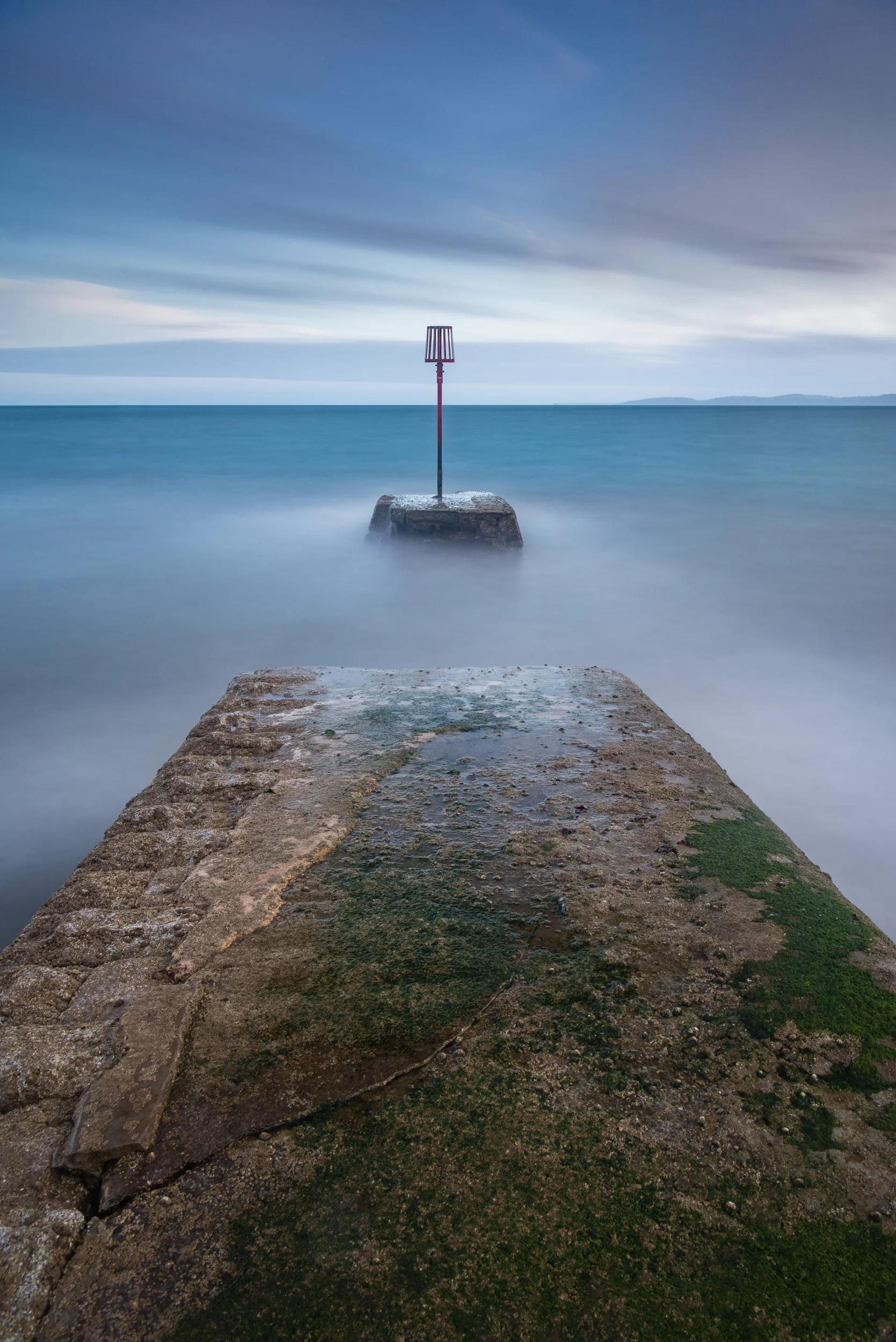
As you can see from the video, I had a successful trip and I've come away with an image I was very happy with. By checking out what the conditions were going to be like before I headed out I could be reasonably confident that my image would meet my vision for that location.
Not as calm as it looks. Nikon D750, Nikon 24-70 f/2.8 VR, 195 secs at f/11, Lee Filters ND Grad, Polariser, and Big Stopper. Processed in Lightroom CC.
Audio Quality
As I mentioned in the video, though the photography went well I had a few problems with the video. When I had the camera facing into the wind I lost all the audio of my voice over the wind noise so I had to ditch a lot of the clips. Being a landscape photographer this won't be the last time I will have to deal with this issue so I have purchased a Rode smartLav+ external mic (and some added furs for extra noise reduction). Though I will have to sync up the audio in post using Premiere Pro CC (my Sony RX100 M4 doesn't have a mic input), the improvement in audio quality will be worth it. So expect to hear my dulcet tones much improved in the next video!
Do you plan?
So do you plan your trips out with the camera? Or do you chuck the camera in the car and go for it? Let me know in the comments. And if you have a couple of minutes please like and share this blog post. Till next time....

Remember to Look Around
It's all to easy to concentrate on the scene in front of you, but as I discovered there can be a lot going on just behind you.
Photographing An Old Friend
I don't know about you but I have a few places on my location map that are easy to get to and provide a variety of angles to shoot from. So when the weather forecast for last Tuesday was a bit 50/50 for a good sunset I thought I'd go somewhere I know so that if it fails to be spectacular I won't have spent a significant amount of effort getting there.
How I saw the scene last year.
Heading down to my target location of Emsworthy Rocks just down from Haytor I was still confident that I was going to get a good shot. I decided to shoot the rocks and tree from a position that I hadn't used before. My plan was to have my back to the setting sun so that the tree and rocks would be bathed in golden light. There wasn't going to be much going on in the sky so I positioned the main elements higher up in the frame leaving some of the ground rock formations in the foreground.
Playing the Waiting Game
I went through all my normal checks for exposure and sharpness and then waited with the remote release for that magic moment where the colour would bath my subject in glorious golden light.
This is the scene I came to shoot but the light and sky just weren't what I wanted.
Well some time passed and I had shot a few frames but the scene just lacked a bit of punch. In my focus on the scene in front of me I'd failed to look to see what else was going on. It's all too easy to go out with a singular focus on what you want to achieve but this can sometimes mean you'll miss something a bit more special. I was convinced that my target scene would come good. However I casually turned 90 degrees to my right and was presented with a much more interesting scene. The light on the rocks was much more pleasing and the sky had a bit more interest about it.
Change of Plans
On the same spot as the last image but 90 degrees to the right.
I pondered if I should go to the hassle of changing my composition and moving my tripod (which had taken bit of setup to balance on the rock I was perched on). I knew I would regret it if I didn't at least try so I repositioned the tripod, got a Lee Filters ND 0.9 medium grad out and shot a few frames of this new scene.
I did go back to shooting a few frames of my original composition but I already knew that I'd grabbed the best shot I was going to get that night. So what did I learn from this particular adventure? Don't get too focused on one scene or shooting a particular direction. The landscape, particularly the wilds of Dartmoor, are wide open spaces and the light can look very different simply by looking a different direction from the same point. I was committed to getting the image in my head but I almost missed a much better one.
Have you had a similar experience? Have you looked round to find a much better shot or do you remain focused on what is in front of you? Let me know in the comments.

The Pain and Joy of Photography Competitions
Do you enter photography competitions? Do they bring pain or joy? Let's discuss!
Measuring Success
There are many ways to try and measure the success of your photography. You can post your images on social media sites such as Flickr, Instagram or even Facebook and see how likes you get. If you are a full time photographer you can measure your success by how well your business is doing.
I measure the progression of my photography skills in two ways. Firstly I have my images regularly critiqued by a professional photographer (see my post on Tuition and Mentoring). This provides invaluable and detailed feedback on my images that I can use to further develop my skills. The other way I measure progression is through my success (or failure) in photography competitions. For me having my work recognised in competition provides some sort of validation for my photography. Some people may consider this shallow or vain, but for me photography competitions have often been a great source of inspiration and being placed in one of the more prestigious competitions would be a great source of pride and joy.
Entering Competitions
One of my entries in LPOTY 2015.
It's only recently that I've actually started entering images into competitions. Though I've always I wanted to enter I probably lacked some of the commitment to achieve this in the past (see my bog post on Practising the Craft of Photography). Over the last couple of years I've put a significant amount of effort into being placed in Landscape Photographer of the Year (LPOTY). I fully appreciate that going from entering no competitions at all to being successful in LPOTY is a bit of a jump but for me LPOTY is the pinnacle in landscape photography competitions. So I'm aiming high that's for sure but seeing an image printed the LPOTY book would be for me at least, a dream come true.
The good thing about having such a lofty goal is that it has driven me to get out more with my camera and improve my photography. In 2015 I entered a number of images into LPOTY but failed to have any shortlisted. At the time I was gutted not to have progressed anywhere. I had put a significant amount of effort and passion into those images, and the rejection was painful.
Rejection and Motivation
This image was shortlisted in OPOTY 2016 but it unfortunately didn't make it any further. It was however published in Outdoor Photography magazine (issue 206).
However, I use that pain as a way to motivate myself even more! I decided to submit some of my images in the Outdoor Photographer of Year competition (OPOTY) in 2015. One of my images was shortlisted for the competition but that was as far as it went. The image did go onto win the monthly competition in Outdoor Photography magazine which was a huge confidence booster. I love Outdoor Photography magazine so seeing my image in print there was really pleasing.
So for the 12 months following the end of LPOTY 2015 I worked hard at my photography. I was out shooting more than ever and I undertook more 1-2-1 tuition days with my mentor (see blog post on Tuition and Mentoring). By the time LPOTY 2016 had come around I had already had a few images in Outdoor Photography magazine published and I had won a local photography competition.
One of my entries in LPOTY 2016.
When I entered my images for LPOTY 2016 I was more confident and was excited about the possibility of being shortlisted. The excitement was unfortunately short-lived as I soon got that email that had caused me so much pain last year. But I'm not letting it get me down. After all, who knows what the judges are really looking for? It's not to say that I necessarily had a bad image it might be that it didn't appeal to that particular judge at that particular time. Art competitions are fickle things so some of my entries from previous years will be submitted again. They might just strike a chord with someone else.
I invest a lot of time into these photography competitions and while rejection is painful, that just makes me try even harder the following year. I'm already hard at work for my OPOTY 2016 portfolio and of course my LPOTY 2017 portfolio. If I do ever get placed in one of these prestigious competitions it will be joyful day. Of course with such a singular goal what would I aim for after that? I'll just have a cross that bridge when I come to it but for now I will live with the pain and joy that competitions bring.
So how do you feel about photography competitions? Are they a painful or joyful experience? Are they a measure of success or just fickle things where luck is a factor? Let me know your thoughts.

The Benefits of Tuition and Mentoring
Tuition and mentoring has had a massive impact on my photography. Read more about this part of my photographic journey in this blog post.
In the beginning...
One of my early landscape images taken in Glen Coe in 2008.
I bought my first DSLR in 2006 when I purchased a Nikon D80. Previous to that I had a Minolta DiMAGE A1 so this was a big step up for me. It was at this point that I started to want to learn more about the craft of photography. So as many people do I went to my the nearest newsagent and picked up a photography magazine. And so started a journey of several years of reading a lot about photography.
The problem was I wasn't actually taking that many pictures. Sure I was inspired by what I was reading and saw, but despite having considerably more free time back then I didn't practice the craft of photography as much. (Read my blog post on Practicing the Craft of Photography). I also wasn't that focused on a specific genre of photography. Most photography magazines have a broad range of articles from portraits to macro so I would often spend time trying these things out. Don't get me wrong, I did go out with my camera, but looking back I don't think I was trying hard enough to really learn about photography.
Changing My Approach
This changed back in 2013, when I decided to go full frame and buy a Nikon D600. I promised myself that if I was going to invest all this money in a camera (and lenses!) I was for sure going to learn how to improve my photography. By this stage though I was fairly sure that my heart lay with landscape photography.
Some early lessons about composition with David Nightingale.
I decided that the best way to make progress was to actually go out and shoot more, and to engage the services of a professional for some 1-2-1 tuition. At the time I was following the work of Blackpool based photographer David Nightingale and so I booked a whole weekend of tuition and got to work on improving my photography. The weekend went well and it was a bit of an eye opener for me. Firstly, I actually didn't know as much about my camera as I thought. While I knew some of my composition skills were lacking, I thought I knew my camera well but this wasn't really the case! It all goes back to practicing the art of photography, something I hadn't been very good at!
Up till this point I had wondered if it were actually possible to teach someone about composition and how to make a beautiful photograph. As many of my previous photographs had been average at best, I was beginning to think that you couldn't really learn an art, you had to have a natural talent for it to start with. While many people do find creating art easy, for me I had to learn about it. Fortunately David reassured me that I could learn the art of photography. So for that reason alone that weekend was a success.
Making Progress
A year later I had kept to my promise of going out more with my camera. I was still bound by my work and family commitments but I was at least using my spare time to go out and shoot. In 2014 I went on a Dawn 2 Dusk Photography workshop on Dartmoor where not only did I have a lot of fun with some like minded photographers but I also learnt a considerable amount about landscape photography. On the workshop I also met Ross Hoddinott, one of the tutors. I had been looking for a local tutor to help with my learning journey and Ross seemed the ideal person.
Learning about timing and waiting for the light on a 1-2-1 with Ross.
A few months later I met Ross for a 1-2-1 session and in that one day I probably learnt more about composition that I had done since I purchased my first DSLR 2006. Not only did I become inspired from that session but I also became more confident with my photography. Since that first 1-2-1 session with Ross I have regularly met with Ross for further 1-2-1s and portfolio reviews and this has had a significant impact on my photography. Each session I learn something new. Sometimes it's a really small change in how I might compose an image, but it often has a big impact.
So this brings me to the point of this blog post. If you are struggling with your photography or you've reached a plateau then I can strongly recommend that you find a tutor or mentor to help with your photography. Find someone close to home or who's work you respect. Most photographers offer some kind of tuition on a 1-2-1 basis now. Or if that seems a little much as a first step try a photography workshop such as those offered by Dawn 2 Dusk Photography.
We spend so much money on gear (something I'm definitely guilty off) but the one thing that has had the biggest impact on my photography is the time I've spent with a professional photographer. No matter what stage you are at with your photography journey I believe a little mentoring and tuition can be very beneficial. Of course I still read photography magazines, Outdoor Photography being my personal favourite, but when it comes to developing as a photographer 1-2-1s for me are invaluable.
Do you have a photography mentor or favourite tutor? What do you think of 1-2-1 days with professional photographers? Let me know your thoughts.

Practising The Craft of Photography
In this blog post I discuss the value of practicing photography, no matter the weather forecast.
Starting Out
When you first start out in photography it's very easy to think that you should be capturing an award winning photograph every time you go out with a camera. After all, you read lots of magazines and books on the subject and they are full of wonderful and inspiring images. So it must follow that these published photographers must always take a great image every time they go out with the camera.
This is a perception that I had for a long time and it often had a negative impact on my photography as I felt I should be capturing a quality image each and every time I went out. One day though I was watching a documentary about Colin Prior the renowned landscape photographer. In the film we saw some of the challenges he went through the get an image that would realise his vision. It did in fact take him several days camped up on a mountain range to finally get that image.
Learning A Lesson
From this I learnt that even the most seasoned of landscape photographers don't just go out there and take 5 star images on every shoot. There is also a lot of failure and patience. This was a valuable lesson and from this I decided to reevaluate how I approached a landscape shoot. I am lucky, or unlucky depending on how you look at it, in that I don't need to earn my living from photography. There is therefore little pressure for me to return home from a shoot with an image that I can sell. This means that I can almost put the photography bit to the side and just enjoy being outdoors. Returning with an wonderful image almost becomes a bonus or a by-product of my adventures.
Practise, Practise, Practise
This all leads me on to the real topic of this blog post and the concept of practising photography. Without the pressure (implied or real) of having to get an amazing image, I use my time outdoors to not only enjoy the landscape but to practise my craft. As with any skill it takes practice and repetition. If I only took my camera out when the conditions were absolutely perfect would I be able to capture an image when I really needed to? Would I remember how and where to focus? Would I remember to check my ISO settings?
The forecast conditions were never going to produce an award winning image, but having time with the camera was invaluable
When the moment comes, and it can be rare, I want to be prepared and know what I'm doing. So I practise. I go out, even when the conditions might not be perfect. I enjoy being outside and I enjoy setting up the camera, looking at compositions and taking pictures, even if the end result is an average image. At least I've practised my craft and I will be better prepared for that magic moment, which can come anytime, and sometimes when you least expect it.
John Free made an excellent video on practising street photography and I strongly suggest you watch it (as the lessons still apply to landscape photography).
And after that, well, get out with your camera and practise. Don't worry that's not an award winning image but be satisfied that you got outside and you still remember how to use your camera.
Do you practise your photography? Do you still come home from an unsuccessful shoot feeling satisfied? Let me know in the comments below.
Till next time….