
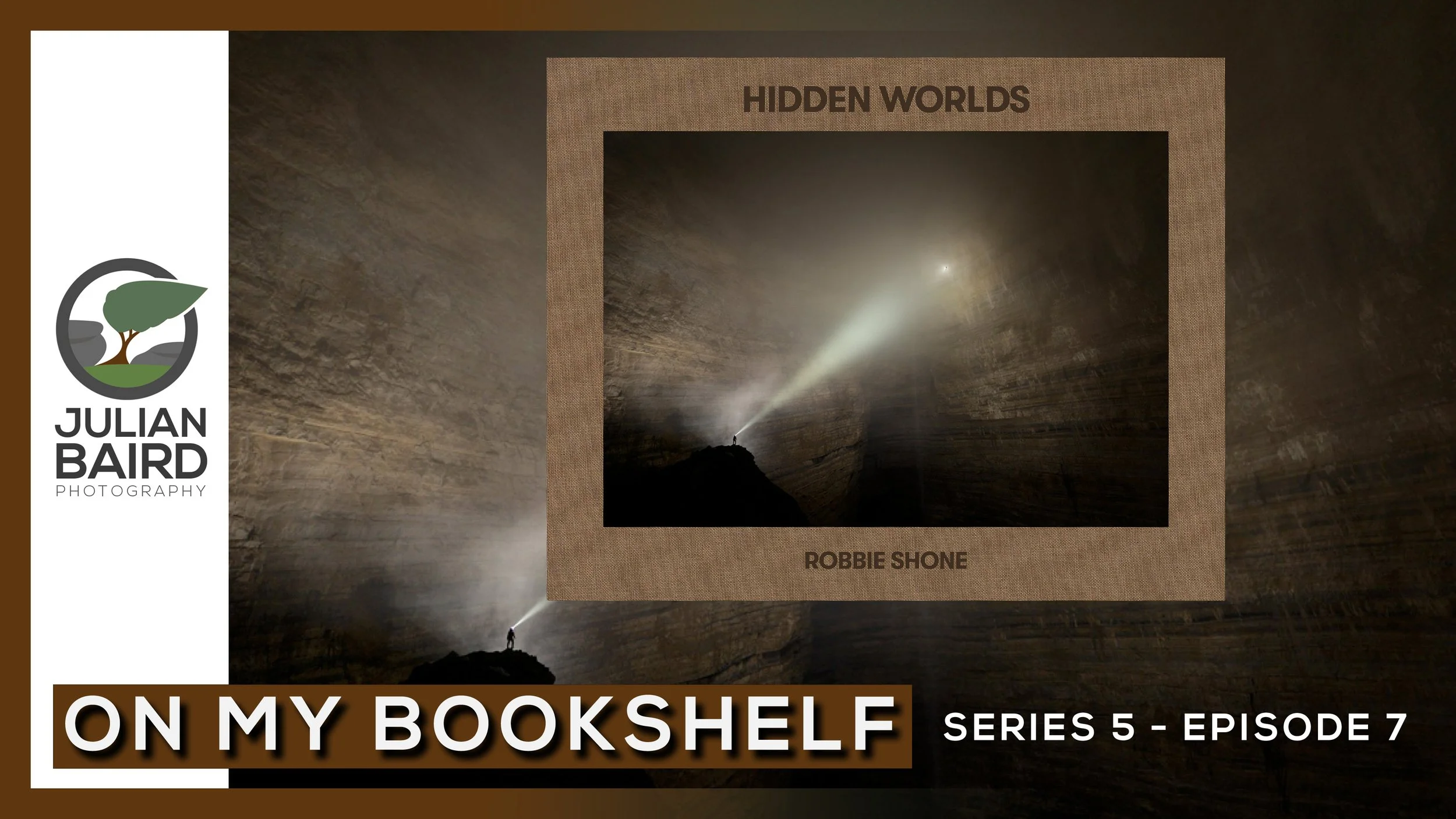
Hidden Worlds by Robbie Shone and Published by Kozu Books - On My Bookshelf S05E07
Would you be willing journey 2000m below the surface of the earth to capture a photograph? Fortunately for us there are photographers like Robbie Stone who have made the exploration of caves their life. In his book, Hidden Worlds, Robbie shares some the images he has captured over the last 20 years. Is this a book for your bookshelf?
A Journey to the Centre of the Earth
When you think about photographing the landscape you will likely think of mountains, rivers, forests, clouds sunlight. But I would imagine few of us consider photographing the landscape that is below the surface of the earth! And why would we. It’s cold, claustrophobic, dangerous and most importantly there’s no light!
For photographers like Robbie Shone though, what lies beneath our feet is a world of adventure and discovery, and a world that must be photographed. In his book, Hidden Worlds, Robbie shares some of the photographs he has captured over the last 20 years exploring the deepest, longest, and largest caves in the world.
This book offers a view into a fantastical world that most people will never see, but is it a book for your bookshelf?
You purchase a copy of Hidden Worlds by Robbie Shone directly from Kozu Books - https://www.kozubooks.com/books-new/hidden-worlds-by-robbie-shone
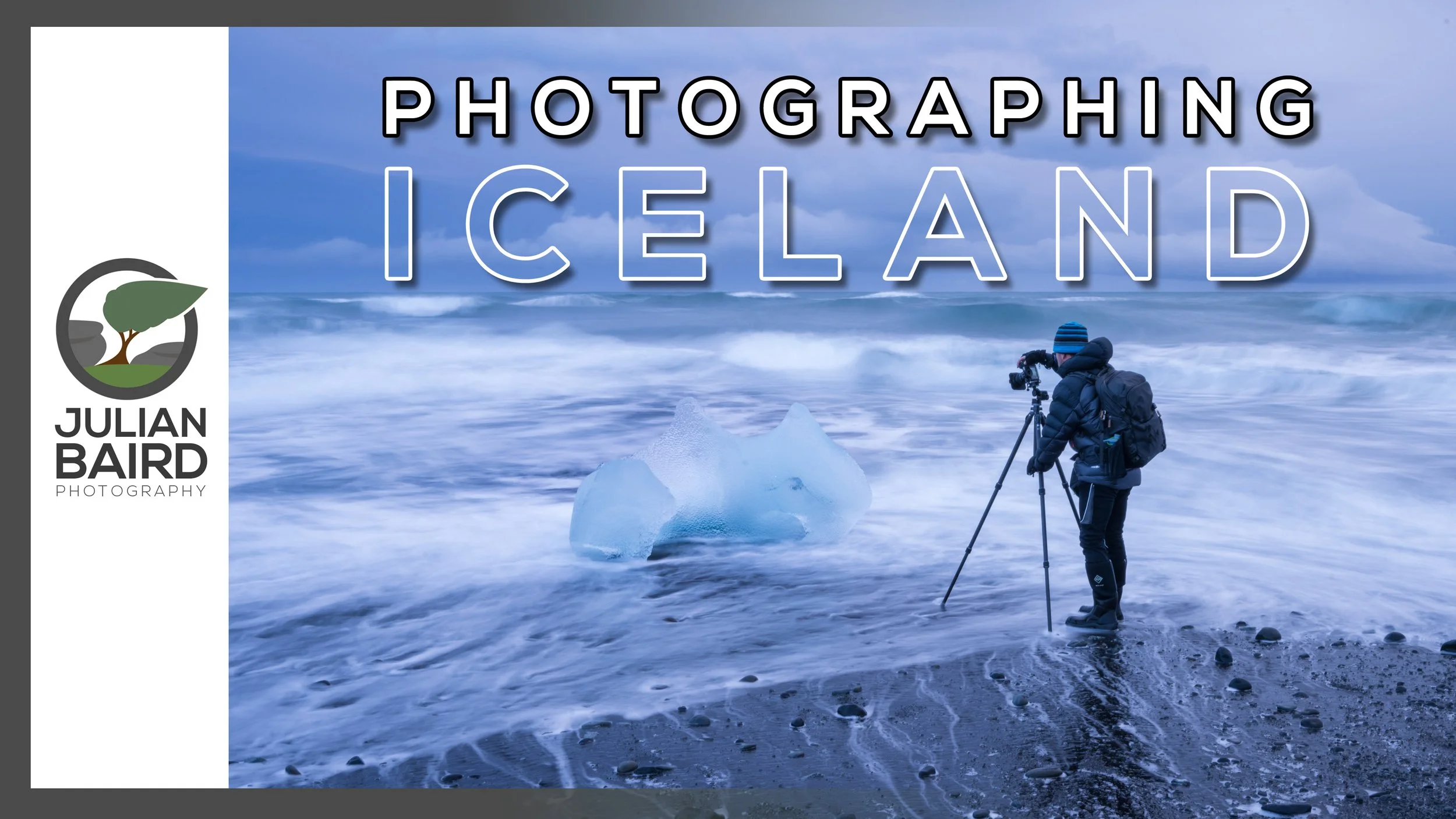
300th Blog Post - My Landscape Photography Adventure in Iceland
The world is full of amazing places to photograph, but few countries have captured the heart and imagination of photographers like Iceland has. In this blog post and short video, I'll show you some of the locations I visited on my trip to Iceland and the landscape photographs I was lucky enough to capture.
Iceland - Vignettes of Landscape Photography
If you are super keen to see some video and photographs from my photographic adventure to Iceland, then I’ve produced this short video. I decided not to produce and film a full video as I wanted to focus on the experience of being there and capturing landscape photographs. However, as you’ll see, the landscape was just too stunning not to capture any video!
If that has whetted your appetite for Iceland, then read on and I’ll tell you all about my photography adventure to Iceland!
Iceland Wasn’t My First Choice
Saying that Iceland wasn’t my first choice may seem an odd way to start this Icelandic photography blog post. Iceland is well known for being high up on a lot of landscape photographers' bucket lists so why wouldn’t it be on mine? Of course, Iceland is on my bucket list, it just wasn’t as high up as another location.
Every year I like to go on a big photography trip. These trips are an opportunity to completely immerse myself in landscape photography. They aren’t always in far-flung locations. They don’t need to be. For me, it’s about being able to dedicate myself to the art of landscape photography and the experience of spending extended amounts of time outdoors.
While I am more than happy to photograph the many locations across the UK, the Faroe Islands has long been at the top of my list of international locations to photograph. I had decided that 2021 was going to be the year that I was going to make that dream come true. However, the world had different plans and things were turned upside down with the pandemic. The Faroe Islands would have to wait.
As one opportunity passes you by, another one comes along. Without the Faroe Islands, what would I do for my big photo trip in 2021? Iceland of course! An epic country for landscape photography, and number 2 on my international photography bucket list. It might not be my first choice, but I would have nothing to complain about if I spent a week photographing Iceland. If I could get away to Iceland for a week, I could still count myself very, very fortunate.
Workshop or Go Solo?
I’m no stranger to a bit of international travel. I even had a “gap year” back in the early 2000s in which I independently travelled across parts of Asia, New Zealand, and Australia. The point I’m making is that I’m no stranger to arriving in a country and sorting my own travel plans and itinerary out.
So, it may seem surprising that I chose the option of going on a dedicated landscape photography workshop in Iceland. I went down this route for several reasons. This was not only my first international landscape photography trip, but it was also my first time in Iceland. More importantly though, I only had a week. If I’d had several weeks to play with, I would have felt a lot more confident as I would have had the time to get to know the country and how things work there.
I wanted to maximise my limited time there and going on a workshop would remove the pressure of decision making, route planning and scheduling. Yes, you don’t get the freedom that you would do by travelling solo, but for my first visit, going on a workshop would be an excellent introduction to Iceland.
A large part of that decision to go on a workshop was driven by the workshop company I chose. I opted to go on a Dawn to Dusk Photography workshop. I’ve been on several Dawn to Dusk workshops, and I know Ross and Mark would make their Icelandic workshop something special. I don’t think I would have had as much confidence with any other workshop provider. I know the itinerary would maximise our time there, I’d be guided to some of Iceland’s photographic highlights, and the travel, accommodation, and food would be excellent.
So, I booked the workshop, bought a new winter jacket, a new flight friendly camera bag (the Shimoda Designs Explore v2 30) and booked a flight from Bristol to Reykjavík. I just needed to keep my fingers crossed so that I didn’t catch COVID or that the travel rules got tighter!
My Icelandic Photography Adventure
Day 0 and 1 - Arrival and The Big Drive
My Icelandic journey started like any other international trip and that is with a very early morning flight. I was a little nervous as this was the first time travelling with my camera gear and even though I knew my bag was within limits I was worried someone was going to ask me to put it in the hold. I needn’t have worried, and nor should I have worried about all the additional checks and paperwork put in place because of the pandemic. I arrived in Iceland a few hours later and cleared security with no stress.
Starting my adventure in Iceland the right way. Coffee and Bushmills at Reykjavík airport .
Despite having a window seat on the plane, I didn’t see any of the Icelandic landscape because of the very low cloud. This grey and overcast weather continued for the rest of the day so I met up with some of the workshop attendees and we went out for pizza. We went to the most excellent Antons Mamma Mia. This place comes highly recommended.
The next day, the first official day of the workshop, was a day of travel. We were going to drive from Reykjavík to Höfn on the southeast coast of Iceland. It would be from there that we would snake our way back along to coast back to our start point over the next few days.
I’d like to tell you all about the beautiful scenery I saw on this long drive, but the weather had remained grey and overcast and I saw very little. What I did see looked amazing though, so I was still excited about getting started with the photography.
Just before we reached our hotel in Höfn we had time to stop at Jökulsárlón Iceberg Lagoon to capture the first images of the trip.
Jökulsárlón Iceberg Lagoon, Iceland - Nikon Z7, Nikkor 24-70mm f/4 at 28mm, f/11, 4 secs at ISO 64, Kase Filters CPL.
Day 2 - Vestrahorn and Eystrahorn
What can you say about Vestrahorn? It’s one of Iceland's most iconic views. A black sand beach with golden dune grass, the ocean, and an epic mountain range. It’s simply stunning to look at but I have to admit, I did struggle a little with picking out a composition. Perhaps I was overwhelmed by the view. Did I mention how amazing it looked?
Capturing images of Vestrahorn. Simply stunning.
I just needed to take my time. Fortunately for me, I was on holiday and had lots of time to just stand there and soak up the view. And sometimes that’s just what you need to do. Take it all in and wander about. Don’t bother with the camera straight away. Keep it in your bag for a bit. Sure enough, after a short while, I started seeing compositions and then, only when I was sure I had something to photograph, did I get my camera out. After the first shot was taken the creative floodgates opened and I was in my happy place.
After a couple of hours of happy photography, it was off to the cafe at the entrance to Vestrahorn for a hot chocolate and rum! What a morning.
Vestrahorn #2, Iceland - Nikon Z7, Nikkor 14-30mm f/4 at 15mm, f/11, 0.6 sec at ISO 64.
Vestrahorn #5, Iceland - Nikon Z7, Nikkor 14-30mm f/4 at 30mm, f/8, 1/20th sec at ISO 400, 7 image panoramic, 6:17 crop.
Vestrahorn #9, Iceland - Nikon Z7, Nikkor 14-30mm f/4 at 14mm, f/11, 1/4 sec at ISO 64, 6:17 crop.
Vestrahorn #10, Iceland - Nikon Z7, Nikkor 14-30mm f/4 at 16mm, f/11, 1/4 sec at ISO 64.
After some refreshments, we drove onto Eystrahorn. The weather had taken a turn for the worse and the interesting dawn skies had been replaced with a grey overcast sky. While the mountain range was impressive, the flat conditions meant I wasn’t connecting with the view like I had been at Vestrahorn.
It’s times like this that it’s good to think a little differently, so I took a walk over to the beach. The beach was made up of millions of jet-black pebbles which moved under the impressive white-water waves that were crashing along the beach. I wondered what this all looked like from above, so I got the drone out of my bag and sent it up. What I saw just blew me away.
The Black Sands of Eystrahorn #2, Iceland - DJI Mavic Pro, 1/100th sec.
The Black Sands of Eystrahorn #5, Iceland - DJI Mavic Pro, 1/100th sec.
From just a relatively low height the whole scene was transformed. I could see all these wonderful patterns being created by the waves and the contrast between the black beach and the white water was striking. Not only did it look great on video, but the still images I was capturing looked even better. I had let go of my preconceived idea of what I was going to photograph at Eystrahorn and found something much more rewarding!
The Black Sands of Eystrahorn #4, Iceland - DJI Mavic Pro, 1/100th sec.
The Black Sands of Eystrahorn #1, Iceland - DJI Mavic Pro, 1/100th sec.
After returning to the hotel for dinner we headed back out to Vestrahorn to see if we could capture the Northern Lights but unfortunately for us the northern lights activity level was low that evening. It wasn’t a wasted trip though as we were able to get some practice in and get some nighttime shots of Vestrahorn.
Vestrahorn at Night, Iceland - Nikon Z7, Laowa 15mm f/2, 15 secs at ISO 800.
Day 3 - A Little More Vestrahorn and The Diamond Ice Beach
That’s me photographing Vestrahorn. Photograph courtesy of Ross Hoddinott.
The following day the weather forecast for dawn was looking like it might favour another trip to Vestrahorn. One of the wonderful things about visiting Iceland in November is how late sunrise is, and how long it lasts. Sunrise is about 10 am and because the sun's ascent from the horizon is relatively slow, you get more time to make the most of the morning light compared to how it is in the UK.
We returned to Vestrahorn on what was mostly a cloudless morning but the warm glow from the rising sun illuminated the mountain range beautifully. What you can’t tell from the photographs is the strength of the wind. You had to be very careful with your camera and tripod. Not holding onto your gear was a sure-fire way to ruin your holiday. It was the gusts that could really catch you. You could see them travelling across the water. All you could do is hold your tripod and take a wide stance. It was incredibly good fun though!
Vestrahorn #14, Iceland - Nikon Z7, Nikkor 14-30mm f/4 at 14mm, f/11, 1/8 sec at ISO 64, 6:17 crop.
Vestrahorn #13, Iceland - Nikon Z7, Nikkor 14-30mm f/4 at 16mm, f/11, 1/8 sec at ISO 64, 16:9 crop.
After stopping at the Viking Cafe at the entrance of Vestrahorn for another hot chocolate and rum (another advantage of being driven around Iceland), we drove westward to the Diamond Ice Beach at Breiðamerkursandur. This beach is famous for the icebergs that float down from the Jökulsárlón Iceberg Lagoon and then break up into chunks of ice that then get washed up onto the beach.
It was late in the day by the time we got there but I still managed to get a few shots to whet my appetite for the following day.
Diamond Ice Beach #1, Iceland - Nikon Z7, Nikkor 14-30mm f/4 at 20mm, f/13, 1.3 sec at ISO 64, Kase Filters ND Grad and CPL.
Diamond Ice Beach #3, Iceland - Nikon Z7, Nikkor 14-30mm f/4 at 15mm, f/13, 2 sec at ISO 64, Kase Filters ND Grad and CPL.
Our hotel for the night was the Fosshotel Glacier Lagoon which was very wonderufl. I admit a campervan gives you more flexibility, but a bar and restaurant after a hard day of photography are very welcome!
Day 4 - The Diamond Ice Beach and Svínafellsjökull Glacier
Dancing with waves and ice! Photograph courtesy of Ross Hoddinott.
After a great night's sleep, lots of breakfast and even more coffee I was excited about returning to the Diamond Ice Beach. There was still a limited amount of ice on the beach but sometimes you can have too much choice, so it didn’t take long to identify some of the more interesting mini-icebergs.
The principal difficulty with shooting the ice is timing. To get the composition I wanted I needed to be close to the ice, but this approach also meant dealing with the incoming waves. It was a matter of waiting for a wave to recede, running out and sticking the tripod in the sand, firing off a couple of shots, and then running back before your feet got wet (or worse). An advantage of being in a group was that we could act as spotters for each other. You don’t always see the waves coming if you are focusing on your camera and so it was good to have someone shout “WAVE”! It was an exciting experience for sure.
Diamond Ice Beach #8, Iceland - Nikon Z7, Nikkor 14-30mm f/4 at 16mm, f/11, 1.6 sec at ISO 100, Kase Filters CPL.
Diamond Ice Beach #5, Iceland - Nikon Z7, Nikkor 14-30mm f/4 at 16mm, f/11, 2.0 sec at ISO 100, Kase Filters CPL.
Diamond Ice Beach #4, Iceland - Nikon Z7, Nikkor 14-30mm f/4 at 16mm, f/11, 2.0 sec at ISO 100, Kase Filters CPL.
You often see photographs from this location coupled with glorious light, but for me, the dark moody skies work just as well. My main problem when I got home was editing. I captured a lot of frames from this location. Each one had a slightly different water pattern but trying to select just a few for final processing was a challenge.
Diamond Ice Beach #13, Iceland - Nikon Z7, Nikkor 14-30mm f/4 at 20mm, f/11, 1.0 sec at ISO 64, Kase Filters CPL.
Diamond Ice Beach #14, Iceland - Nikon Z7, Nikkor 14-30mm f/4 at 21mm, f/11, 1.0 sec at ISO 64, Kase Filters CPL.
Diamond Ice Beach #11, Iceland - Nikon Z7, Nikkor 14-30mm f/4 at 18mm, f/13, 1.0 sec at ISO 64, Kase Filters CPL.
Doughnut, hot chocolate with rum and a view of some icebergs. Happy days.
After a hot chocolate and rum at the cafe, we drove on to Svínafellsjökull Glacier. It was another location with awe-inspiring views. As with Vestrahorn, I struggled initially with finding a composition. Another benefit of being on a workshop is that you can not only get inspiration from your fellow workshop attendees, but you can also lean on the expertise of your instructors. Sometimes you can’t see the compositions because the views are so big, so a little direction can be very welcome.
My favourite photographs from Svínafellsjökull Glacier, as with Eystrahorn, came from the drone. The ability to place the camera wherever I wanted provided me with compositions that simply wouldn’t have been impossible with a camera on a tripod. It's not just the ability to photograph a wider view of the glacier, but for me, it was about photographing the surface of the glacier. The drone gives you a unique viewpoint of the glacier face, and what the surface looks like. Despite these photographs being abstract, they are some of my favourites from Iceland.
Svínafellsjökull Glacier Surface #2, Iceland - DJI Mavic Pro, 1/200 sec.
Svínafellsjökull Glacier Surface #3, Iceland - DJI Mavic Pro, 1/190 sec.
The Face of Svínafellsjökull Glacier #1, Iceland - DJI Mavic Pro, 1/105 sec.
Svínafellsjökull Glacier #1, Iceland - DJI Mavic Pro, 1/560 sec.
The Mountains of Svínafellsjökull Glacier, Iceland - Nikon Z fc, Nikkor 24-200mm f/4-6.3 VR at 54mm, f/8.0, 1/60 sec at ISO 100.
Day 5 - Fjallsárlón Glacier and Reynisdrangar Beach
Taking photographs of Fjallsárlón Glacier with noctilucent clouds in the sky. Photograph courtesy of Ross Hoddinott.
Before coming to Iceland, I hadn’t considered how windy it might be. I knew it would be cold, snowy, icy, and rainy, but I didn’t realise how windy it could get there until I arrived. That first experience of the fierce winds at Vestrahorn had certainly opened my eyes as to how strong the wind could be, but the morning we went to Fjallsárlón Glacier was something else!
It was a bitterly cold morning, and I was glad to have my new down jacket on and my gloves with hand warmers inside, but nothing could protect you from the wind. It was going to make photography extremely challenging. Unlike the previous days when it had been windy, the challenge of battling with the wind had been exciting. Here it was just plain hard work.
Fjallsárlón Glacier #1, Iceland - Nikon Z fc, Nikkor Z DX 16-50 f/3.5-6.3 VR at 39mm, f/9, 1/125 sec at ISO 320, 7 image panoramic, 6:17 crop, handheld.
Fjallsárlón Glacier #1, Iceland - Nikon Z fc, Nikkor 24-70mm f/4 at 39mm, f/11, 1/60 sec at ISO 250, Kase Filters CPL.
It was almost a relief to be back on the bus to start our journey towards Vik. Though the photography was incredibly challenging, it’s always important to remember the experience of being at these locations. Places like Fjallsárlón Glacier are amazing, and I felt extremely fortunate to have seen it.
On the way to Vik, we stopped off at Fossalar Waterfalls. The conditions weren’t ideal for photography but it’s hard to drive by this roadside location and not take some photographs.

Fjallsárlón Glacier #1, Iceland - Nikon Z fc, Nikkor 14-30mm f/4 at 30mm, f/11, 0.6 sec at ISO 250, Kase Filters CPL.
Photographing Reynisdrangar Beach.
We arrived in Vik and headed down to Reynisdrangar Beach for sunset. The Reynisdrangar rock stacks are iconic in Iceland but as I found with some of the other famous locations in Iceland, I initially struggled to find a balanced composition. Fortunately, time was on my side so I had the opportunity to figure out where I might place the beach, waves, rock stacks and headland before the sun went down.
Reynisdrangar Beach #1, Iceland - Nikon Z fc, Nikkor Z DX 16-50mm f/3.5-6.3 VR at 18mm, f/7.1, 1/160 sec at ISO 100.
Reynisdrangar Beach #3, Iceland - Nikon Z7, Nikkor 24-70mm f/4 at 61mm, f/11, 30 sec at ISO 64.
After dinner, we headed out to see if we could capture images of the Northern Lights. It was forecast to be a clear night but with limited aurora activity. Sure enough, we didn’t see any aurora, but I did manage to capture this image of the milky way. Time was running out to capture photographs of the Northern Lights
Night Sky, Iceland - Nikon Z7, Laowa 15mm f/2, 20 sec at ISO 3200.
Day 6 - Reynisfjara Beach and Seljalandsfoss Waterfall
The next day was grey and overcast, and the sky was almost devoid of colour. Our first location of the day was Reynisfjara Beach where we could photograph the Reynisdrangar stacks from the west. With low light, an overcast sky and a black sandy beach, the only colour to be seen was on my fellow photographer's jackets.
Reynisfjara Beach #5, Iceland - Nikon Z7, Nikkor 24-70mm f/4 at 42mm, f/11, 25 secs at ISO 64, Kase Filters CPL.
Reynisfjara Beach #4, Iceland - Nikon Z7, Nikkor 24-70mm f/4 at 42mm, f/11, 25 secs at ISO 64, Kase Filters CPL.
There is something about the contrast of the white water against the black beaches of Iceland that really inspires my photography. Despite the flat sky conditions, I had immense fun capturing images of the beach in both an easterly and westerly direction. The simplicity of the scene captured my imagination in a way that a morning with a glorious sky can’t.
Reynisfjara Beach #8, Iceland - Nikon Z7, Nikkor 24-70mm f/4 at 39mm, f/11, 30 secs at ISO 64, Kase Filters CPL and ND.
Reynisfjara Beach #6, Iceland - Nikon Z7, Nikkor 24-70mm f/4 at 39mm, f/13, 2.5 secs at ISO 64, Kase Filters CPL.
After a rewarding morning at the beach, we moved onto another iconic Iceland location, Seljalandsfoss Waterfall. Photographing this mighty waterfall was challenging in a way that I had not yet experienced in Iceland. The conditions underfoot were extremely icy. Just as well I had purchased the recommended ice spikes for my boots as some of the viewpoints were thick with ice. Watching the other visitors dance about on the ice while wearing trainers was almost entertainment in its own right.
Seljalandsfoss Waterfall #1, Iceland - Nikon Z7, Nikkor 14-30mm f/4 at 16mm, f/11, 1/6 sec at ISO 64, Kase Filters CPL.
Seljalandsfoss Waterfall #4, Iceland - Nikon Z7, Nikkor 14-30mm f/4 at 24mm, f/13, 0.5 sec at ISO 64, Kase Filters CPL.
At Seljalandsfoss Waterfall with Ross Hoddinott and Mark Bauer of Dawn 2 Dusk Photography. Their Icelandic workshop did not disappoint.
One visitor did catch my attention. He was trying to balance his camera on a fence post so that he could take a long exposure of the waterfall. It was difficult to watch as I was sure his attempts at using the post as a tripod were going to end in tears. I couldn’t watch anymore, and I asked if he’d like to borrow my Gorillapod. I’m glad he did, both for the benefit of his photography and the lifespan of his camera.
Returning to our hotel in Vik, we had dinner and prepared to head out with the cameras again for the last chance to capture photographs of the Northern Lights. Did we succeed….

Night Sky, Iceland - Nikon Z7, Laowa 15mm f/2, 20 secs at ISO 3200.
As you can see, it was another evening of very low aurora activity. You can see a little in the photograph, but it was barely visible. So, after a week in Iceland, I didn’t see the aurora borealis. I can’t say I wasn’t disappointed but not seeing the Northern Lights was not going to define my Icelandic trip. Seeing the aurora borealis was only one part of a much bigger Icelandic experience. Besides, not seeing them has given me a great excuse to come back.
Day 7 - Home and a Memory Card Full of Icelandic Memories
Our vehicle for the week. I saw many amazing sights through those windows.
We all had flights to catch the following morning, so it was an early departure from Vik. Much of the journey was in the dark so there wasn’t an opportunity to see much more of Iceland. Unlike the first days journey where I saw nothing, the remaining time spent on the bus had been wonderful. I spent most of my time with my face planted to the window, looking at the landscape and saying things like “that’s bonkers”. Because that is what the Icelandic landscape is like. It’s bonkers! I’d never seen anything like it.
As we drove back to the airport I reflected on my week in Iceland. There was no doubt that the photography had been challenging, but I consider that a good thing. Sometimes you need to pull yourself away from what you know and photograph something completely different. And there aren’t many places more different than Iceland!
More than that though, Iceland was a holiday. A chance to get away from it all. Meet new people, try different foods, visit unique locations. Iceland will be a trip that I will never forget. And thanks to a memory card full of photographs, I’ll have some amazing images to treasure.
I’d like to say this was a once in a lifetime trip, but I barely scratched the surface of Iceland. The itch that I had to go to Iceland hasn’t gone away, it just got worse. I can’t wait to go back.
It’s been great for me to write down my experience. Along with the photos, this text will help me remember what an amazing time I had in Iceland. I hope you enjoyed reading about it and seeing my photographs.
On My Bookshelf - Photographing Iceland
If you’d like to learn more about Iceland and the locations to photograph, then check out this video review, I did of Photographing Iceland by James Rushforth. It’s an essential purchase for anyone going to Iceland and also for anyone who just enjoys a good photography book!

Glencoe Landscape Photography - A 5 Minute Photo Adventure
In this coffee break length video I head to the Three Sisters in Glencoe for a spot of landscape photography. Unfortunately the conditions were a little windy. Did that put me off? Of course not!
Short, Sweet, and Very Windy
When I go on a family holiday to Scotland I often make grand plans for some landscape photography adventures. The reality is that these plans rarely come to fruition and I have to scale things back. With the time I do have for photography I do try and cram in as much as possible.
This year I was on holiday not far from Glencoe so when my family suggested we head to there for a pub lunch at the Clachaig Inn. I thought there would be a great opportunity to finish the day with a little bit of landscape photography. With the family safely heading back home I decided to hit some of the photographic highlights of Glencoe. Unfortunately, the weather conditions were going to somewhat dampen my plans.
Well, I say dampen, but rain would have been very welcome. In all my excitement about photographing Glencoe I had forgotten that it hadn’t rained there in over a week. In fact, it had been hot and sunny all week. As most of my favourite spots for landscape photography in Glencoe involve water of some kind, this made things very challenging.
I wanted the video to cover three locations, but every location I visited looked horrible and dry. As it got closer to sunset I decided to head to a viewpoint that would allow me to capture an image of the Three Sisters. Unluckily for me though the weather had other ideas!
I do hope you enjoyed this short video. Do you have a favourite location in Glencoe? Have you ever taken photographs in very windy conditions? Let me know in the comments below.
Those Photographs
Here are the photographs you saw in the video.
Beinn Fhada and Gearr Aonach, Glencoe, Scotland - Nikon D850, Nikkor 16-35 mm f/4 VR at 25 mm, f/10. 1/8th sec at ISO 64.
Gearr Aonach, Glencoe, Scotland - Nikon D850, Nikkor 24-70 mm f/2.8 VR at 31 mm, f/13. 1/4th sec at ISO 64.
The Three Sisters - Beinn Fhada, Gearr Aonach, and Aonach Dubh, Glencoe, Scotland - Nikon D850, Nikkor 16-35 mm f/4 VR at 16 mm, f/13. 0.6 sec at ISO 64.
Looking Back
All this talk of Glencoe has made me think about the last time I made a video there, so I thought it would be a good time to share that video again:

Wild Camping in Wales
Can you combine landscape photography with wild camping? That's the question I wanted to answer when I asked fellow photographer and experienced wild camper Gareth Danks to take me on my first wild camp. Read the blog to find out how I got on!
What's Wild Camping
Until recently I hadn't heard of wild camping. Obviously, I'd heard of camping but I'll be honest with you, it never really appealed to me. I like a nice warm bed and a full cooked breakfast if I have to stay away from home!

Gareth Danks - photographer, wild camper and all round great guy.
One of the great things about having my YouTube channel is the number of different people I have connected with. One such person is Gareth Danks and he is super keen on wild camping. Through watching his videos I saw that wild camping is more than just pitching your tent on a windy campsite.
As I watched through his videos I started to see the appeal of wild camping. Changes in camera and tent technology now meant you were able to take all the gear required to take photographs and get a good nights sleep. While I'm no stranger to an early morning, there are some locations that just aren't practical to reach before sunrise. However, by camping on location, you could be in the right place the night before.
Wonderful Wales
When Gareth finally talked me into wild camping all we had to do was agree on a location. Pen y Fan has always been a location I'd wanted to photograph and given that Gareth had both experience of camping and photographing there, it seemed like a great place for my first wild camp. We put a plan together, picked a date, and hoped for good weather.
If you want to see how I got on in my wild camping adventure then check out the video I made below:
And here is Gareth’s video:
More Wild Camping?
So would I go wild camping again? Absolutely I would! OK, the weather wasn't great for photography, but I had such a good time camping. I was really impressed by modern camping equipment. It was surprisingly easy to put up the tent (under guidance from Gareth of course), it was comfortable, warm, and it was even possible to make a great cup of coffee. OK, it's not as a good as a nice B&B, but it has the benefit of being much more flexible.
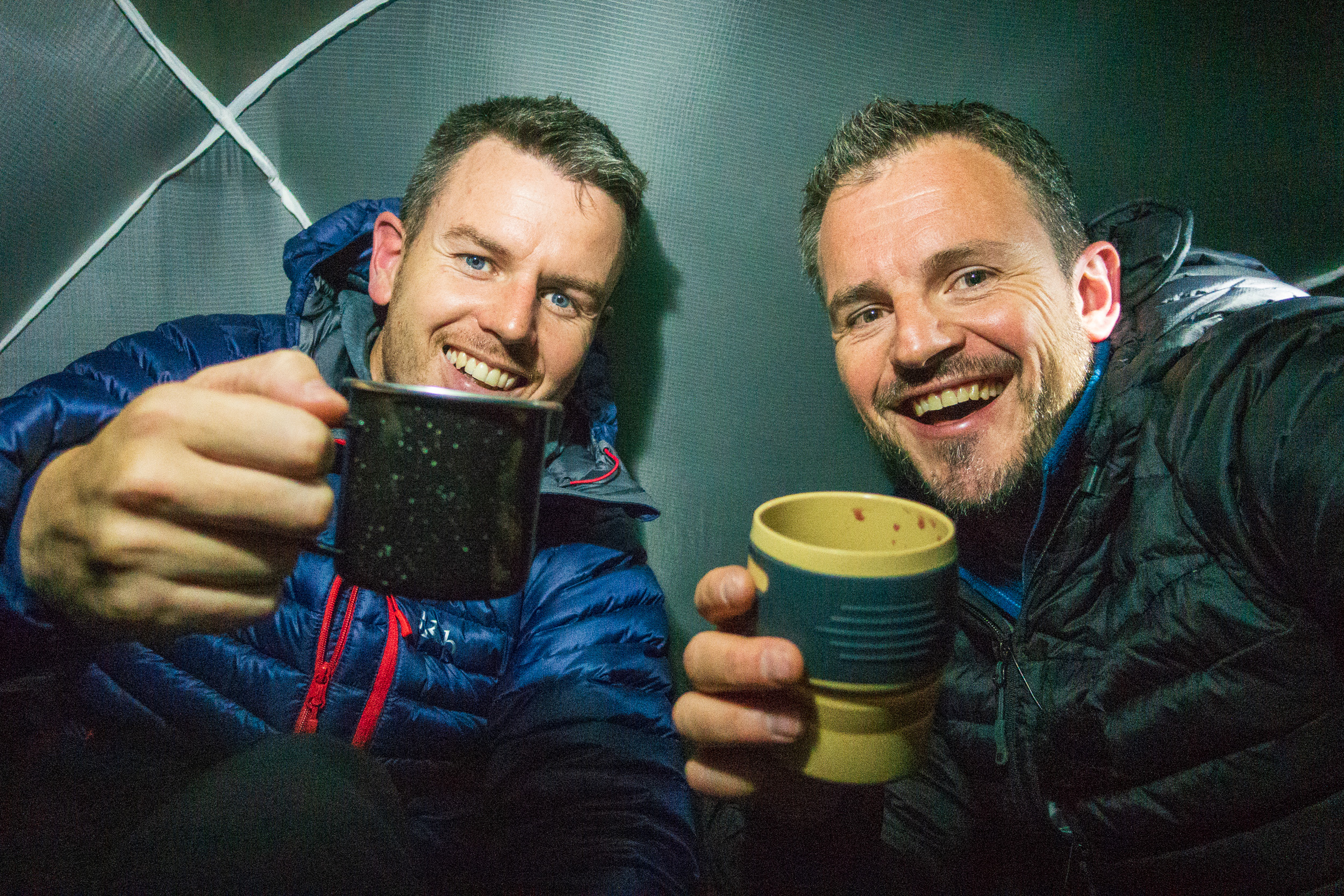
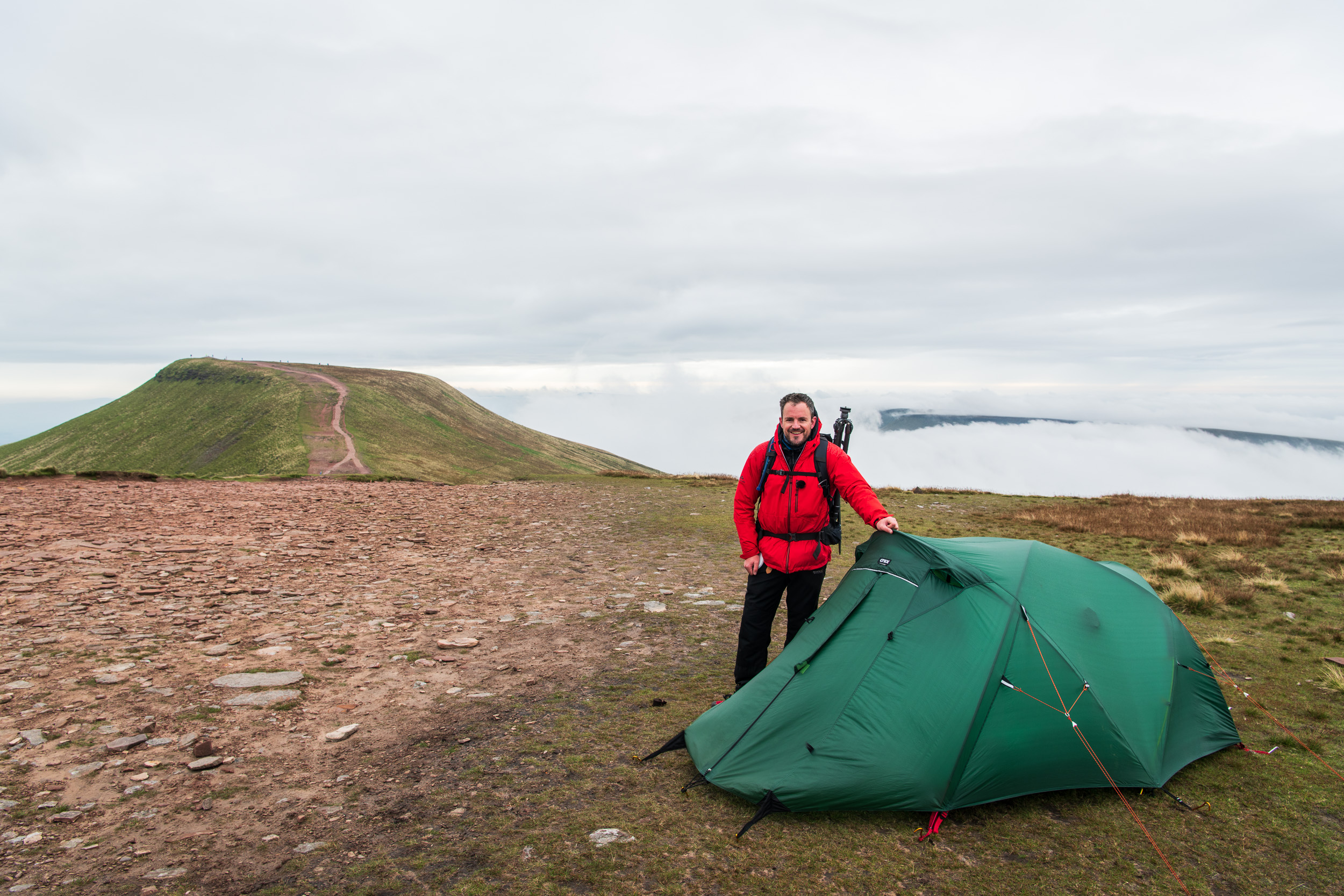
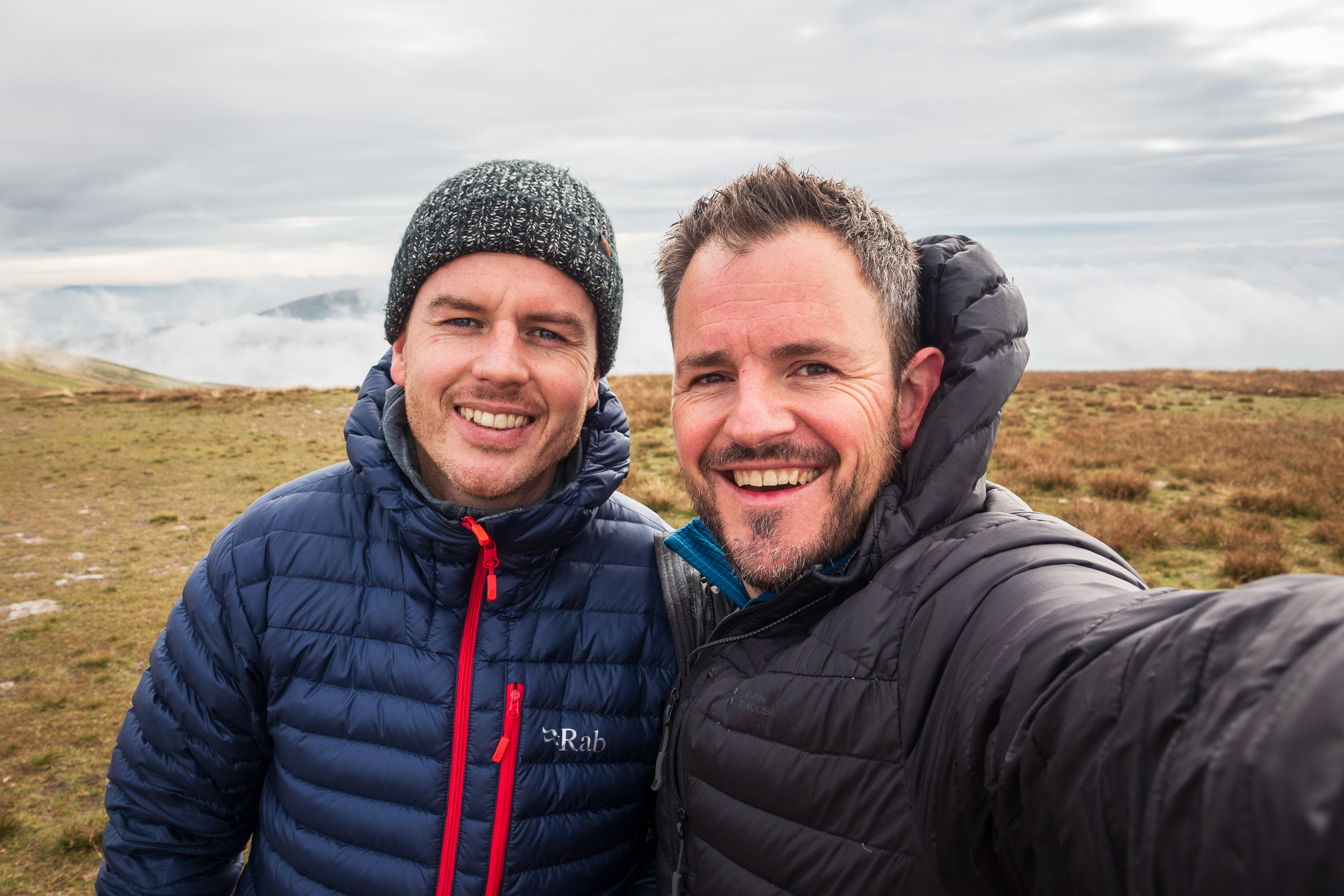
I don't think I'm ready for a wild camp in the winter, but I sure I'll be giving it another go next spring.
So have you been wild camping before? Do you remember the first time you did it? Would you like to give it a try? Let me know in the comments below.
The Photographs
Here are the photographs from the video:
Creeping Clouds over Cribyn - Pen y Fan, Brecon Beacons, Wales: Nikon D850, Nikkor 24-70 mm f/2.8 VR at 34 mm, 1/80th sec at ISO 64, f/8.
Cefn Cwm Llwch Mountain Path - Pen y Fan, Brecon Beacons, Wales: Nikon D850, Nikkor 24-70 mm f/2.8 VR at 34 mm, 1/80th sec at ISO 64, f/8.
There You Are Cribyn - Pen y Fan, Brecon Beacons, Wales: Nikon D850, Nikkor 24-70 mm f/2.8 VR at 34 mm, 1/80th sec at ISO 64, f/8.
Photographing Britain's National Parks
In the blog this week I’m very happy to share with you the story of my latest adventure. Check out the images and video I captured as I travel to three different national parks, across three countries and all in one day!
Grand Ideas
One of the primary goals of my YouTube channel is to share my landscape photography adventures. By sharing my adventures I can hopefully provide a little inspiration to my fellow landscape photographers or even encourage people to get out there and see the great outdoors.
Sometimes my adventures are unplanned, but every now and again I come up with a plan for a grand adventure! The problem is that these grand plans aren't exactly simple to execute. Time is the normally the limiting factor for me.
However, when I read about National Parks Week, I thought it was the perfect excuse to execute one of those grand adventures. My idea was simple. I would visit 3 national parks, in 3 different countries and do it all in one day. Would it even be possible? Let's find out.
As you saw in the video, it is indeed possible. I wouldn't exactly recommend it though. It was a lot of driving and a very long day. But I sure did enjoy it! The locations I visited were stunning, and that was only 3 of the 15 national parks in Britain.
If you haven't visited a national park before, or it's been a while, I really recommend that you check out the National Parks website as there is sure to be one near you. I'm really lucky as I have Dartmoor on my doorstep. The national parks are a valuable resource, so if you have some time it's also worth considering spending some time on your local national park as a volunteer. You can see how I got on one year volunteering on Dartmoor here.
I really hope you enjoyed this video. If you are looking for a bit more detail on the locations I visited and the photographs you saw, you'll find them below.
So are heading out for National Parks Week? What is your favourite national park? Let me know in the comments below.
Wales - Snowdonia National Park
For more information about Snowdonia National Park, click here.
Snowdonia National Park - near Plas y Brenin, Wales: Nikon D850, Nikkor 16-35 mm f/4 at 25 mm, 1/20th sec at ISO 64, f/13, Lee Filters Circular Polariser.
England - Lake District National Park
For more information about The Lake District National Park click here.
Haweswater Reservoir - Lake District, England: Nikon D850, Nikkor 16-35 mm f/4 at 17 mm, 1/20th sec at ISO 64, f/13, Lee Filters Circular Polariser.
Scotland - Loch Lomond and The Trossachs National Park
For more information about the Loch Lomond and The Trossachs National Park, click here.
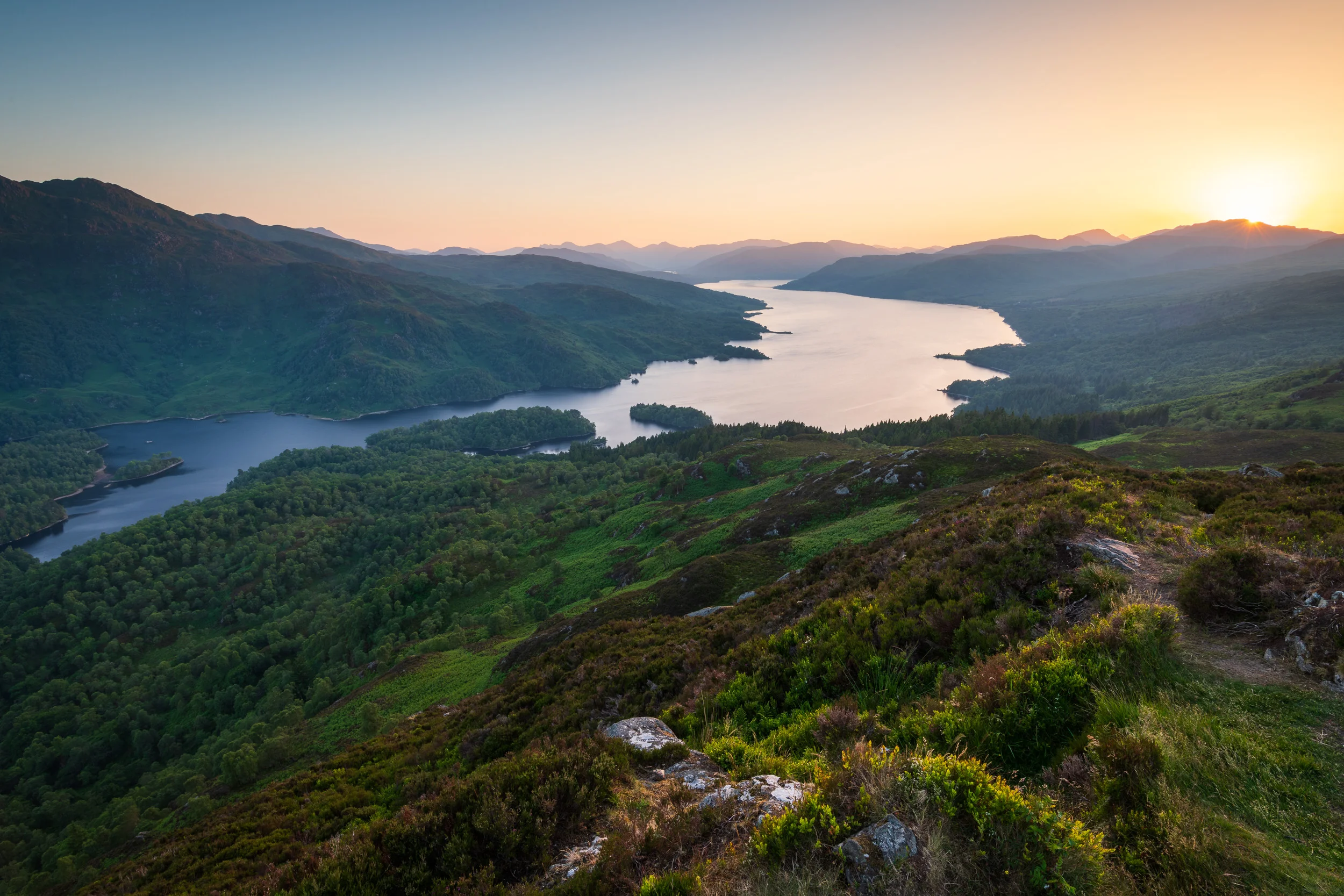
A Pastel Sunset at Ben A'an - Loch Lomond and The Trossachs National Park: Nikon D850, Nikkor 24-70 mm f/2.8 at 70 mm, 1/5th sec at ISO 64, f/13, Lee Filters 2 Stop ND Grad.
Looking North from Ben A'an on a Beautiful Summers Evening - Loch Lomond and The Trossachs National Park: Nikon D850, Nikkor 24-70 mm f/2.8 at 48 mm, 1/3rd sec at ISO 64, f/8, Lee Filters 2 Stop ND Grad.
A Summer Sunset At Ben A'an and Loch Katrine - Loch Lomond and The Trossachs National Park:: Nikon D850, Nikkor 16-35 mm f/4 at 18 mm, 0.5 sec at ISO 64, f/18, Lee Filters 2 Stop ND Grad.
Landscape Photography Adventure in the Lake District - Part 3
In this special blog post, I share with you the final part of my landscape photography adventure video from the Lake District.


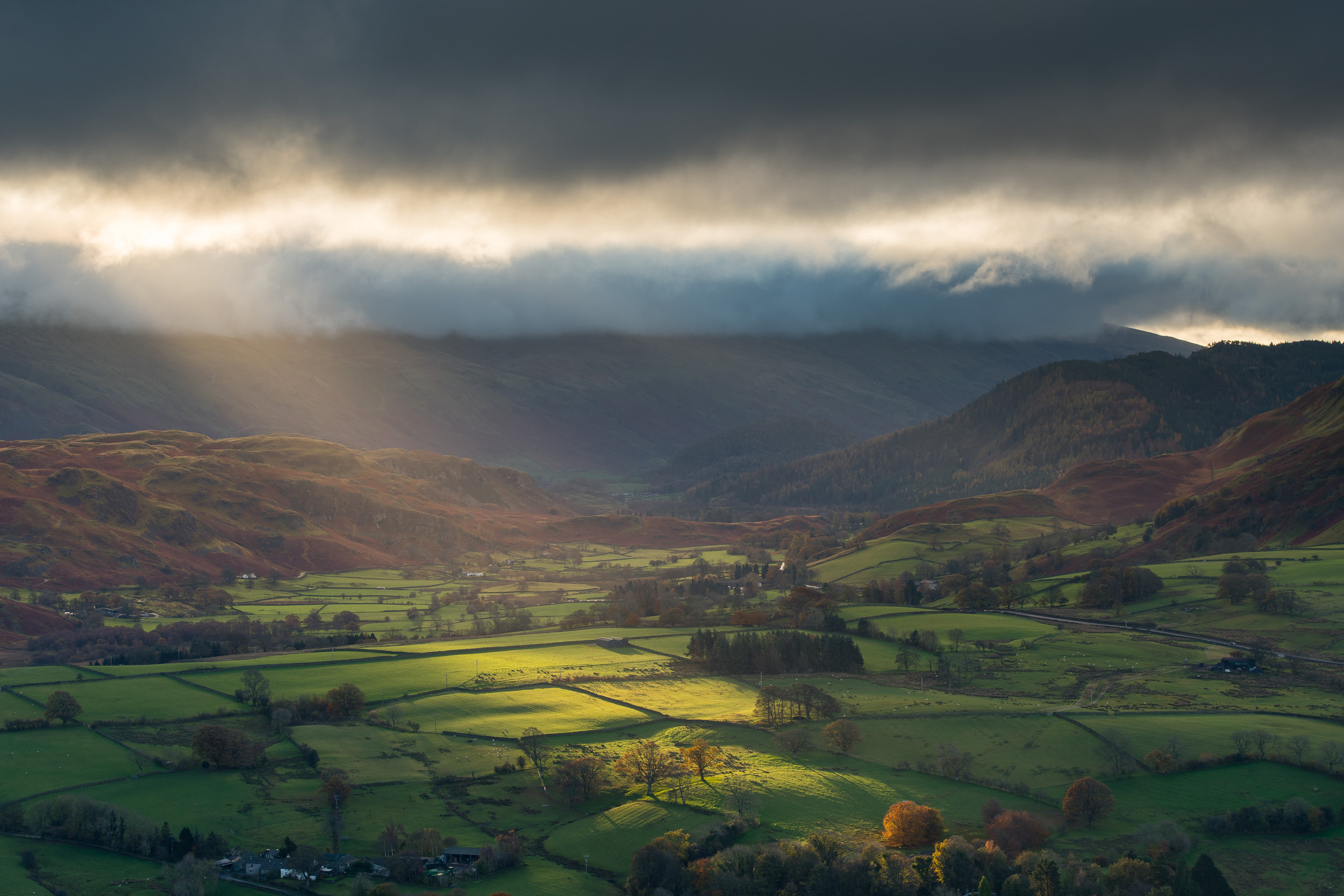
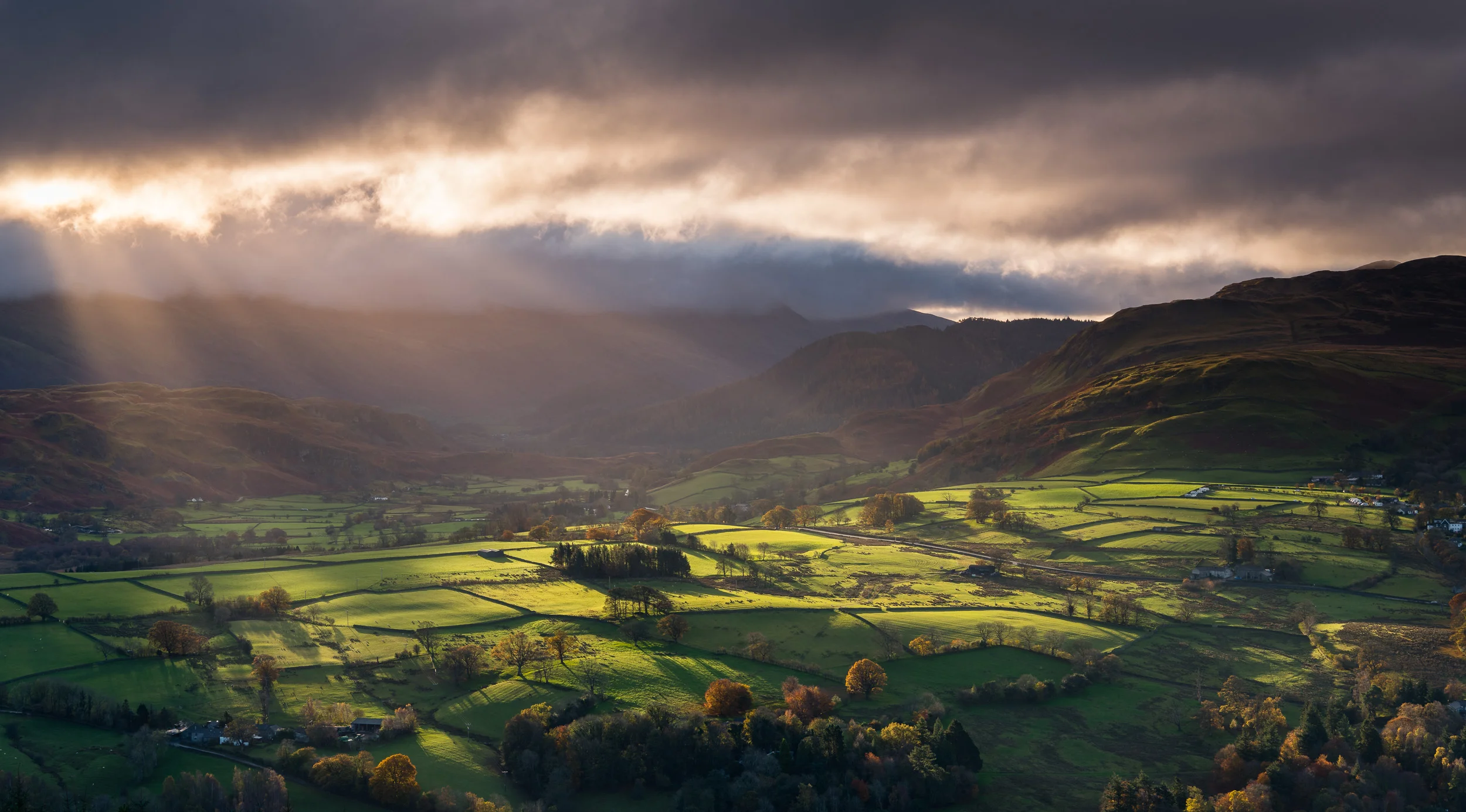
If you watched part 1 and part 2 you'll know that I didn't have the best of luck with the weather. For two days I had grey, flat light, and while I was capturing nice images, they just lacked the dramatic light that I know the Lake District can produce. Then, and I'm not joking here, the light broke through the clouds in the last 15 minutes of my adventure. I was just about to pack up and leave as I need to get back to my hotel to check out when all the action happened.
As long as I could go away with one great image I would have been happy. It just happened that on this trip I needed to wait until the very end of my trip!
Overall I had a really good time in the Lake District. While the photography was challenging at times, it was also a lot of fun. As is often the case with these trips the enjoyment comes from more than just photography. I'm a big fan of the outdoors, so just being outside and wandering about some of these great spots and locations is a wonderful experience. I also met some great people on my adventure. From fellow photographers, hill walkers, and even a fell runner. I guess I like to talk as much as I like to take photographs!
I hope you enjoyed this three-part blog and vlog on my recent Lake District adventure. I'm already making plans for more adventures next year, so remember to stay tuned.
So have you ever photographed the Lake District? What has been your favourite 15 minutes of photography? Let me know in the comments below.

Landscape Photography Adventure in the Lake District - Part 2
In this special blog post, I share with you the 2nd part of my landscape photography adventure video from the Lake District.
In the blog last week I shared with you part 1 of my Lake District photography adventure. This week I'm very happy to share with you part 2 of that adventure. I'm not going to write much else this week as let the video and the images below tell the story.
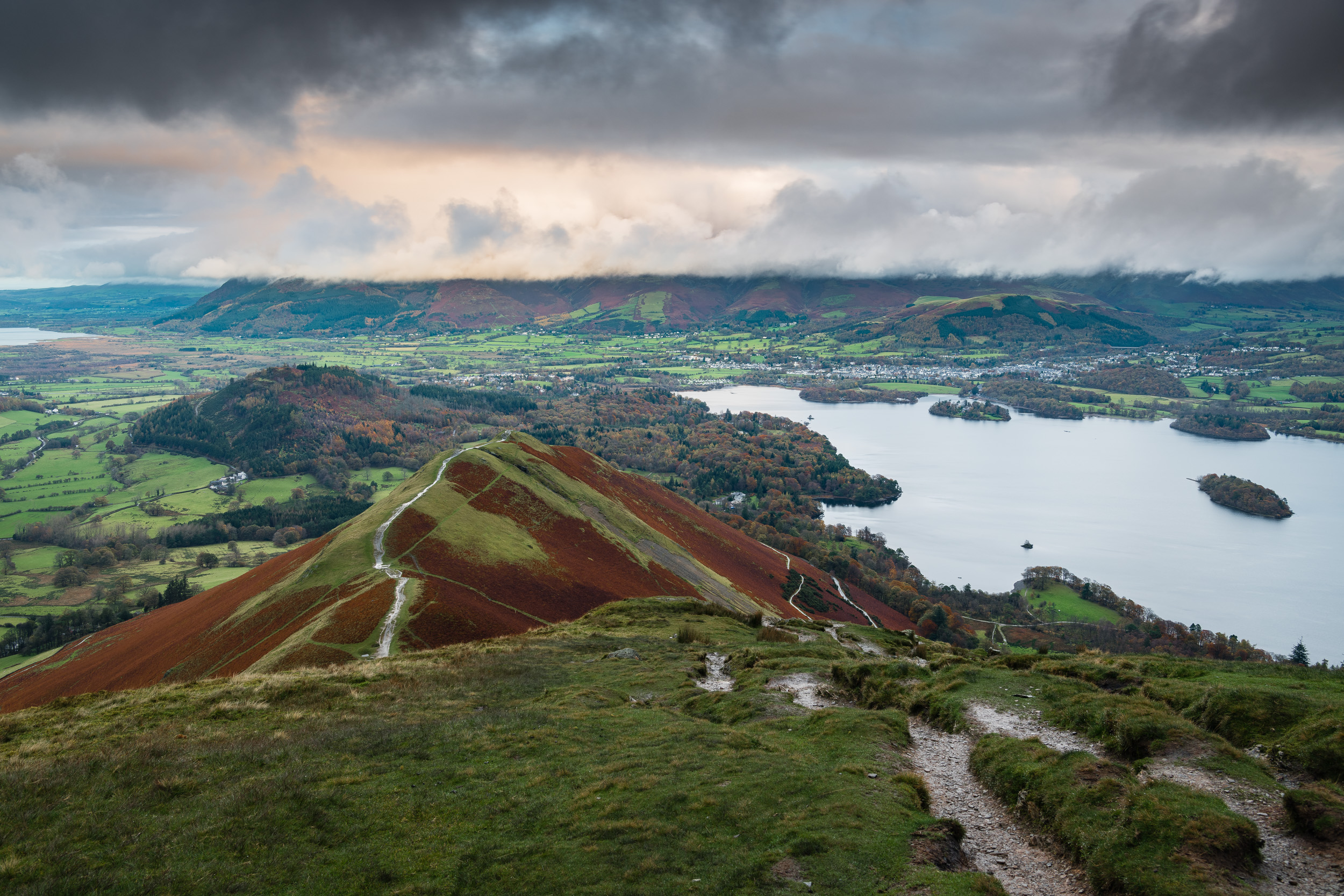


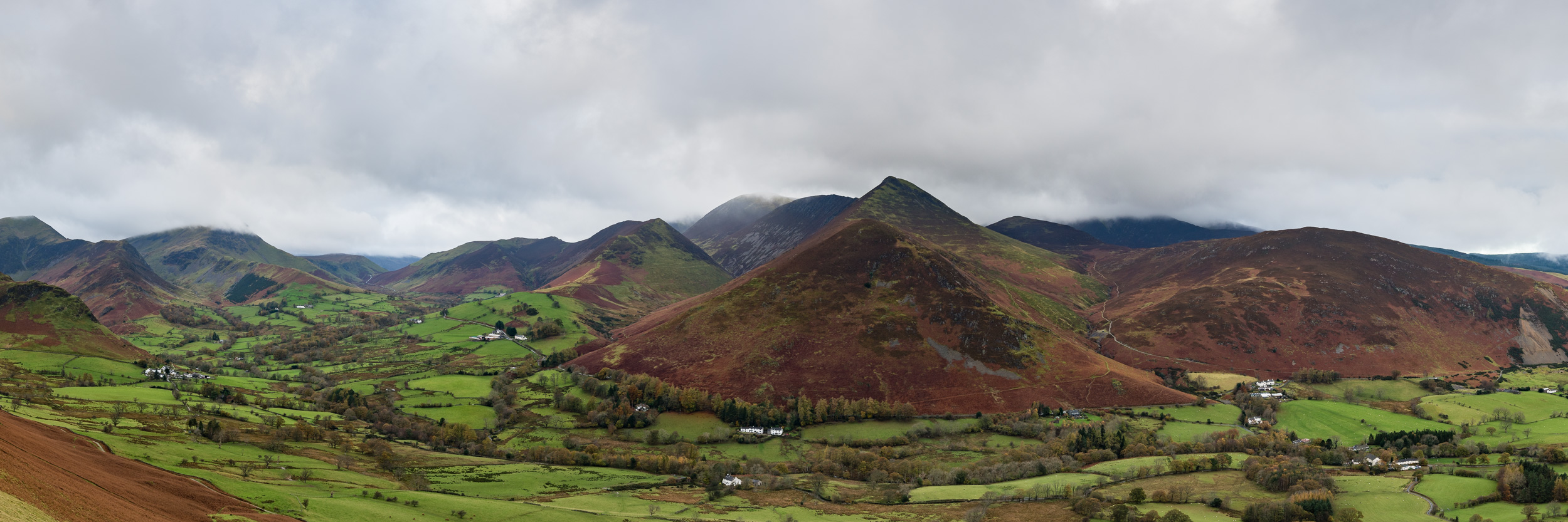
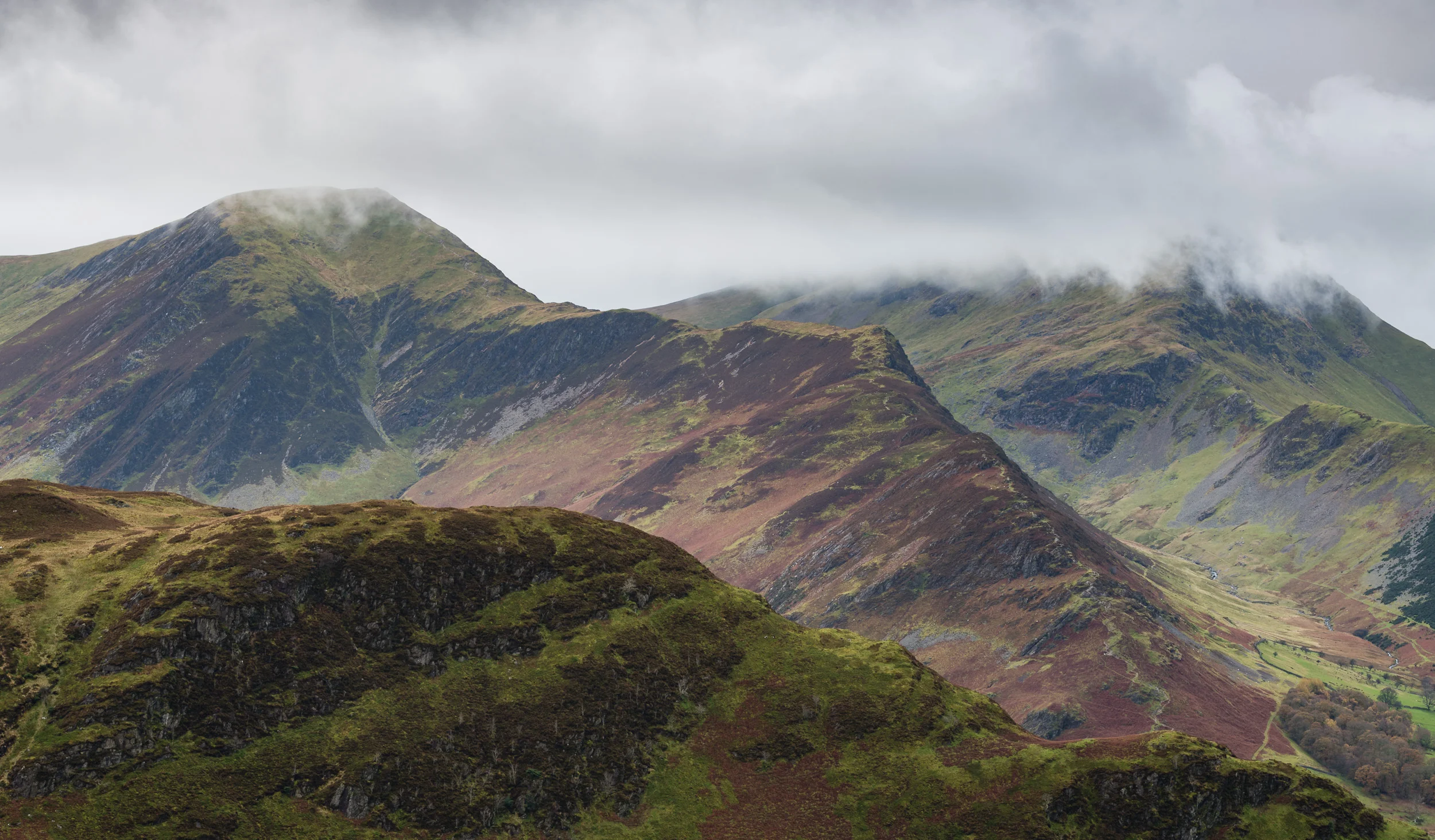


I hope you enjoyed part 2 of my Lake District adventure. Remember you can see part 1 here, and the 3rd and final part will be published next week right here on the blog.

Landscape Photography Adventure in the Lake District - Part 1
In this special blog post, I share with you the 1st part of my landscape photography adventure video from the Lake District.
Adventure
I love a going on a landscape photography adventure! Don't get me wrong, I'm very lucky to live in the south west of England. I've got easy access to two national parks and more coastline than I could ever photograph. Every now and again though you need to spread your wings, push your photography and get out there and visit somewhere different.
Earlier this year I had a fantastic adventure in Glencoe so I was keen to go on an adventure for autumn. But where would I go? Well, there aren't many better places to go in the UK for autumn than the Lake District.
I had given myself two and half days of photography in the Lake District. In that relatively short time, I had a list of locations that I wanted to shoot. These were a combination of locations that I had marked on my custom Google map over the years, some from my previous visit last year, and some from the excellent book Photography the Lake District.
As with my Glencoe adventure I knew I wanted to record my time at the Lake District using both photographs and videos. So in the next few blog posts not only will I be sharing with you the images that I captured but I've also created a 3 part video series so I can share the story behind the images.
Part 1 - Buttermere, Ashness, and Ullswater
Here is part 1 of the video in which you will see me photograph the lone tree on Lake Buttermere, Ashness Bridge, Ashness Jetty and Ullswater.
I hope you enjoyed the video and the images I captured. Here are the images again if you want to see them in a little more detail.


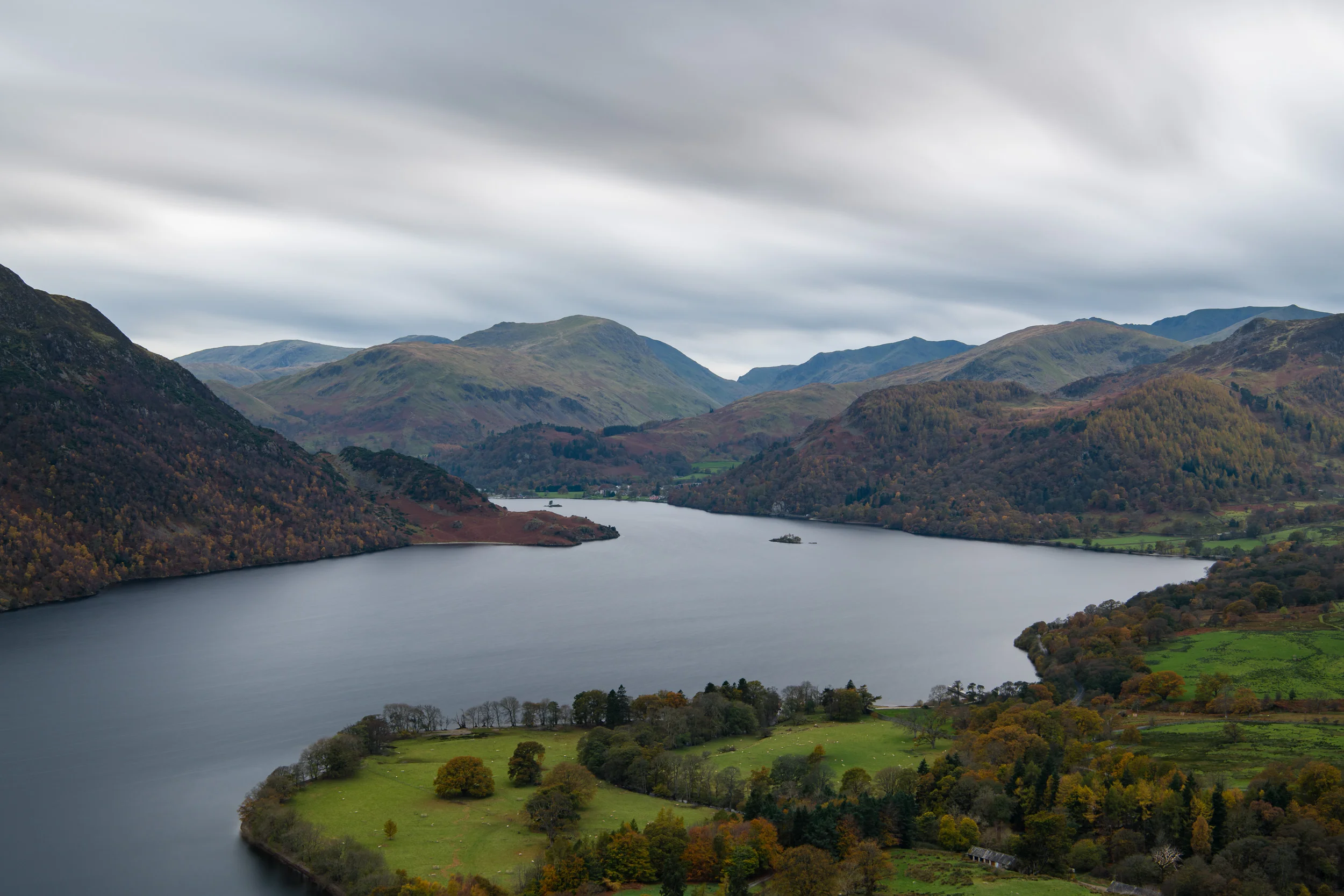
I hope you enjoyed part 1 of my Lake District adventure. I will be publishing part 2 next week so you won't have long to wait!

The Rumps - 5 Minute Photo Adventure
In this blog post I take you on another 5 Minute Photo Adventure. This time I'm back in Cornwall to photography the twin headland known as the Rumps. This is a great coastal sunset location and offers fantastic views of the surrounding coast. Read the blog and watch the video to see why.
Seeing More
The more 5 Minute Photo Adventure videos that I make the more I realise how amazing the coastline around the south west of England is. Over the last few years of photographing my local coastline, I've discovered many wonderful and dramatic locations. I am indeed very lucky to live in a place where I can access a wide range of beautiful photographic locations.
By shooting these videos I have started to discover more about the locations I photograph. For each video, I try to shoot lots of B-Roll so that I have additional footage to help tell the story of the location. This could be me walking around the location or using the drone to capture some aerial footage. It's from this aerial footage that I have seen some amazing coastal sights and views. It could be the elevated view or the view that would otherwise be inaccessible that provides me with a new way of looking at a location. A great example of this would be my previous 5 Minute Photography Adventure video from the Valley of the Rocks (insert link).
When I get home from shooting a video and I look at the B-Roll I often see how much more that location has to offer. Sometimes I get very focused on making an image that I forget to look around me and see what else there is. The B-Roll not only adds the video itself but also reminds me to keep my eyes open when I'm on location and not to just look through the viewfinder.
The Rumps
With so many great locations to pick from in the South West, it was hard to decide where to shoot my next video from. So, as I often do I checked out my custom Google Map and spotted the location known as The Rumps. The weather forecast was looking OK, but I thought it would be worth the risk so I packed my gear and headed out in the car. Here is what happened:
The Images
In the video, I showed you just one of the three images that I took that evening. Here are all three for you to look at:


While these images are pleasing enough, I don't feel any of them stand out. When shooting one of my 5 Minute Photo Adventure videos it's always nice to get a standout image to finish the video with, but the video is more about my desire to share the location with the viewer, tell them about my process of shooting the image, and hopefully inspire them to visit the location. So I don't necessarily consider it too much of an issue not to have a portfolio class image at the end of each video. It would be nice if every trip out with the camera did produce a portfolio class image but this simply isn't the case. For me, any time out with the camera is time well spent. Getting an awesome image is a bit of a bonus.
Looking at the images now I don't think the compositions work particularly well. Sure, not having great light didn't help, but I'm not entirely sure nice side lighting or a pink sky would have helped. The images lack balance and in some cases, they need more negative space in the lower part of the foreground.
So while these images might not necessarily be my best work, they are still important. Every image I take, good or bad, I will personally critique to see how I might improve next time. Photography is a journey of constant learning and improvement, but one that I still very much enjoy.
Looking back at my previous visits though, I think I prefer this viewpoint. This image was taken south of the viewpoint in the video and shows a bit more of landscape around The Rumps.
Have you been to The Rumps before? How much do you critique your own images? Are there any locations you like to me make a 5 Minute Photo Adventure video on? Let me know in the comments below.

Valley of the Rocks - 5 Minute Photo Adventure
In the blog this week I head off to the Valley of the Rocks in north Devon to shoot another 5 Minute Photo Adventure video. See the images I took at this dramatic coastal location and be inspired to visit yourself as I show you grandeur of this location from the air.
Drama!
Photographers will often use the word dramatic to describe the coastline of the south west of England. I've even been know to use the word once or twice in my own videos! While it is true that much of the coastline in the area is indeed dramatic, there are few such locations as the Valley of the Rocks in North Devon that have really earned that title.
No matter if you are a photographer or not, walking along the South West Coast Path as it cuts through the valley is a sight to behold. On a good day you can see out over the channel and onto Wales, or just appreciate the steep and rocky cliffs as you stroll along the path at what appears to be a dizzying height.
But enough of me waxing lyrical about the location, take a look at my latest 5 Minute Photo Adventure video to see what I'm talking about.
On Location
I hope you feel inspired to visit the Valley of the Rocks. I shot a little more drone footage than I probably would have for one of these videos, but sometimes you need more than 15 to 30 seconds of video footage to help tell the story of a location.
I opted to shoot from an elevated position so that I could get a long view down the valley and hopefully get some nice evening light across the rock faces. These are two of the images I took, just taken a little time apart.
Nikon D750, Nikkor 16-35mm f/4 @ 22mm, ISO 100, 1 second, f/16, Lee Filters circular polariser and ND grad.
Nikon D750, Nikkor 16-35mm f/4 @ 22mm, ISO 100, 1.3 seconds, f/16, Lee Filters circular polariser and ND grad.
I'm reasonably happy with both images. They are probably the best images I've captured there. However, being the picky photographer that I am, there are a couple of things I would like to have been a little different. Firstly it would have been nice for the golden light to be a little stronger and more widespread. You can just about see the golden light coming through on the foreground rocks, but having more it along the valley would have been nice. However, it did light up the sky very nicely.
While things like the light are sometimes out with my control, the composition is my job. It's not that I'm unhappy with the composition of both photos, but for the first image, I should have shot just a little wider. Perhaps around 17 or 18 mm. The setting sun in that image is very close to the edge of the frame. I should have either excluded it all together or given it more room. I was probably concentrating on other elements around the frame or just waiting for the sun to go from the frame. It might have been that this was a test shot while I was waiting for the sun to leave my composition. It's strange how sometimes that an image you never intended to be the "one" can end up being the favourite from a shoot.
Go Explore
Though I only photographed from one location that evening, there are numerous spots along that part of the South West Coast Path to shoot from. It's well worth getting there a little early just to have a wander and take in the location. No matter what you shoot with or what you like to photograph you should find something inspiring. It might even be the wondering goats or the cricketers playing a match on the valley cricket field!
So have you been to the Valley of the Rocks? Did the video and images give you the inspiration to visit this stunning location? Let me know in the comments below.
And before you go....

Oh, and one last thing. I'm very happy to be in Feedspots Top 75 Landscape Photography blogs. Why not check out out the other 74! There are some top names in there so it's well worth checking out.

Trevose Head - 5 Minute Photo Adventure
In this blog post I take you on another 5 Minute Photo Adventure. This time I'm off to Trevose Head on the north Cornish coast. This amazing location has a lot to offer the landscape photographer. Read the blog and watch the video to see why.
As a landscape photographer I'm extremely lucky to live in the south west of the UK. Even if I didn't have Exmoor and Dartmoor, I would still have over 630 miles of the South West Coast Path to photograph. With so much to choose from I couldn't possibly pick a favourite location, but when it comes to Trevose Head, I'd have to say it's up there in my top 10 Cornish coastal locations to photograph.
So what makes Trevose Head so special? Well, for me it's the drama of the location. It's got the lighthouse perched on a cliff edge, the rocky inlet where the waves come crashing in and it makes for a great sunset location just about all year round. And did I mention you can drive within 200m of the best spot to shoot from?
On the downside it is very exposed and getting blasted by rain, wind and sea spray isn't to be unexpected, so sometimes it's nice to have the car nearby after you've been battered by the elements!
If this sounds like the kind of location you might want to photograph, why not check out my 5 Minute Photo Adventure video below:
Padstow Lifeboat Station
As I showed in the video, the lighthouse isn't the only spot to photograph at Trevose Head. Located not farm from the lighthouse is Padstow Lifeboat station. As you can see on the map below both locations are close together and so if you have time it's worth visiting.
This was my first time visiting the lifeboat station. I remembered it after looking at the area on my custom Google Map while I was wondering about. It's not that easy to photograph if you want to include the surrounding elements such as the stairs down to the entrance, but with the right lens and a bit of moving about, a good image can be made.
Nikon D750, Nikkor 16-35mm f/4 at 22mm, ISO 100, 30 seconds, f/13, Lee Filters circular polariser, Little Stopper and ND grad.
Trevose Head Lighthouse
Though the forecast for Trevose Head was to be for relatively clear skies, as you can see from my first image this wasn't exactly the case.
Nikon D750, Nikkor 16-35 f/4 at 19mm, ISO 100, 2 seconds, f/11, Lee Filters circular polariser, 3 stop ND and ND grad.
While I do like this image what I was really hoping for was for some golden light from the setting sun (off to the left) to illuminate the rock faces. This would have really lifted the tone of the image. However, sometimes you just have to work with the light you have so I decided to adopt a slightly different style.
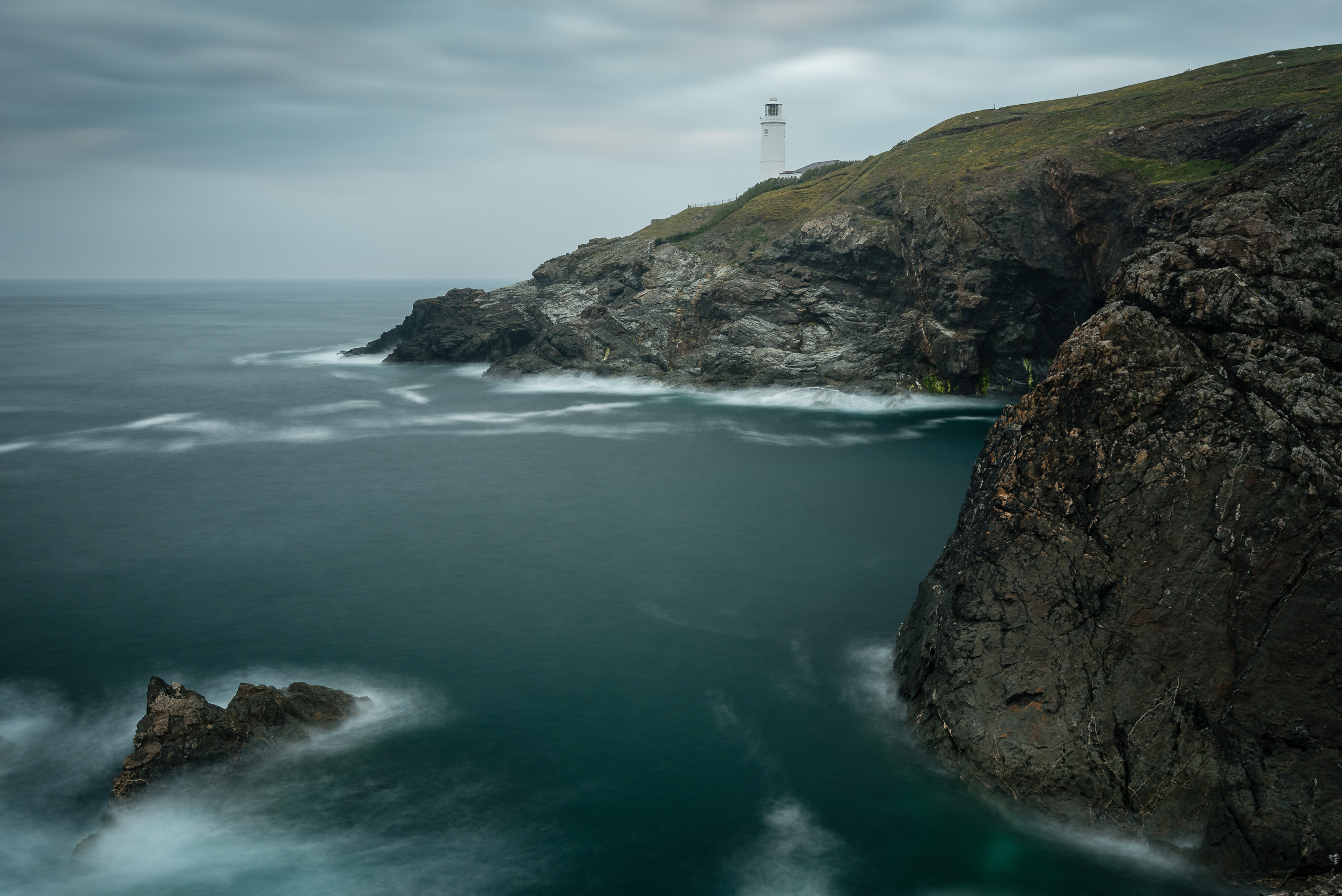
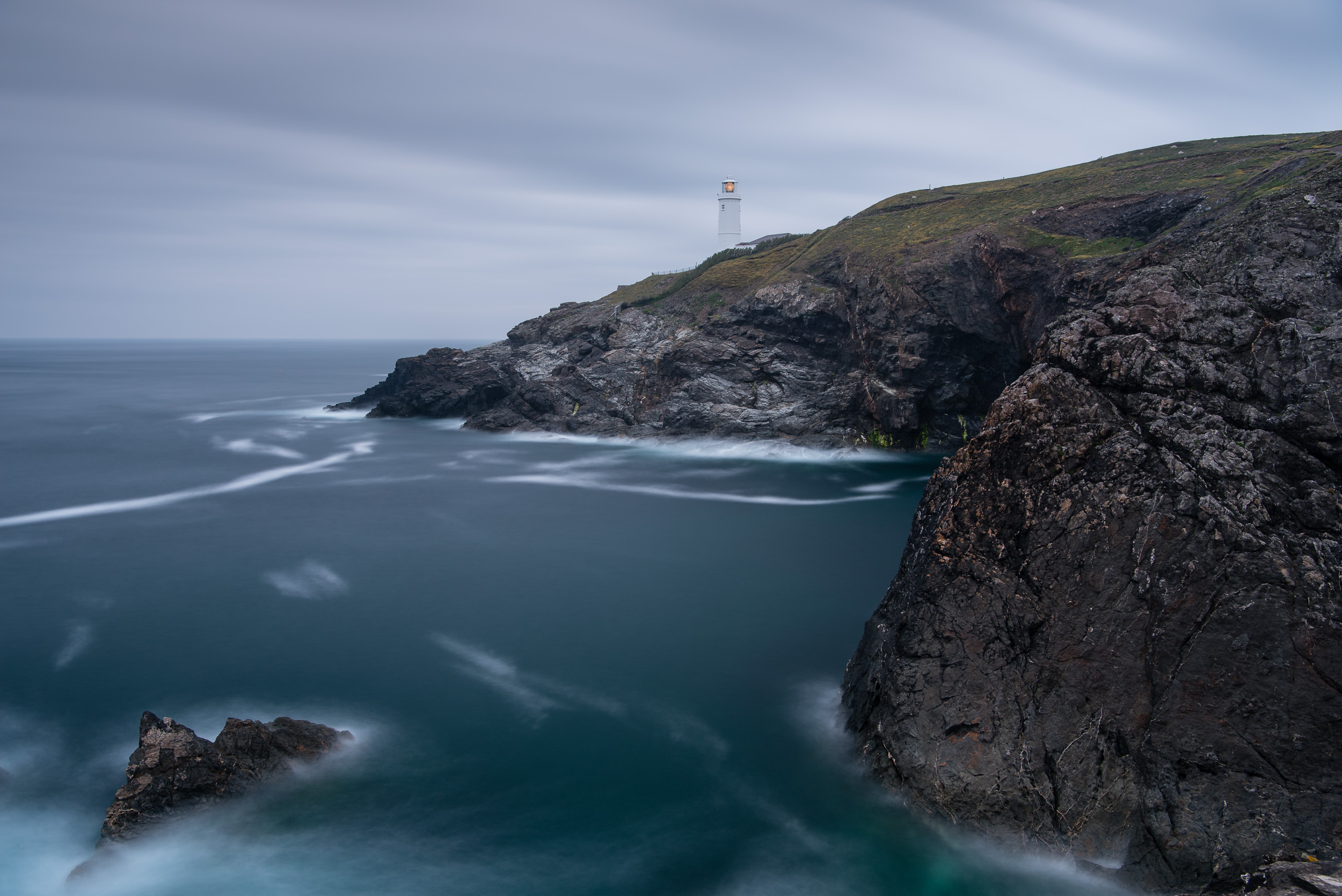
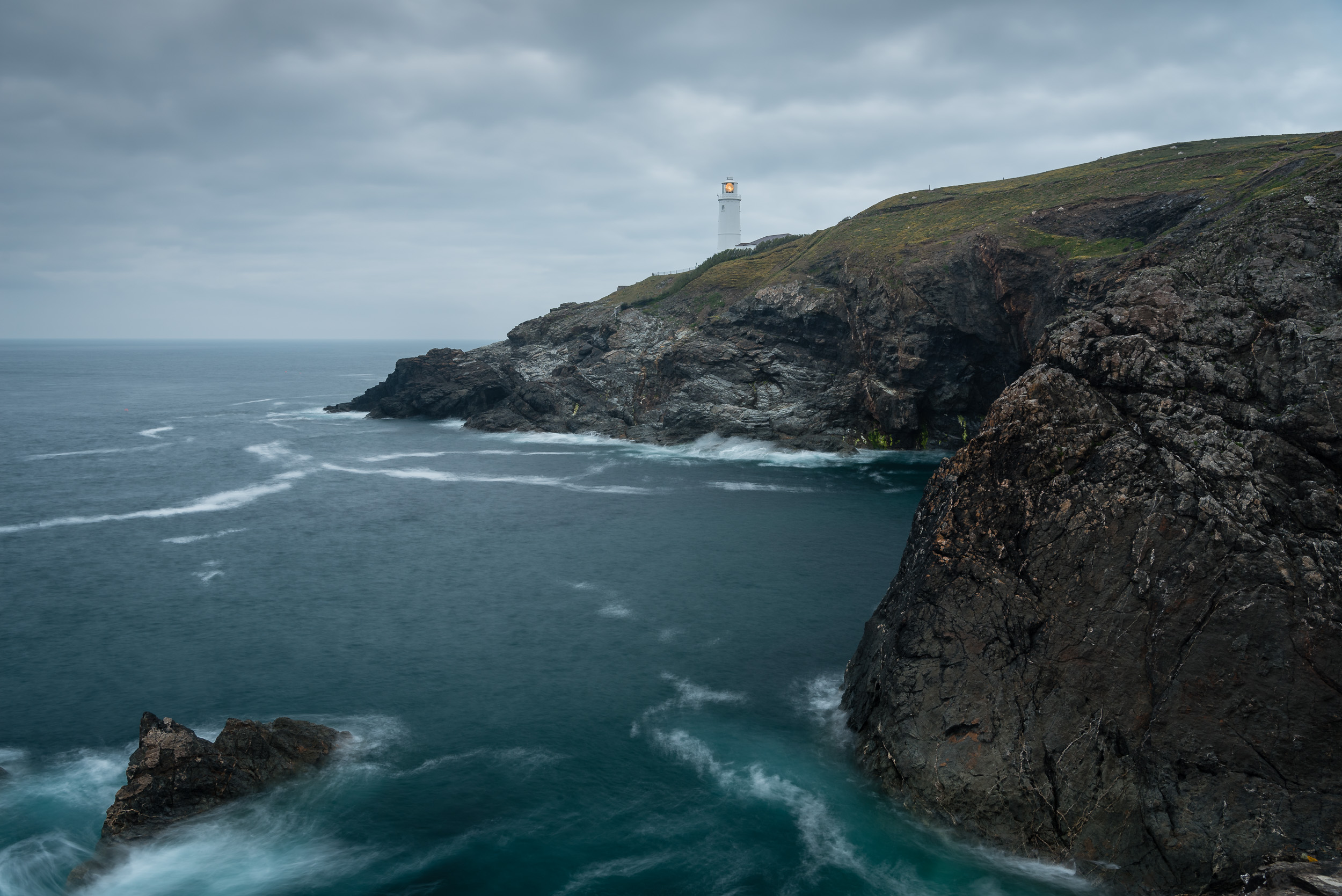
By embracing the grey and opting for longer exposures I was able to create a set of darker and moodier images. I also varied the exposure times by choosing different ND filters. The longer exposures allowed the crashing waves to paint white lines and create shapes on the image.
I'll be back...
Though I didn't manage to create the image I had planned for I still came away with some images that I'm very happy with. I also got a chance to to photograph Padstow Lifeboat station, so it was good to get two locations for the price of one! One thing is for sure, I'll be heading back to Trevose Head again in the near future.
So have you been inspired to visit Trevose Head? Have you photographed this location before? Let me know in the comments below.

Bedruthan Steps Photo Adventure
In the blog this week I share with you the story of my latest trip to Bedruthan Steps to photograph the coastal thrift. Not only will you see the images from that trip, but I also share with you my top tips for photographing Bedruthan Steps. And if that wasn't enough for you, I also share with you my latest 5 minute photo adventure video!
Why Shoot Bedruthan Steps
I have a great many locations on my custom Google map, many of which can be shot at any time of year. There are a few however that are best shot at particular times of the year. Bedruthan Steps on the north Cornish coast is one such location. It has plenty to offer the photographer with golden sand beaches (at low tide) and miles of dramatic Cornish coastline.
It's spring time though when Bedruthan Steps comes to life. Like many areas along the coast, springtime brings on the flowering of the thrift, a beautiful pink flower that likes to cling to the side of the coastal cliffs. If you can find a nice clump of thrift and you are lucky enough to get some great morning or evening light, you'll have everything you need to produce an amazing image.
While there a number of locations to shoot the thrift in Cornwall, my favourite place to shoot them is at Bedruthan Steps. There is nothing quite like seeing the thrift flowering all along those stunning coastal cliffs.
The Clock is Ticking
The thrift flowers in spring but it may only be in its prime for a couple of weeks. This unfortunately isn't exactly the same time every year so knowing when to go isn't easy. Bedruthan Steps is a 1 hr 40 minute drive so I want to be reasonably assured of good conditions if I go. I would also need to the good conditions to match up with a free evening for photography!
However, time was ticking for me. I had started to see some spectacular shots of the thrift at Bedruthan Steps on Instagram so I was starting to panic that I was going to miss the best of the thrift this year. Luck had not been with me. When I had a free evening the weather was rubbish, and when the weather was forecast was good I didn't have free time. I was getting frustrated!
As mid May rolled round I came to the conclusion that I would have to go now or forget about for this year. So with a dubious Sunday evening forecast I decided to put caution to the wind and go for it regardless of the conditions.
A 5 Minute Photo Adventure
As I announced in my recent blog post for Daymark Tower, I've started a new series of videos that aim to give the viewer an introduction to a location and inspire them to photograph it. So for the 2nd of my 5 Minute Photo Adventure videos I've created this video of Bedruthan Steps which I filmed on my recent trip there:
I hope you enjoyed that video and that it has indeed inspired you to visit Bedruthan Steps. If you want to see the images from the video in a bit more detail you'll find them below.
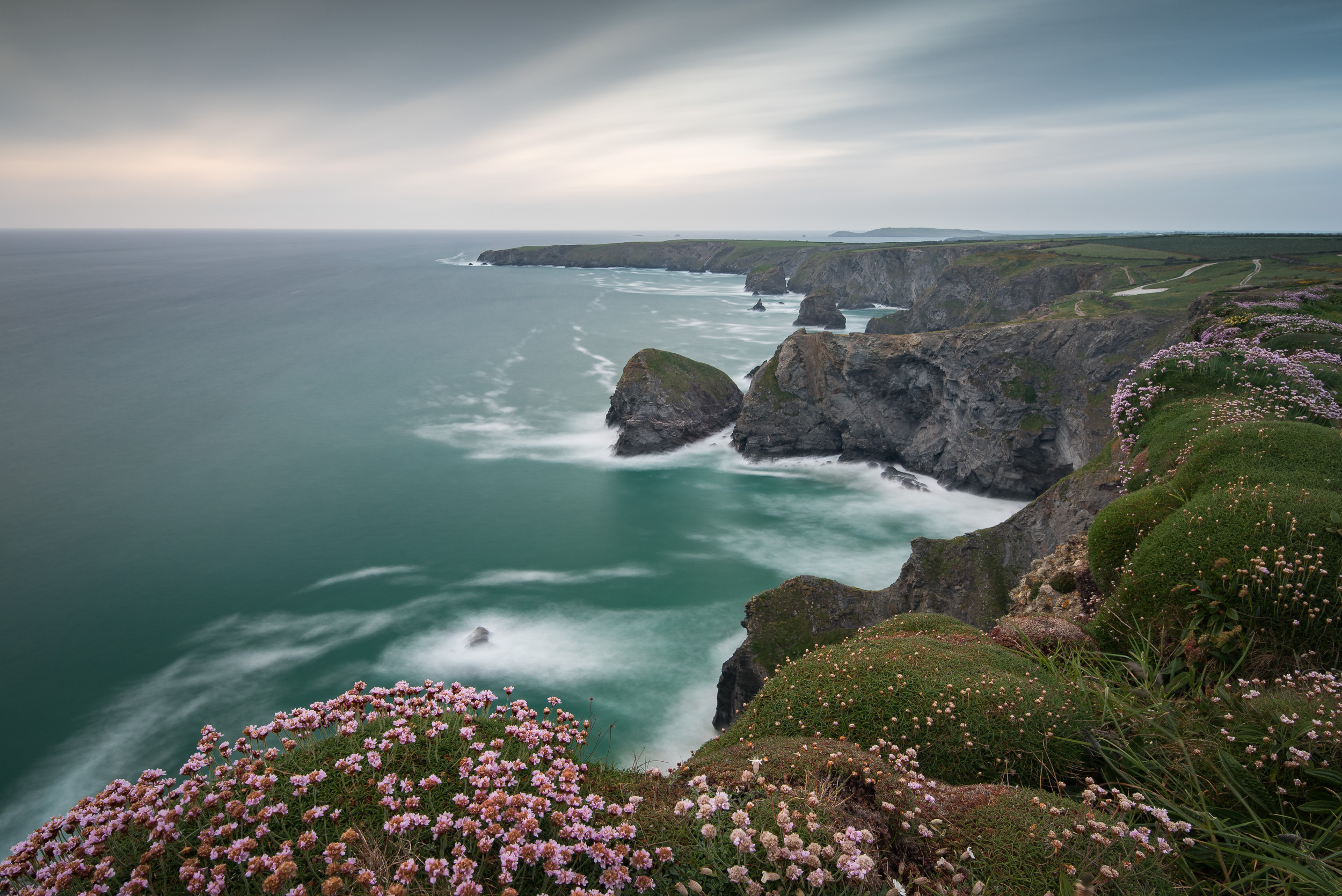
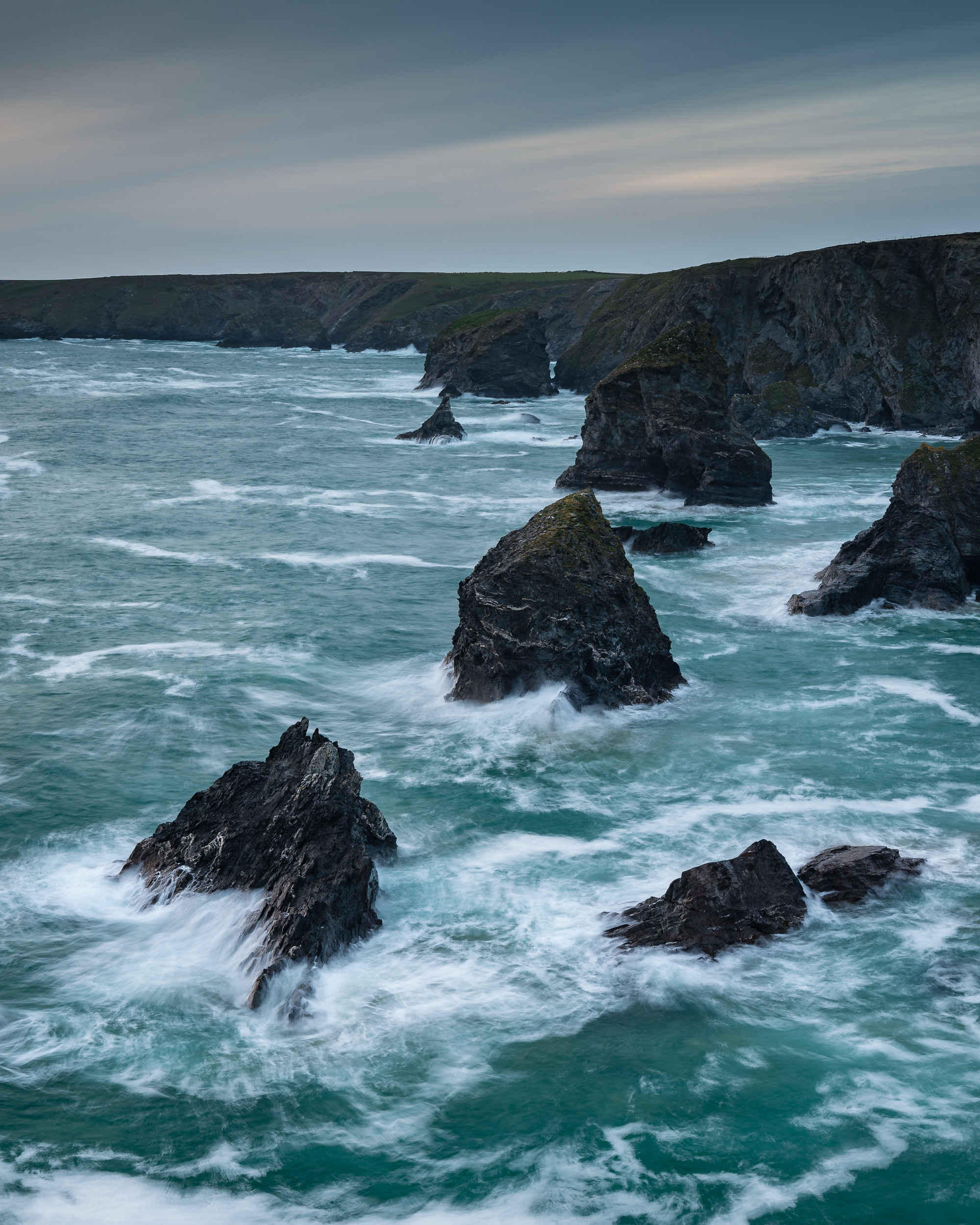
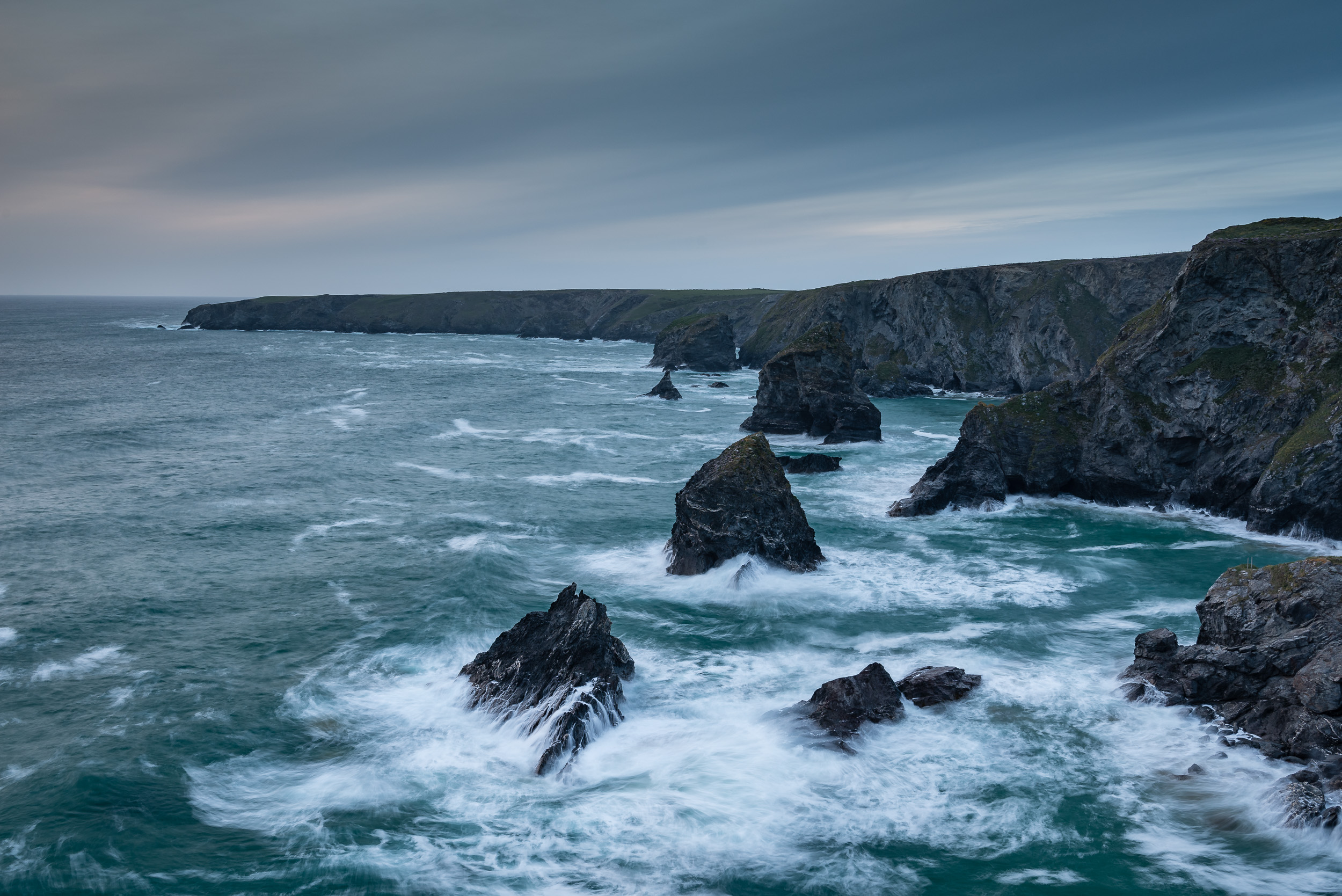
So if that has inspired you to visit Bedruthan Steps, here are my 3 top tips to help you make the most of your visit:
Lenses - Take a wide angle lens for shooting the thrift, but also take a medium telephoto (like a 24-70mm) and shoot and isolate some of those rocky sea stacks.
Walk the Walk - Though there are a couple of great viewpoints just a short walk from the National Trust car park, you'll find so much more by walking along the coast path. So give yourself sometime to explore the area. The beach at Bedruthan Steps is also worth checking out, but only at low tide and you don't mind the steep descent.
Be Careful - It should go without saying, but do be careful on the cliffs, especially when photographing the thrift. It's all too easy to get very close to the edge in search of some nice thrift, and if it's windy up there you don't want to loose your balance.
Though I was keen to get to Bedruthan Steps to photograph the thrift, it is a location I will visit at anytime of year. The coast line is beautiful and spectacular there and given the right like it can make for some epic photographs.
So have you visit Bedruthan Steps? Have you photographed thrift before? Let me know in the comments below.

My Top 5 Tips to Improving Your Landscape Photography
In this blog post I share with you my latest video in which I tell you what my top 5 tips are to improving your landscape photography.
Tips for Landscape Photographers
I've been shooting landscapes since I got my first DSLR back in 2006. However, it's probably only in the last few years that I've started to really progress as a landscape photographer.
In this vlog, I share with you the 5 things I think will help you improve your landscape photography. This is a personal list, and not even necessarily the only 5 things you should do. It's just 5 things that I did that had a direct impact on my landscape photography. Hopefully, some of them will work for you also!

In Summary
I explain the tips in the video, but for those of you who are currently unable to watch the video, the tips are:
Practice - Make sure you practice your photography. Practice lots!
Be Inspired - Have plenty of sources of inspiration!
Get Involved - Go on a workshop or enter for a magazine feature!
Get Sharing - Share your work or enter a competition!
Adventure - Get out there and go on a photography adventure!
And there is a bonus tip, but you'll just have to watch the video for that one!
So do you have any tips you want to share? What things did you do to improve your skills as a photographer? Which of my tips are you going to follow? Let me know in the comments below.
Glencoe Adventure - Part 2, The Vlog
In this 2nd of two special Glencoe blog posts, I'll share with you my vlog of the 24hrs I spent in Glencoe before the workshop. It was a busy and tiring time but the effort I put in resulted in some special images!
Maximising your Time
Last week, in part 1 of my Glencoe Adventure blog, I shared with you the images and stories from my time at the Dawn 2 Dusk Glencoe photography workshop. This week, in part 2, I will be showing you what I got up to with the 24hrs I had between arriving in Glencoe and the start of the workshop.
I had booked the workshop more than 12 months in advance so I had plenty of time to organise and plan my trip. Though the workshop started at 1 pm, the risk of being delayed if I decided to travel up on the day was just too great. So the only option was to travel up the day before. Rather than opt for a mid-morning departure from Devon and arrive early evening in Glencoe, I decided that a very early start was in order.
If I left at 5 am and undertook the 520-mile journey, I could feasibly make Glencoe for about 3:30 pm, just in time to get some sunset pictures! I then also had the morning to do a dawn shoot, with perhaps some post-breakfast shooting and all before the start of the workshop. My plan had been hatched!
Rather than write about the 24 or so hours I had in Glencoe, I've documented my adventure in my latest vlog. Check out the video below, and if you haven't subscribed to my YouTube channel then what are you waiting for!
Needless to say, I did not regret that 4:30 am alarm call!
Image Gallery
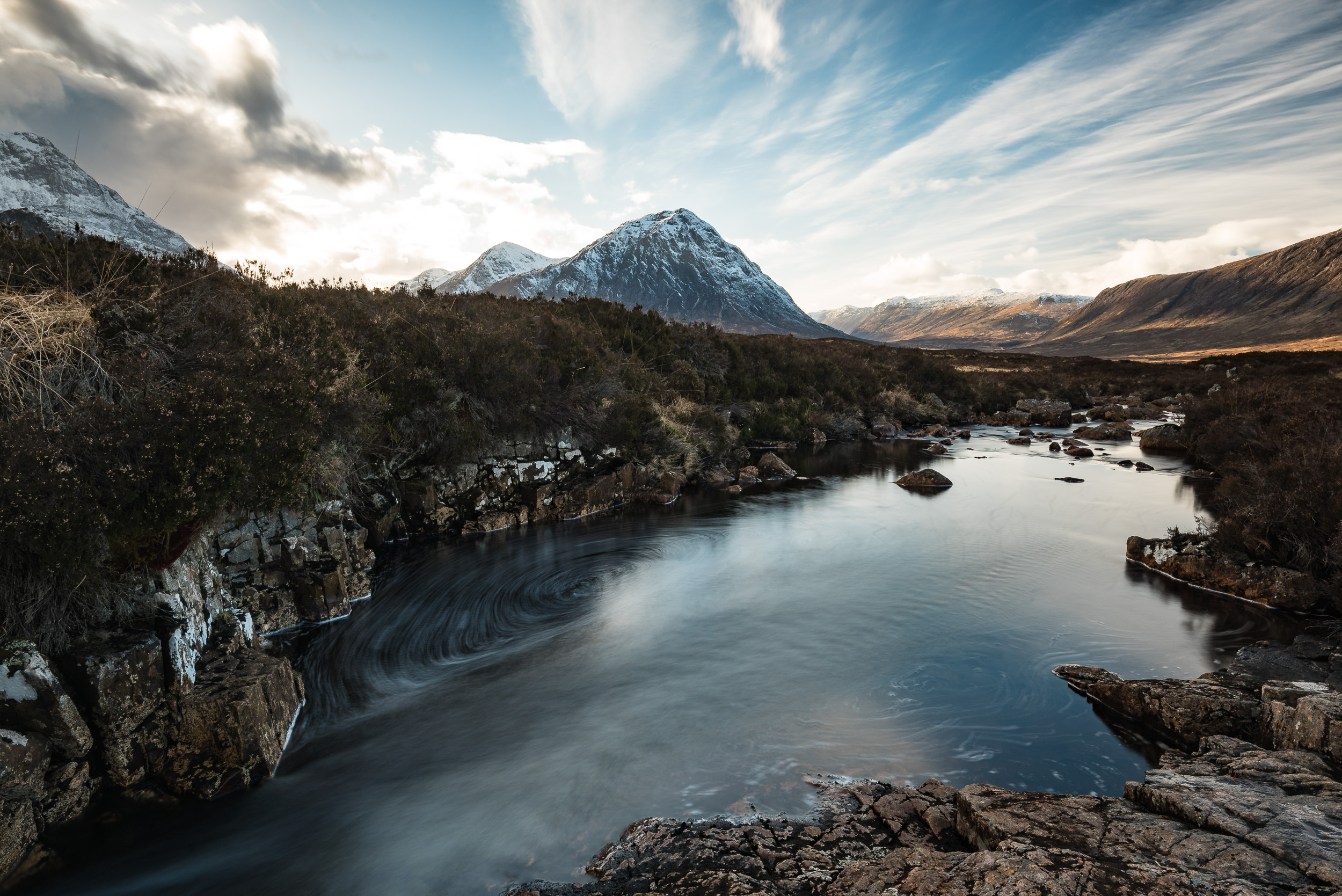
The gallery below is a collection of the images that I took during my 24hr adventure in Glencoe. They are in the video but sometimes it's nice to see them in a bit more detail so click on an image to bring them up in a lightbox.




A Good Book to Pass the Time
The video is just a snapshot of my 24 hours before the workshop so here is a few stories that weren't in the video.
Firstly, while the journey from home to Glencoe took around 10 hours, it didn't feel like a very long drive. The principle reason for this is entertainment. I've been a long time subscriber to Audible and listening to a good audiobook is a great way to pass the time on those long car journeys. For the journey, I started a new book called Fear the Sky by Stephen Moss and read by R. C. Bray (who also read the other excellent sci-fi book The Martian). I had a feeling it was going to be good (as it was recommended by the same person that recommend The Martian to me), but I was engrossed from the moment the story started. Let's just say that I almost didn't want the journey to end!
Most landscape photographers drive a lot and if reading any of the Game of Thrones novels seems like an impossible task then why not pass the time with a good audio book.
Waders and Being Social
One of the shots that I wanted to get while I was there was a sunset shot of Stob Dearg (Buachaille Etive Mor) from the River Etive. To get the shot that I wanted I would need to wear a pair of waders (as inspired by this Thomas Heaton video). I borrowed my father-in-law's waders and put them in the boot of the car, unsure whether I would actually need them or not. When I arrived in the layby near my planned shooting location I felt a bit silly putting on waders to go out and take images. No one was about though so I set off on the short walk to the location where I would shoot.
However, as I approached the spot I could see another photographer there. This is generally not an issue and I'm always up for a bit of a chat but what would this person think if they saw me wearing waders to take photographs! Well, imagine my surprise when he also was wearing waders! All of a sudden it didn't feel that odd to be wearing a pair of waders to take photos.
The chap in question was Johnny Baird and we joked about what the odds would be that there would be two photographers named Baird, wearing waders, taking landscape photographs from the middle of the river that evening! Landscape photography can be a solitary pastime so it's nice sometimes when you meet a like-minded individual and you can chew the fat over photography while standing in the middle of a river!
Johnny has a wonderful portfolio of landscape images and I strongly suggest you check out his Facebook page.
A Missed Opportunity
After my epic early morning of photography shooting Stob Dearg from Beinn a'Chrulaiste I was hugely satisfied with my morning's work. After breakfast though I thought I go and see if there was anything else I could shoot before the workshop started in the afternoon. I also thought it would be a good chance to properly test out my latest addition to my kit bag, the DJI Mavic Pro.
One of the locations I visited was the spot where you can photograph Stob Dearg and the River Coupall. As this is such a hugely popular spot for landscape photographers I was not surprised to see another couple of photographers there already. I didn't want to spoil these photographers experience of the location so I did ask if they didn't mind if I flew the drone around the area. It wasn't a problem and as the drone is often a talking point we also got chatting about drones and photography in general.
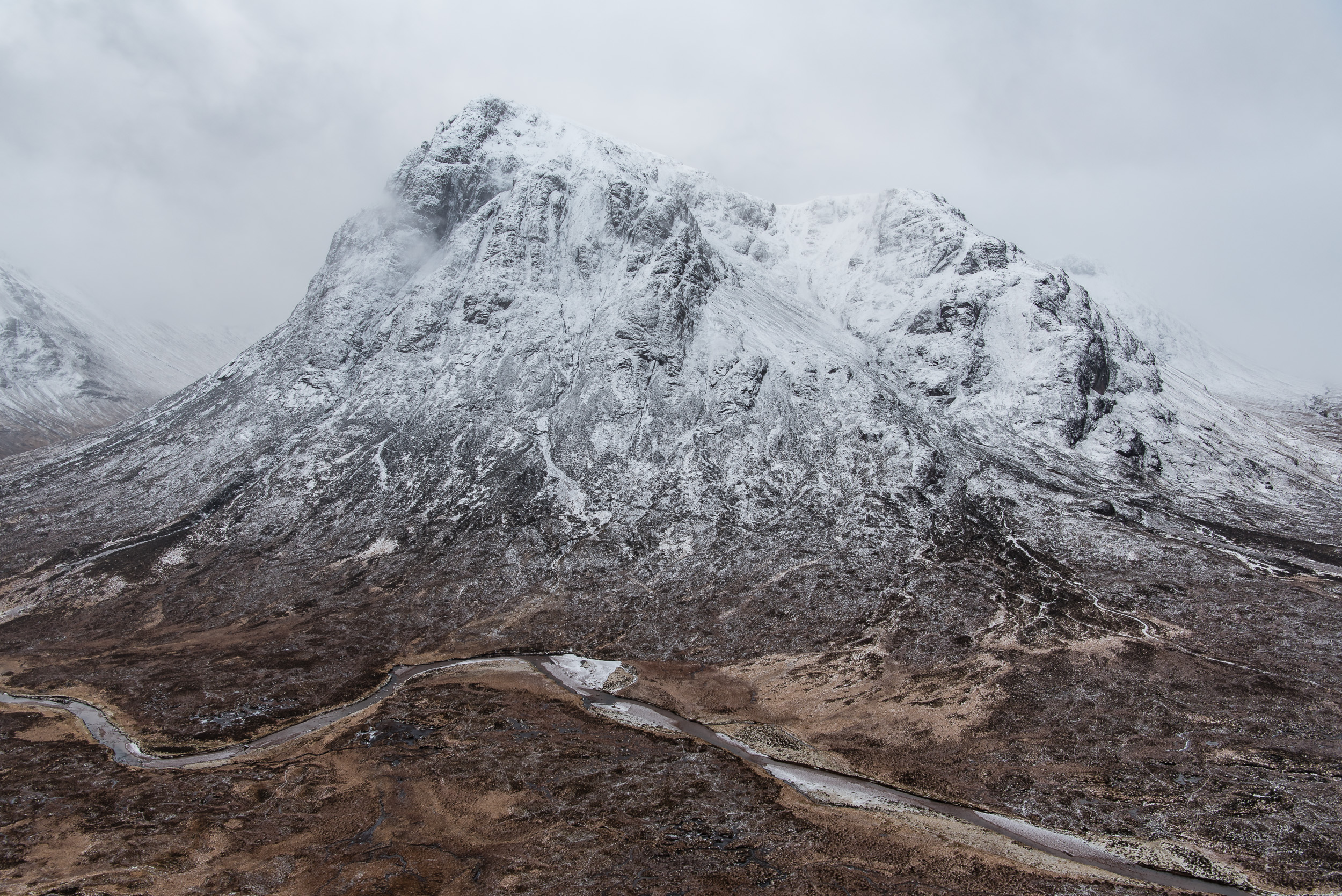
The conditions at the location were also ideal for stills photography. The snowy peak of Stob Dearg was clearly visible, there was some cloud in the sky and plenty of water in the river. All I had to do was walk the very short distance back to the car and get my DSLR. Except I didn't. I already knew that we would be visiting this very location in a couple of days during the workshop so why would I bother shooting it now. After all, I'll get the same shot when I return.
Having grown up in Scotland I really should have known better. After all, Scotland is well known for having weather that produces all four seasons in one day. Sure enough, when I did return with the workshop group the conditions were totally different. One of the main focal points of that spot is the visibility of Stob Dearg but when I returned it was covered in cloud. Though I waited and waited for the cloud to clear it never completely cleared, leaving me regretting my rather silly decision of not shooting the scene when I was there earlier! Lesson learnt.
An Epic Adventure
Even if I'd only had those 24 hrs in Glencoe it would have been a worthwhile trip. As I said in the intro of the video it's important to go on an adventure every now again and push the boundaries of your landscape photography.
It took time and effort to get up Beinn a'Chrulaiste at dawn to get those shots of Stob Dearg but it was worth every step to have the pleasure and simplicity of shooting up there. The previous few weeks shooting in my local area hadn't been hugely successful and this trip to Glencoe gave my passion for landscape photography a well-needed boost.
So if you are struggling with what to do next with your landscape photography take a few days off work, grab your camera and go somewhere where you've never been before. It will be time and money well spent!
So when was the last time you went on an adventure with your photography? What's the furthest you've driven to get a photograph? Let me know in the comments below.

Glencoe Adventure - Part 1, The Workshop
In this first of two special Glencoe blog posts I'll share with you my images and stories from the Dawn 2 Dusk Glencoe workshop that I attended recently. It was a fantastic few days of photography. Though the weather was typically Scottish at times, the variable conditions resulted in some awesome images.
The Importance of Adventure
I have talked about the importance of practising the art of photography on this blog a number of times. For me, and I expect this is the same for many photographers, most of this practice will take place in your own back yard. Not literally of course, but most of the time you are out with a camera it will be in your local area. For me, this is Devon with the occasional visit across the border to Cornwall or Dorset.
While there are many benefits to shooting locally, such as time and familiarity, there is nothing quite like the challenge of pushing the boundaries of your photography by going on an adventure! Adventure means different things to different people, but for me, it's the excitement of travel, of meeting new people and of course photographing something new. All these elements can really push your photography in a way that you sometimes just can't get locally.
Though I have visited Glencoe a number of times and even grew up not far away, this will be my first time in the area as a dedicated photographer. So while the area might be familiar, the prospect of photographing it was exciting, to say the least. Well worth the 3 days off work (plus the weekend) and the 10 hours drive each way!
This week, in the first of two Glencoe blog posts, I will be sharing my memories, thoughts and photographs of the Dawn 2 Dusk Photography Glencoe photography workshop that I attended. Next week, in part 2, I will be sharing the images and video that I took with some of the extra time I had in Glencoe.
Why Workshops are Important
So why didn't I just spend all the time I had in Glencoe doing my own thing? Well, for me at least, workshops provide a number of unique benefits that I can't get by shooting on my own:
Practical and Artistic Development - Tuition is still a big part of my development as a landscape photographer and for the Glencoe workshop, I had access to two of the UK's leading landscape photographers, Ross Hoddinott and Adam Burton. Having access to this level of photographer not only helps with the artistic side of my photography but also with some of the more practical aspects of photography (read how later in the blog post).
Being Social - The life of a landscape photographer can be a solitary existence, especially if you favour early mornings like me. However, every now and again it's just good to be around like-minded individuals. Just by chatting during the day you can not only learn about how your photography looks to others, but also learn from their photography. At night, normally around the bar, it is a great chance to share those funny, odd, or disastrous trips out with the camera.
Local Knowledge - There is only so much planning and preparation you can do on the computer. In order to maximise time with the camera when you arrive at a new location, it's sometimes useful to have access to some local knowledge. For me, workshops provide me with an introduction to the photographic possibilities of an area and while I could do this myself I don't always have the extra time.
So now that we've talked about the importance of adventure and the value in workshops, let's get into the most important aspects of this adventure, the photographs!
Day 1: Castle Stalker
The 2.5-day workshop started with a briefing at our base of the Clachaig Inn just outside Glencoe village. Adam and Ross managed to suitably embarrass me by remembering my birthday with a chocolate cake and singing happy birthday! After the very sociable start of coffee and cake, we all headed down for a sunset shoot at Castle Stalker on Loch Linnhe.
Nikon D750, Nikkor 70-200mm f/2.8, @ 200mm, f/8, 1/60th second, ISO 100, Lee Filters ND Grad, 16:9 crop.
As you can see from the shot above, the descending sun illuminates the side of the castle rather nicely. I was hoping to get a similar shot to this with water surrounding the island, but as the tide came in the light became flat thanks to some heavy cloud where the sun was setting.
It was still a good start to the workshop and we all headed back to the hotel for some well-earned food and drinks.
Day 2: Lochan na Fola and Stob nan Cabar
As you might expect with a landscape photography workshop it was an early start to the 2nd day. Fortunately, the drive to our next location of Lochan na Fola wasn't far from our hotel so the alarm call wasn't too early.
When we arrived at Lochan na Fola the water was beautifully still giving us some wonderful reflections of Stob nan Cabar. Just as we setup though some cloud rolled in blocking the view of the mountain. As we waited I decided to try out my new drone the DJI Mavic Pro. The arrival of the drone caused a bit of excitement amongst the group as I demonstrated some of its capabilities. While I couldn't get find a gap in the cloud to fly a little higher, I did get the chance to grab a quick group shot.
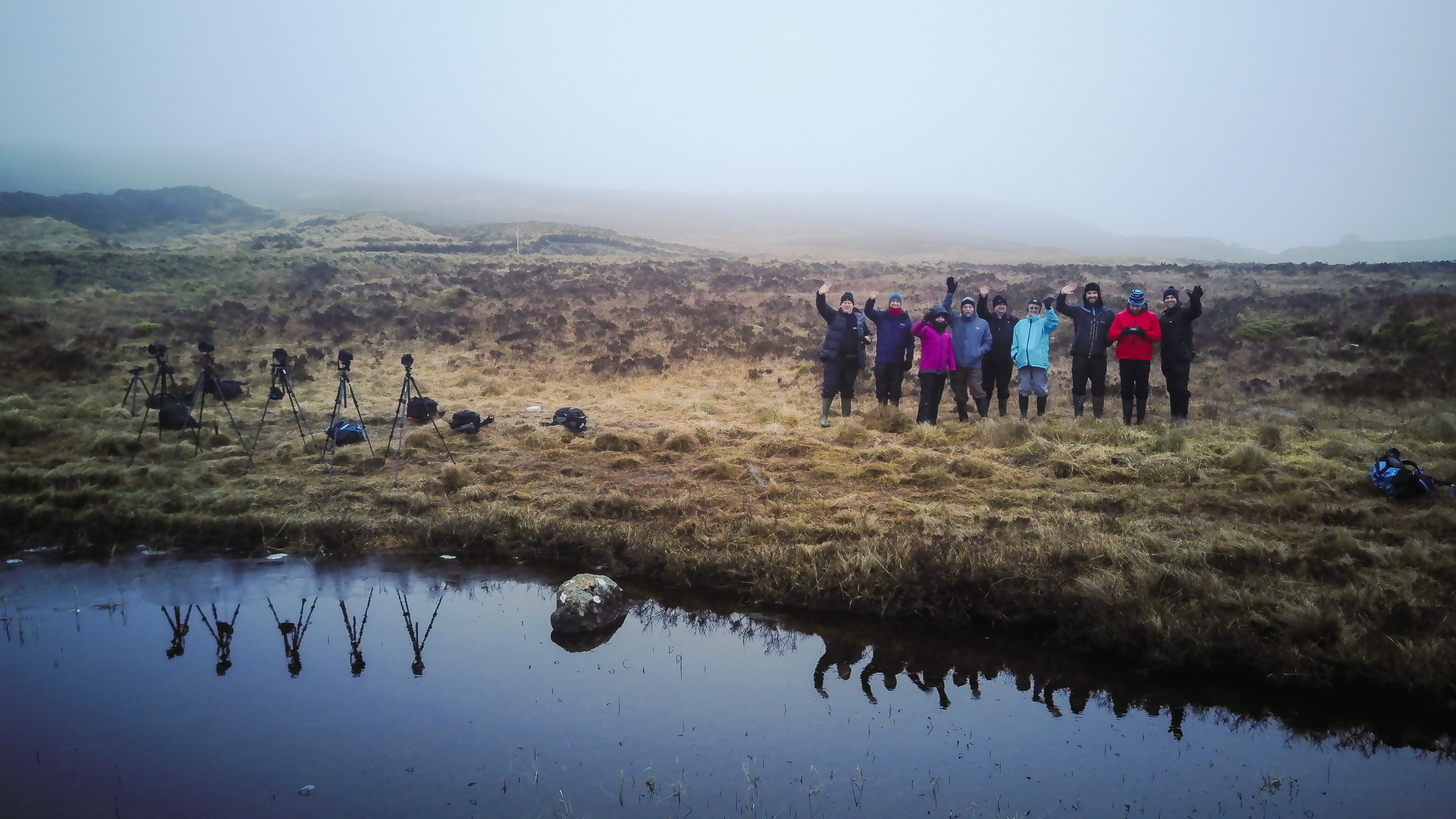
We didn't have to wait to long for the cloud to clear though and all of sudden it was battle stations as we were presented with some truly epic scenes!
Nikon D750, Nikkor 16-35mm f/4 @ 18mm, f/11, 1/20th second, ISO 100, Lee Filters Circular Polariser.
Nikon D750, Nikkor 16-35mm f/4 @ 26mm, f/11, 1/20th second, ISO 100, Lee Filters Circular Polariser.
I can't decide which of the two images above I like the most. Both of them greatly appeal to me with their near perfect reflections and frosty reeds in the chilly lochan. It would have been so easy just to go back to the hotel and have an early breakfast when the cloud came in, but everyone was glad they stuck it out.
Day 2: Lochan na h-Achlaise and Loch Ba
After a very successful morning and a big Scottish breakfast, we headed up to Lochan na h-Achlaise. Shooting around midday is always challenging though and coupled with the bright blue sky I did struggle a little bit to get some images.
However, by exploring along the shore line of Lochan na h-Achlaise I did find this interesting composition.
Nikon D750, Nikkor 24-70 f/2.8 @ 34mm, f/13, 30 seconds, ISO 100, Lee Filters Circular Polariser and Big Stopper.
Exploring just a little further I found this scene just off the road at Loch Ba. This is a more pleasing image thanks to the horseshoe arrangement of the foreground rocks and the reflection of the mountain in the water.
Nikon D750, Nikkor 24-70 f/2.8 @ 40mm, f/13, 2.5 seconds, ISO 100, Lee Filters Circular Polariser and Little Stopper.
I also had just enough time to try and capture a panorama of the area using my DJI Mavic Pro.
DJI Mavic Pro - 7 images stitched and processed in Lightroom.
Day 2: Blackrock Cottage
Blackrock Cottage is probably one of the most photographed locations on Glencoe, but it would have somehow seemed rude not to photograph it. After all, we were passing it on our way to get coffee from the cafe at the ski centre.
I rarely convert to black and white but in this case, the image seemed to work better without colour. The texture on the mountain (Buachaille Etive Mor) really stands out.
Nikon D750, Nikkor 24-70mm f/2.8 @ 62mm, f/11, 1/25th second, ISO 100.
Day 2: Glen Etive
Towards the end of day 2, we headed down the long and windy road of Glen Etive towards the head of Loch Etive. Here the stunning mountains reach right down into the sea loch and it's an ideal location for capturing the last light as it touches the tops of the mountains.
As I waited for the light I was still able to capture some striking images of the north east shore of Loch Etive.
Nikon D750, Nikkor 24-70mm f/2.8 @ 26mm, f/11, 198 seconds, ISO 100, Lee Filters Big Stopper, ND Grad and Circular Polariser.
As I've written on this blog before it's always important to see what is going on behind you. It appeared that the sun was shining on the mountains diretly behind me!
Nikon D750, Nikkor 70-200mm f/2.8 @ 150mm, f/8, 1/5th second, ISO 100, Lee Filters Big ND Grad.
In my hurry to get to the head of the loch to capture last night on the mountains I completely missed another great composition. It wasn't until I was heading back to the car that I found a few of my fellow photographers shooting this interesting scene.
Nikon D750, Nikkor 16-35mm f/4 @ 19mm, f/11, 20 seconds, ISO 100, Lee Filters Circular Polariser and ND Grad.
I had actually walked by this location in my hurry to get to the head of the loch. Perhaps I should have taken just a little more time to explore this area before settling into my chosen location.
Day 2 was certainly a busy one. Would day 3 be just as good?
Day 3: The Study
After the successes of day 2, the weather had a change of heart and went typically Scottish. Lots of low clouds, and lots of rain. Our initial plan was to do a pre-breakfast shoot of Buachaille Etive Mor. We would go down to the river Coupall to shoot the waterfalls with the mountain in the background. Only trouble was you couldn't see the mountain or anything really. Reluctantly we headed back for an early breakfast and discuss our next move.
With the weather forecast predicting a stop to the rain, our tutors suggested we shoot from The Study, a slightly elevated viewpoint with excellent views of the mountains (The Three Sisters). Sure enough, the rain stopped and we were back in business.
I don't often shoot panoramas but this viewpoint seemed like the ideal location to do so. Fortunately, Adam Burton was on hand to give me some excellent tuition on how to setup the tripod correctly and the best way to rotate the camera. Taking my new found knowledge I managed to capture this image of The Three Sisters.
Nikon D750, Nikkor 24-70mm f/2.8 @ 24mm, f/11, 1/100th second, 10 vertical images stiched and processed in Lightroom CC.
I then decided to opt for a much tighter composition giving me one of my favourite images from the workshop.
Nikon D750, Nikkor 70-200mm f/2.8 @ 90mm, f/11, 1/40th second, ISO 100, Lee Filters ND Grad.
Day 3: Stob Dearg and the River Coupall
There is no doubt that this location has been photographed a lot. However, that doesn't make it any less worth shooting. There are always new compositions to be had, different weather conditions to manage and personal style to put into an image.
The key element for this location is a visible Stob Dearg (Buachaille Etive Mor), something that was missing that afternoon. This made my decision a couple of days earlier not to photograph this very scene because "I'll be back in a couple of days", even more heartbreaking.
However, with probably an unjustified amount of optimism, I put on my wellington boots, got into the river and set up my shot. All I needed was for the cloud to clear from the mountain. So I waited, and waited, and waited. It came so very close to being completely clear, but as the sky darkened I knew it wasn't going to happen.
Though you can't see the whole of the mountain in this image, I still like the end result.
Nikon D750, Nikkor 16-35mm f/4 @ 19mm, f/13, 0.8 seconds, ISO 100, Lee Filters Circular Polariser and 0.3 ND Grad.
Though it had been a challenging day with the weather, it was still a successful day out with the camera.
Workshop Summary
At the start of this blog post, I mentioned the three things that I look for on a workshop; personal development as a photographer, social interaction, and local knowledge.
There is no doubt that my artistic eye has developed a little bit more and that I'm now better prepared to shoot panoramas. I also got to spend a couple of days with a great group of people who shared my passion for landscape photography. We all shared some great stories in the bar! And finally, thanks to some excellent planning and local knowledge, the weather and conditions rarely caused a problem with the flexible itinerary.
I've come away with some great images and some even better memories, so it was definitely worth a few days off work and a very long drive!
In Part 2...
In part 2 of my Glencoe Adventure blog post, I will tell you about the images I took during the spare 24 hrs I had before the workshop started, including a video of my very early and snowy ascent of Beinn a'Chrulaiste!