

Discovering Beauty in a Winter Woodland
In the blog this week I head back to Holne Bridge to show you why I’m photographing one of my favourite autumn locations in the middle of winter.
Inspired by a Bit of Luck
I recently shared a blog post in which I talked about having a Plan A, B and C and how I ended up photographing one of my favourite autumn locations in winter. The photographs I captured surprised me and they made me realise that I was maybe missing a trick by ignoring Holne Bridge in the winter.
If I was missing a trick then I thought other photographers might be missing out on great photographs from their favourite seasonal locations by not shooting them off-season. As I already wanted to head back to Holne Bridge to capture some more winter landscape photographs I decided that I would create a video of my experience and share it with you in the hope that it will inspire you to do something similar.
Using a Circular Polariser
Over the last few weeks I’ve been chatting to a fellow photographer who is just starting out with his use of filters and I said one of the most important filters for most landscape photographers is the circular polariser. This statement was particularly true for me at Holne Bridge. In fact when it comes to photographing water the circular polariser is an essential bit of kit for me.
In the photographs below you’ll find an example of the same scene, one photograph was taken with the polariser on, and the other with no polariser. I think it clearly shows how much of a difference this filter can make. I’ve included a little demo of the effects of a circular polariser in the video as well. (If you are interested I use the Kase Filters K9 circular polariser).
I really hope you enjoyed this video and that it’s maybe inspired you to visit one of your favourite locations off-season. If it has or you already do something like this then please let me know in the comments below.
The Photographs
As always, here are the photographs that I captured in the video. Just click on them to see them in a larger format.
Holne Bridge at Winter, Dartmoor, Devon - Nikon Z7, Nikkor 14-30mm f/4 at 23mm, f/13, 1/4 sec at ISO 200, Kase Filters K9 holder and CPL.
The same image as above but without the polariser.
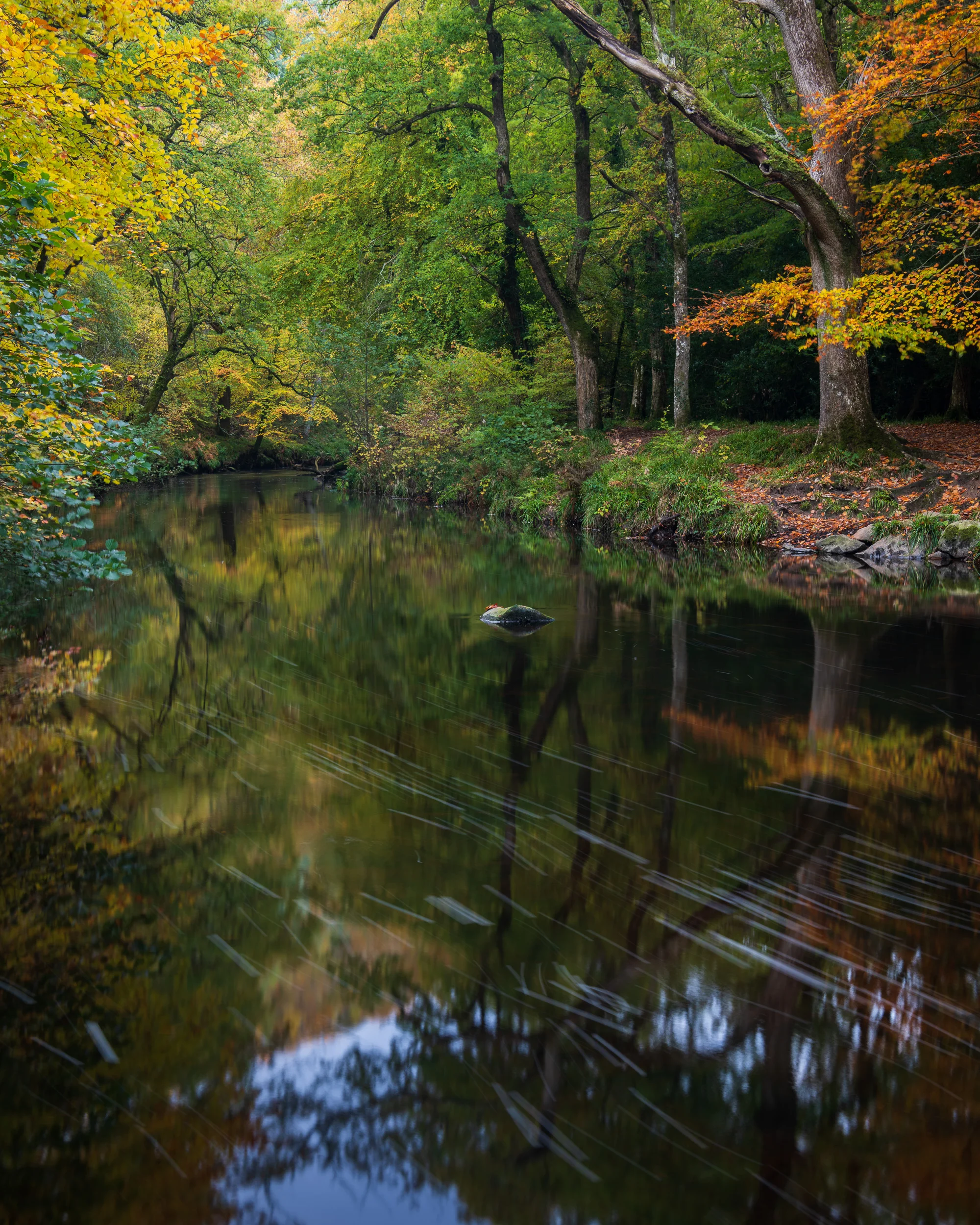
Winter River at Holne Bridge, Dartmoor, Devon - Nikon Z7, Nikkor 14-30mm f/4 at 18mm, f/13, 1/4 sec at ISO 400, Kase Filters K9 holder and CPL.

Have a Plan A, B and C
As my plan C location, I didn't think I would end up at Holne Bridge on Dartmoor to capture this image. But after a failed shoot at my plan B location I was pleased that I'd had the foresight to consider a backup to the backup location.
Plan A
I like Fridays. It’s the end of the working week, the weekend is just around the corner and I’ll probably open a bottle of wine in the evening and eat something with a few red lights on the packaging. More than all that its the day where I almost always get out for a dawn shoot. That doesn’t mean the weather will be good though!
The Friday morning of this blog I had planned to meet up with a friend and fellow photographer for a bit of a catch-up. We were going to head down to the coast to shoot some moody seascapes. The weather forecast was for showers and overcast skies, but hopefully perfect for what we had planned.
Unfortunately my friend had to cancel. This of course isn’t a problem. Life and work sometimes change your priorities. Something of which I’m all too aware of myself. I would of course need a plan B.
Plan B
I could of course stick with plan A, but the location was further than I probably really had time to travel to. This mattered less when I was meeting up with someone, but as this shoot would be on my own I decided that I would pick somewhere closer to home.
Combestone Tor in 2014 - my first and last visit.
As part of my plan to take more risks and be more spontaneous in 2020 I decided that I should try somewhere new. Having just read an article by Ross Hoddinnot on some Dartmoor locations I decided that I must try and photograph Combestone Tor. Though this location wasn’t completely new to me, I had only shot it once some 6 years ago, so I still thought it would still be somewhere fresh for me to shoot.
When Friday morning came round I went outside to take the dog for a quick walk before I headed up to Dartmoor. Despite the weather forecast predicting overcast skies I could see some high cloud and a lot of stars. It looked like it could be a great morning after all!
I had to make a decision. Do I go to the coast and make the most of the sunrise, or stick to my original plan of going to Dartmoor where the weather might well be very different. My closest coastal location is Dawlish Warren and it is very much the safe bet but I have photographed this location many times before. This would not achieve my goal of shooting somewhere new. Despite my gut instincts to go to Dawlish Warren I decided to keep to my plan of going to Dartmoor. I felt it was important to spend some time working on new locations.
The weather up on Dartmoor that morning was as predicted. Very windy and cloudy. Not worry, the point of the visit was not to get a great image but explore the location. And explore I did. However, I never really got inspired. I never even got the camera out. It seems like a location with plenty of potential but I just couldn’t find something I wanted to photograph. Maybe it was just the lack of morning light, or the chilling wind, or maybe I just need a few more visits so I can get to know the location better.
Whatever the problem, I wasn’t going to capture any images there so time for plan C!
Plan C
Holne Bridge, Autumn 2019
I hate to head out with the camera and take no photos, so knowing that this might happen if I went up to Combestone I decided I needed a backup plan. The route up to Combestone fortunately takes me past Holne Bridge. This is a location I’ve photographed a few times, but only in autumn. This tree-lined river location is perfect for catching those wonderful autumnal colours.
I’d never really considered shooting it during the winter. With most of the trees probably being bare I didn’t think it would make for an interesting photograph. However, if I had to drive past it on my way home why not stop and take a photo anyway. I wouldn’t even have to walk very far!
So on the way back from Combestone I pulled over, grabbed my gear and popped down to the river. This was my plan C location so I was a little short on time which meant I didn’t have a lot of time to go exploring for new compositions. I decided that if I wanted to get a shot I would go with what I already knew. I did try a few different angles from a couple of new spots, but I eventually decided that I would capture roughly the same composition that I’d done during a previous visit.
Winter at Holne Bridge, Dartmoor, Devon - Nikon Z7, Nikkor 14-30mm f/4 at 24mm, f/11, 0.5 seconds at ISO 320, Kase Filters K9 Holder and CPL.
OK, I’ll admit, it’s not the most original composition that I’ve made, but given it was a bit of a grab shot as part of a backup plan I’m pretty happy with the result. I’d much rather have this image than have nothing at all from the morning. Besides, it was actually rather nice shooting a location in a totally different season. This is something I learnt from my year-long project on Dartmoor that I recently published. In fact it has inspired me to visit this location again in the very near future and not just wait for autumn. I think there is more to this location than just autumn colours.
A bit of a long story from me in this post but I hope you’ve found it enjoyable and that if you don’t normally head out with a plan A, B and C, then it’s maybe time you did.
Practising Landscape Photography and Risk vs Reward
Is there value in practising your landscape photography? Do you consider risk vs reward? In the blog this week, I head to Belstone on Dartmoor National Park to capture some landscape photographs and to answer those questions.
The Value of Practising Landscape Photography
In the blog last week I spoke about the need to practise landscape photography. That trip to Dawlish Warren beach was my first trip out to capture landscape photographs in over a month. I certainly felt a little rusty so I was keen to keep the momentum going so I decided to head out again as soon as I could.
I decided I would head out a couple of days later and instead of shooting the coast again I opted to head up onto Dartmoor. The weather conditions weren’t exactly ideal for landscape photography. The forecast was predicting 100% clear skies (everywhere) and sub zero conditions.
Despite the weather forecast I was committed to going out and getting some practise in with the camera. Practising photography became really important to me after watching this video by John Free. I know John is a street photographer but the message is clear. It’s probably one of the most important photography videos I’ve ever watched.
Risk vs Reward
While the goal of my trip to Dartmoor was to practise my photography, I was still hoping to get some good photographs. This is where the risk vs reward bit comes in. It’s rare that the weather forecast is 100% accurate or the conditions are predicted to be perfect for landscape photography (whatever perfect might be), so there is always an element of risk.
Sometimes the risk is part of the excitement though. If you always knew what the the conditions were exactly going to do then some of the joy of landscape photography would be lost. While the forecast conditions wouldn’t necessarily yield a great photography, if I didn’t take the risk of going I might miss something special.
So did my trip to Dartmoor pay off? You find out in the video below where you will see the images I took and hear me talk more about the value in practising photography and risk vs reward. Enjoy!
I hope you enjoyed that 5 Minute Photo Adventure <insert playlist URL>. Do you practise your landscape photography? How do you measure risk vs reward? Let me know in the comments below.
The Photographs
As always here are the photographs from the video.
Dawn at Belstone #1, Dartmoor National Park, Devon - Nikon Z7, Nikkor 14-30mm f/4 at 14mm, f/13, 1/4 sec at ISO 64, Kase Filters CPL.
Dawn at Belstone #2, Dartmoor National Park, Devon - Nikon Z7, Nikkor 14-30mm f/4 at 18mm, f/13, 1/13 sec at ISO 64, Kase Filters CPL.
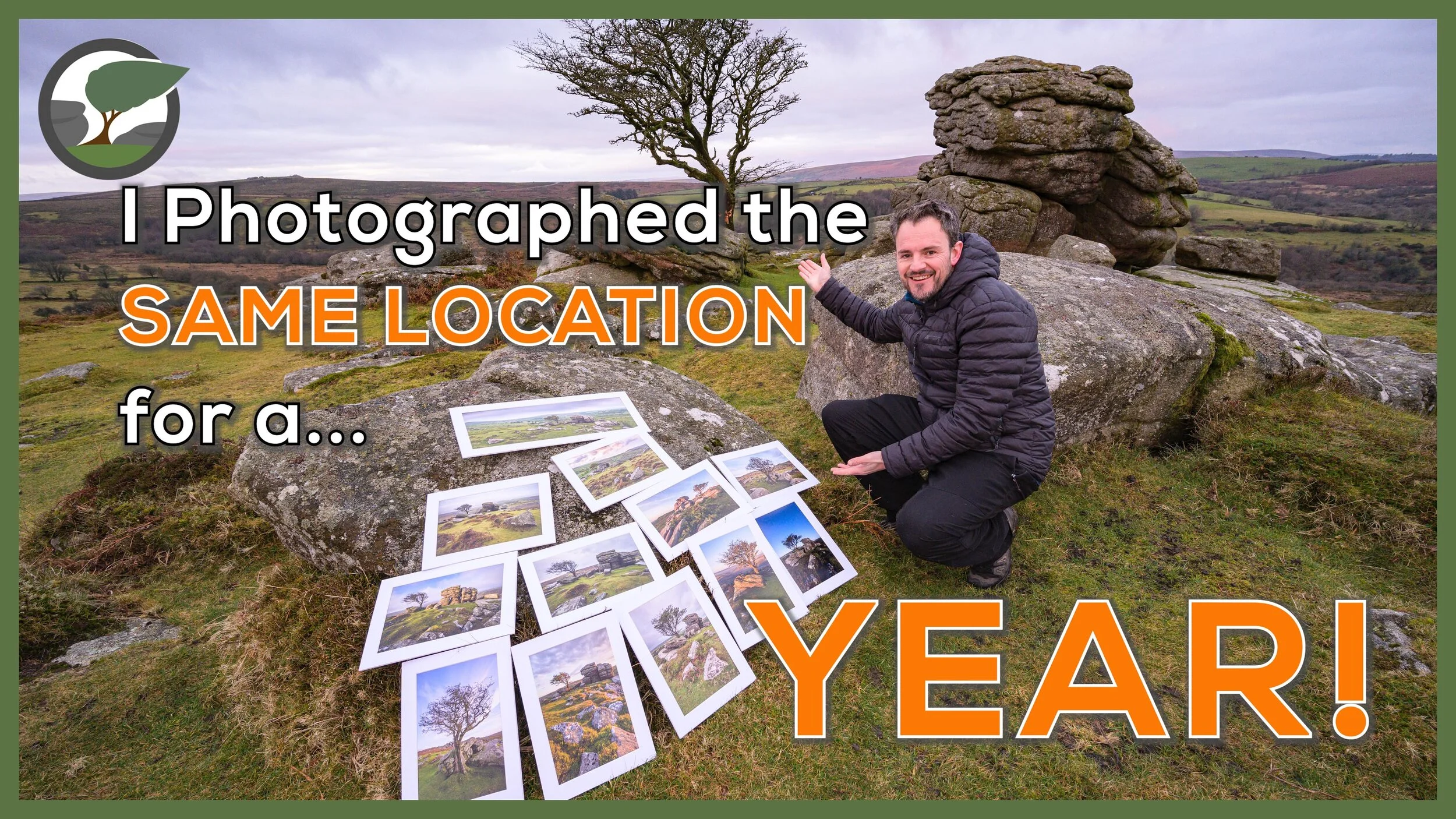
My Year Long Landscape Photography Project on Dartmoor
What happens when you photograph the same location for a year? In the blog this week I share with you the results of my year-long landscape photography project on Dartmoor.
One Year, One Location, Twelve Photographs
I’m going to keep this blog post really short as everything I would talk about here is contained in the video below. So rather than write a lot of text here I hope you’ll be able to find the time to watch my longest ever landscape photography video. I’ve actually tried to keep it as short as I can, but the video does contain a year’s worth of work so I hope you can excuse the length. So grab yourself a coffee or a drink and enjoy!
I do hope you enjoyed the video. Have you ever undertaken a similar project? Which image was your favourite? Please let me know in the comments below.
My Emsworthy Collection
Finally, here are all the photographs I took during the project and that you saw in the video. If you want to see the technical information for a photograph just click on it.


Imperfect Panoramas
In the blog this week I head up to Belstone Common on Dartmoor to capture some panoramic images. However, the results aren't exactly perfect.
Ho Ho Ho!
First of all let me wish you a happy Christmas! No matter how or why you celebrate over the festive period I do hope you a good time doing it. Even though I've written this blog post before Christmas day I can feel pretty sure I had a good time at Christmas myself. It's fair to say I'm probably a little fatter but also a little happier for having spent some time with my family. Besides, a little time away from the camera can also be beneficial.
I didn't write this blog post just to tell you how fat I've got but rather to tell you about a recent trip to Dartmoor I had and how the images I captured didn't exactly work out. Don't worry though, it's not a long tale of disasters and epic challenges that will take you half an hour to read. I just thought I'd briefly share the story of that morning. I'll have you back to mince pies and brandy before you know it.
Creating Panoramic Images
The reason I was up on Belstone Common was that I was looking for new locations to capture panoramic images, with a view of creating a video to show how I got about capturing them. My original plan was to shoot the video when I was up in Scotland at the end of October, but rubbish weather put a stop to that. Never mind though, it's not as if Dartmoor doesn't have any locations worth visiting is it!
Belstone Common is one of my favourite places on Dartmoor to capture landscape photographs but I don't ever remember going up there to take panoramic images. As I was already familiar with the location capturing panoramic images would be easy, right? Well, I hadn't really given much thought as to how different it would be and so when I got up to the location an obvious panoramic composition didn't jump out to me as I thought it might.
Belstone Panorama #1, Dartmoor, Devon - Panasonic Lumix S1R, Lumix S 24-105mm f/4 at 28mm, f/13, 1.3 seconds at ISO 100, Kase Filters CPL. Seven vertical image panorama at 16:7.
What I was finding was that just because I had a viewpoint that would normally work well with a wide angle lens, that didn’t mean I could also make a panoramic out of it. The main challenge was that the locations where I would normally stand were close to some of the tors, but I couldn’t get far enough away to make a panoramic image work, without losing sight of the tors. This was going to be more difficult than I thought. Difficult but not impossible though.
As I was up there for sunrise the conditions were changing quickly so I got myself in a bit of panic as I struggled to find a suitable composition. This is where the problems can start. Being in a rush is never a good thing for photography. I kept second guessing myself as to where I should be so I would take my shots in a bit of a rush. In addition it was also freezing up on Dartmoor. There was a bit of a wind and I was trying not to wear gloves so I could use the camera more easily (and quickly).
Belstone Panorama #2, Dartmoor, Devon - Panasonic Lumix S1R, Lumix S 24-105mm f/4 at 65mm, f/13, 1/4th second at ISO 100, Kase Filters CPL. Seven vertical image panorama at 16:7.
So here lies the problem with the images you see on this blog post. While I know the compositions still need a little work, they are technically flawed. You might not even notice the flaws with the resolution you are looking at them but trust me they are a little bit "soft". This purely down to poor technique because I was rushing things. I should have taken into account the strength of the wind, and also let the camera settle down between frames. All stuff I already knew I had to do.
Why am I telling you this and sharing these imperfect panoramas? This blog has always been about sharing my successes and failures. We all get things wrong every now and again, and I'm no different. Photography isn't all about 5 star images. In fact sometimes it's not even about 2 star images! So don't worry if you've got something wrong and a shoot went badly. It happens to everyone and it's part of being a photographer.
Belstone Panorama #3, Dartmoor, Devon - Panasonic Lumix S1R, Lumix S 24-105mm f/4 at 25mm, f/13, 0.4 seconds at ISO 100, Kase Filters CPL. Seven vertical image panorama at 16:7.
So was my trip to Belstone a waste of time? No. Being outside to witness the start of a new day on Dartmoor is never a bad thing. Have you had any photography disasters? Have you been out on a shoot that just went wrong? Let me know in the comments below.

Holne Bridge - A 5 Minute Photo Adventure
In the blog this week I head to Holne Bridge with Panasonic Lumix S1R to capture the last of the autumnal colours on Dartmoor.
More Time with the S1R
If you a regular reader of my blog you'll know that I've had the Panasonic Lumix S1R on loan for the last few weeks. I've been putting it to good use and I've shot the autumnal colours at Fingle Bridge and produced a video called In The Footsteps of Colin Prior. With those bits of content produced I was ready to (sadly) send the camera back to Panasonic. However, the very kind folks at Panasonic Pro Services said I could keep it for a little longer.
Autumn at Holne Bridge
With the extra loan time I wanted to put the S1R to good use and make another video. As much as I'd loved to have produced another video on the scale of In The Footsteps of Colin Prior I'd have to produce something a little more close to home and within tighter time constraints. As I hadn't made one of my 5 Minute Photo Adventure videos for a while I thought this would be a perfect opportunity to do so. Though the best of the autumn colours were coming to an end I thought I might still be able to capture something interesting at Holne Bridge on Dartmoor.
Holne Bridge is one of my favourite locations to shoot autumnal colours and it was looking great when I visited there a few weeks before this trip (you can see the photos from that blog post here). I was a little unsure how the recent bad weather had impacted the leaves on the trees but fortunately for me local (and very talented) photographer Neil Porter drives through the area on a regular basis. He was kind enough to give me an update and as it was looking positive we both decided to meet up for spot of landscape photography.
A 5 Minute Photo Adventure
It was a great morning of photography and it was great to be joined by Neil. He knows a lot of good spots along the river there and he introduced me to a couple of new ones which I was very grateful for. Anyway, I don't want to spoil the video too much so here it is:
I hope you enjoyed the video and all the content I've made with the Panasonic Lumix S1R. I've really enjoyed using the camera and hope to use one again in the future. I also have to say that the folks at Panasonic Pro Services (who organised the loan) have been fantastic. Really friendly and easy to work with. Should I ever decide to purchase any of the S1 cameras it's good to know that Panasonic have the support services network in place.
I've got some exciting content coming up over the next few weeks including the return of On My Bookshelf, and some special new year videos, so stay tuned!
The Photographs
As always, here are the photographs from the video plus a couple of others that I captured after filming.
Holne Bridge at Autumn, Dartmoor, Devon - Panasonic Lumix S1R, Lumix S 24-105mm f/4 at 28mm, f/11, 1 second at ISO 200, Kase Filters CPL.
An Autumnal River Dart at Holne Bridge, Dartmoor, Devon - Panasonic Lumix S1R, Lumix S 24-105mm f/4 at 53mm, f/13, 1 second at ISO 200, Kase Filters CPL.
Downstream from Holne Bridge, Dartmoor, Devon - Panasonic Lumix S1R, Lumix S 24-105mm f/4 at 29mm, f/13, 0.8 seconds at ISO 200, Kase Filters CPL.
Upstream to Holne Bridge, Dartmoor, Devon - Panasonic Lumix S1R, Lumix S 24-105mm f/4 at 24mm, f/13, 1.3 seconds at ISO 200, Kase Filters CPL.

Autumnal Landscape Photography with the Lumix S1R
After a last minute change of plan I decide to shoot the autumnal colours at Fingle Bridge and I take the Panasonic Lumix S1R with me.
The Panasonic Lumix S1R
A couple of weeks ago in my blog post Return to Holne Bridge, I mentioned that I had a Panasonic Lumix S1R on loan. In that blog post I was out with the S1R to try and familiarise myself with the camera before putting it to use on the project I had planned for it. Having now completed filming for that project I was ready to return the camera to Panasonic but they very kindly asked if I wanted to keep it for another couple of weeks.
Plan A Becomes Plan B
With the camera on loan for a bit longer I had a few ideas on how I could put it to good use. My initial project for the S1R was to make a landscape photography video in Scotland, but I did also have a secondary project planned as well. Unfortunately though, the weather conditions were pretty awful in Scotland in the later part of my trip and so I never got the chance to shoot the 2nd video. This loan extension would be a great time to revisit that project and shoot it on Dartmoor rather than Glencoe.
My plan A was to head up to one of my favourite Dartmoor locations, Belstone Common. Checking the weather forecast the evening before I knew it was going to be a bit of a risk to go there because of the forecasted cloud cover. However I thought it was worth a punt and made my plan for a dawn shoot.
Arriving at Belstone Common the following morning it quickly became apparent that I had been a little too optimistic about the weather forecast, specifically the cloud cover. The cloud cover had even descended into the village of Belstone and by the time I had reached the parking area for Belstone Common it was looking very cloudy indeed.
Normally I wouldn’t necessarily let this put me off and I would risk ascending up to Belstone and hopefully wait for the cloud to clear. This clearing of the cloud can often lead to spectacular scenes but at the back of my mind I thought I’d probably be better going with plan B.
Fingle Bridge
Plan B was to go and shoot at one of my favourite autumnal Dartmoor locations, Holne Bridge or Fingle Bridge. I reckon either would have been good but given Holne Bridge is on the opposite side of Dartmoor from Belstone Common and Fingle Bridge just 15 minutes away the decision was easy.
When I arrived at Fingle Bridge I could see that I had made the right decision. The autumnal colours were looking great and even though it was a bit lighter the sky was still heavily overcast so staying at Belstone probably would have been a waste of time.
Fingle Bridge #1, Dartmoor, Devon - Panasonic Lumix S1R, Lumix S 24-105mm f/4 at 24mm, f/11, 10 seconds at ISO 100, Kase Filters CPL. Three horizontal image panorama at 16:7.
Though it was tempting to just create a short vlog of my time at Fingle Bridge, I decided just to concentrate on stills photography so I grabbed the Lumix S1R but left behind my Lumix G80 (my vlogging camera). As I walked along the riverside and admired the beautiful colours on the trees I was surprised not to see any other photographers or even dog walkers. I wasn’t complaining though. It was very relaxing, just me, a camera, the gentle noise of the flowing river and the wind blowing in the trees. What a way to start the day!
Fingle Bridge #2, Dartmoor, Devon - Panasonic Lumix S1R, Lumix S 24-105mm f/4 at 54mm, f/13, 10 seconds at ISO 100, Kase Filters CPL.
What I like About the S1R
As I said in my blog post Return to Holne Bridge, it is not my intention to review the S1R. There are lots of dedicated written and video reviews out there and they are done by people much more proficient at reviewing than I am. However, having used the camera for a few weeks I thought I would at least share some of my thoughts on this camera.
Things I liked:
47.3 megapixel sensor - no complaints with the image quality.
Dual card slots - dual xQD would have been nice though.
Good controls, knobs and dials - plenty of physical controls.
Focal length of the lens is displayed in the EVF.
Triaxle tilt LCD - you can even flip it out when the camera is in a vertical orientation…..very handy!!
Countdown down timer for long exposures (up to 60 seconds). Also very handy!
The 24-105mm f/4 lens I used. Great image quality and useful focal length.
Minor gripes:
Long exposures are limited to 60 seconds before you need to switch to bulb mode. This is better than most DSLRs and some mirrorless cameras, but not as good as cameras from FujiFilm (which can have exposures timed in minutes).
Size and weight - while some people prefer the feel of a bigger camera, the S1R is big for a full-frame mirrorless camera. It’s about the same size and weight as a Nikon D850 but bigger and heavier than a Nikon Z7. However, in some ways it has more features and controls than a Z7 so some additional bulk is probably necessary (e.g. dual card slots and great video features).
Though the S1R has one of the highest resolutions EVF on the market, I thought images looked a little low on resolution when reviewed. Don’t get me wrong, it’s not bad, but not as good as other mirrorless cameras I have used. I wonder if the embedded JPG preview of the RAW file is low resolution. The images when reviewed in Lightroom look amazing. The EVF looks great when viewing live.
No wide angle zoom lens at the time of loan. (A 16-35 f/4 is due in January 2020 though).
This is by no means a comprehensive list but these are some of the things I wanted to highlight when compared to other mirrorless cameras I have used. Minor gripes aside, there is little to dislike about this camera and anyone buying one is sure to be happy.
Fingle Bridge #3, Dartmoor, Devon - Panasonic Lumix S1R, Lumix S 24-105mm f/4 at 28mm, f/13, 10 seconds at ISO 100, Kase Filters CPL.
A note on the video features:
I know many of you don’t shoot video but for me some of the most stand out features of this camera are the video features. It can shoot up to 4k, 50 fps at 150 Mbps. The video quality is beautiful. I shoot and publish almost all of my videos in 4K but I don’t think anyone would notice much change in video quality if my bitrate jumped to 150 Mbps. On the other hand 50 fps does give me a few more creative options in post production.
As a bonus the S1R writes video to both cards which is definitely welcome. However, my one gripe is that if you have your camera set up for stills (shutter speed, ISO, and aperture) and then you switch to video mode, all the settings from your stills configuration carries over. The same applies when moving from video mode to stills mode. Given that you set the camera up very differently when shooting video and stills this seems a little annoying if you need to quickly switch between both modes.
Panasonic have also now released the Lumix S1H. This camera is a little more video centric and offers video modes such as 6K recording, 400 mbps bit rate (depending on mode), and HLG video. I can just imagine the creative options open to me with this camera if I did another series of Vignettes of Landscape Photography.
In case you are wondering, the video that I did have planned for the S1R has been filmed and is currently being edited. It should be ready in the next couple of weeks. I have also managed to shoot one of my 5 Minute Photo Adventure videos with the S1R so I hope to publish that in the next few weeks as well.
I hope you enjoyed this blog post and the images I capture from Fingle Bridge. Have you been out to capture some autumnal images? Have you considered or even bought an S1R or any of the cameras in the Lumix S1 range? Let me know in the comments below.

Return to Holne Bridge
This week I return to Holne Bridge on Dartmoor to try out a new camera and to give my father-in-law a helping hand with his photography.
Almost Autumn on Dartmoor
Out of all the seasons to photograph I find autumn the most difficult. Despite the autumnal season lasting a few months, the colours are really only at their best for a few weeks. If there are a few windy days this can shorten that period even more. The result of this really short period is that I sometimes miss the best of autumn all together. Last year was one of the few years that I actually made it out when the colours were nearly at their peak. I was lucky enough to capture images from Fingle Bridge and Holne Bridge.
Encouraged by what I captured last year I was really keen to get out again this autumn. Though my primary plan was to head out when the colours were at their best, I thought it would be useful to also head out early on in the season as well. I wanted to do this for a number of reasons. Firstly, I promised to take my father-in-law out for a shoot as he was going on a Dawn2Dusk Photography workshop and wanted to refresh his skills before going. I also wanted to refresh my knowledge of Holne Bridge, which I think is a great location for shooting autumnal landscapes.
The final reason was I wanted to try out the Panasonic Lumix S1R. This camera was on loan to me and I was keen to familiarise myself with it before putting it to use on the project I had planned for it. Fortunately for me I was already used to the handling and interface thanks to my use of the Panasonic Lumix G80 (which is my primary vlogging camera). However, the S1R has a much richer set of features and configuration options compared to my G80 so there was still plenty to familiarise myself with.
Two Mirrorless Cameras
Even though I had the S1R with me, I also decided to take along my Nikon Z7. There wasn’t any special reason for this other than I had a 24-105mm for the S1R and a 14-30 mm for the Nikon Z7 and I wanted to cover a wide range of focal lengths. I’m not planning on reviewing or comparing the two cameras (that’s not really my thing) but if you do want to see how the photos compare I have included a couple of shots from each camera for you to have a look at.


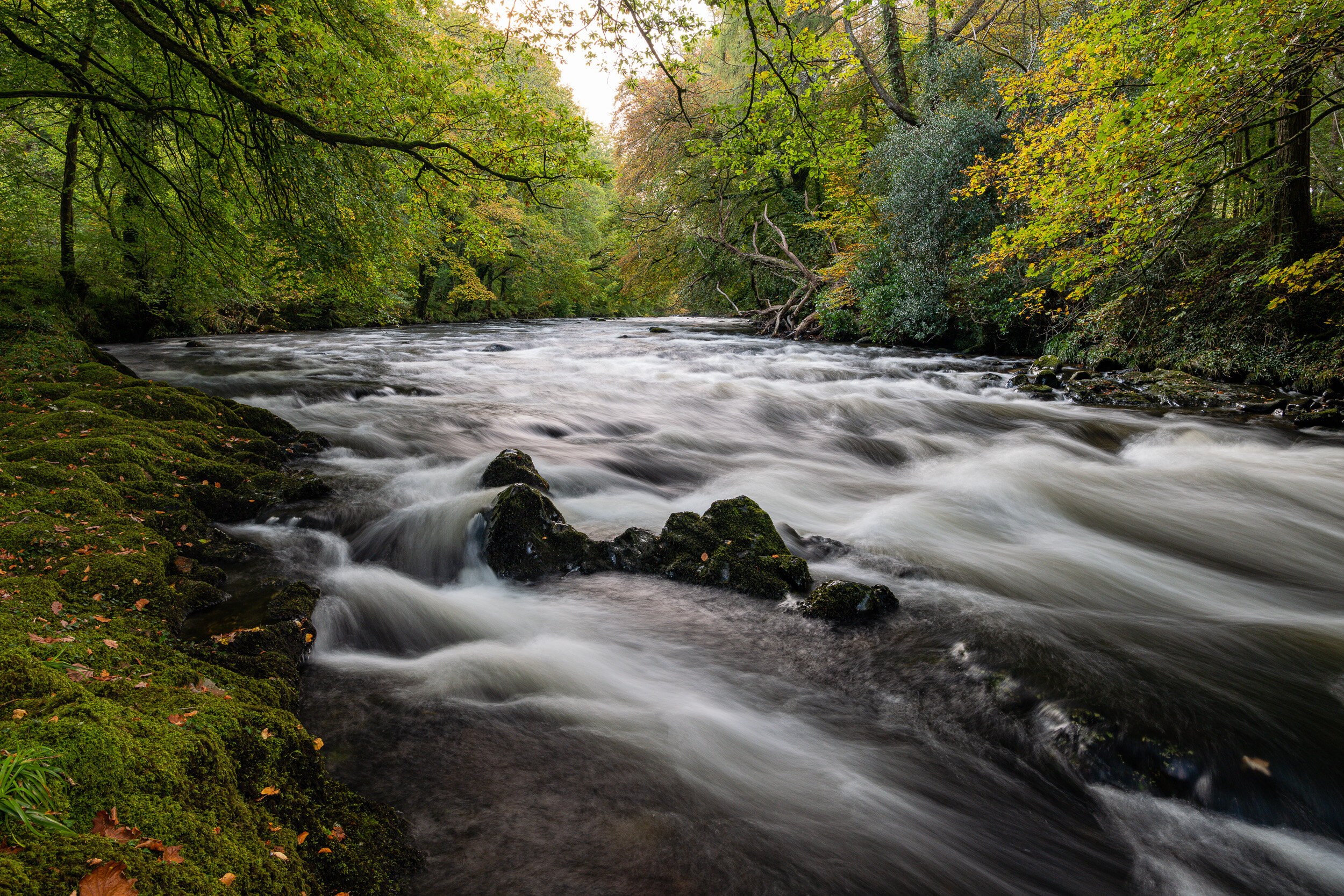
From my perspective the image quality from both cameras was superb and the only differences in the actual output are as a result of post-processing and focal length.
You’ll be able to see what I got up to with the S1R in a few weeks time so stay tuned!
Vibrant Colours
Moving away from gear and back to photography, even though I was a little early for peak autumnal colours the colours I did find were wonderful. There were splashes of yellow from the leaves but there was still a lot of green about which looked wonderfully vibrant.
Holne Bridge #5, Dartmoor, Devon - Nikon Z7, Nikkor Z 14-30mm f/4 at 14 mm, f/11, 2 seconds at ISO 400. Kase Filters K9 filter holder and CPL.
Despite the high water levels and the low light levels (we arrived a little to close to sunset), we both had a great time photographing this stunning Dartmoor location. I familiarised myself with the S1R and Holne Bridge, and more importantly, my father-in-law got himself into the swing of taking photographs again. Considering we were there for probably less than an hour we both felt it was a productive session.
Do you have plans for some autumnal photography? What locations do you like to shoot in the autumn? Let me know in the comments below.

The Worst Time to Try Woodland Photography
In the blog this week I head out to try my hand at woodland photography but I wasn't exactly prepared for success.
Too Tired
I've always considered myself to be a bit of a morning person. I enjoy getting up early, before it's dark, and heading out for a spot of landscape photography. I like the excitement of arriving at a location and not knowing exactly what is going to happen. There is always that sense of anticipation as you wait for your viewpoint to be filled with the light of a new day.
As I looked at the weather forecast I already knew that great morning light was out of the question so I decided that it was time to try something a bit different. For a long while now I've been wanting to try my hand at woodland photography. I've been very much inspired by the work of photographers such as Simon Baxter. Given the weather forecast, I thought this would be a good time to try my hand at some woodland photography and scope out a new location.
For reasons I can't remember I really didn't sleep well that night. I never sleep perfectly if I have to get up early, but this sleep was particularly unsettled. Normally I don't exactly wake up with a skip in my step but waking up that morning I knew I was tired. Really tired. Any sensible person would have gone back to bed but I was determined not to waste this opportunity so I jumped in the car and headed up to Dartmoor.
Too Dark
For a dawn shoot, I like to arrive around an hour before sunrise so I can get myself set up, pick out some compositions and get some of the pre-sunrise light that is often more attractive than sunrise itself. Arriving at my location thought I realised that it was too dark to go exploring and looking for compositions in a field of outdoor photography I had no real experience of. I decided that I'd wait for it to get a little lighter before heading out. I still felt incredibly tired and I ended up having a few power naps in the car.
As it got lighter I headed out to do a little exploring but I knew deep down I was still feeling tired and not very creative. However, I was here and I was going to give it a try. Try I did, but it was hard. Even if I wasn't feeling tired, trying woodland photography was going to be hard. Even with the light I did have, I was clearly here too early, especially as it was very overcast.
I wondered about looking for compositions but just got increasingly frustrated. I tried to visual some of the woodland photographs I had seen and the emotions they had invoked, but I just couldn't get myself started. I would have an idea, shoot it and then when I looked on the back of the screen I felt disappointed.
Dartmoor Woodland #1, Devon - Panasonic Lumix S1R, Lumix S 24-105/F4 at 47 mm, f/8, 0.5 seconds at ISO 100.
Too Short of Time
The other problem I had was time. I had to be home by a specific time so I was also rushing my photography. I wasn't taking the time to really have a proper look around the location and pick out compositions. This really wasn't working for me. The new location, new type of photography, flat light, being tired, and lacking creativity don't add up to a good photographic experience. It really was the worst time to try woodland photography.
Dartmoor Woodland #2, Devon - Panasonic Lumix S1R, Lumix S 24-105/F4 at 105 mm, f/8, 0.5 seconds at ISO 100.
As I headed back up the hill towards the car I looked back on the area I had been exploring. While I had been looking for simple compositions of individual tress and I hadn't paid much attention to wider woodland that stretched out in front of me. In an effort to salvage something of the morning I got my camera out and took a photograph of something that was a little more familiar to me.
Dartmoor Woodland #3, Devon - Panasonic Lumix S1R, Lumix S 24-105/F4 at 105 mm, f/8, 1/6th second at ISO 100.
It wasn’t my greatest morning of photography that was for sure. Has this put me of woodland photography? Of course not. Maybe next time I'll wait for better light and get a good nights sleep.
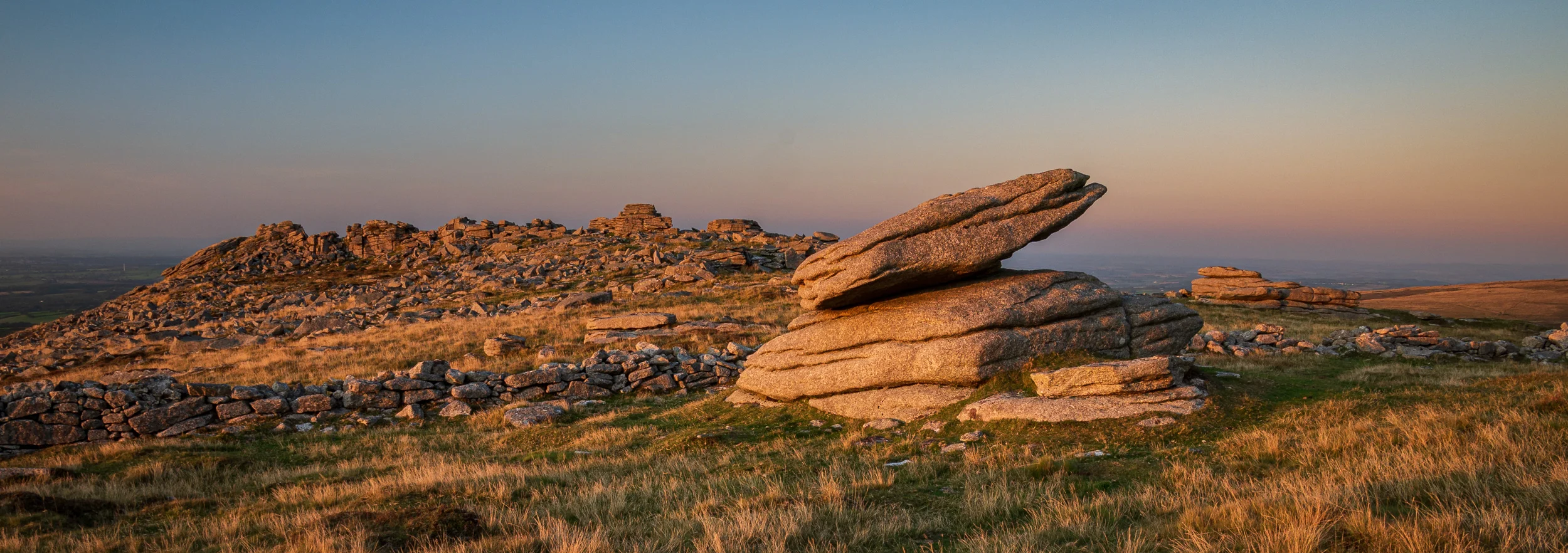
Back to Basics at Belstone
Just because I don’t have a Nikon camera at the moment, doesn’t mean I can’t go out and take pictures.
Better Out Than In
For reasons that I will explain in a future blog post/video, I am without a full-frame Nikon camera at the moment. Now, I could use this time to have a break from landscape photography but that’s not really the way I roll. Despite the lack of a D850 I didn’t want to pass up on a perfectly good opportunity to get out and take some pictures. Well, I say perfectly good opportunity but that wasn’t exactly accurate.
Checking the local forecast it was predicting clear skies. Not just a little clear, but totally clear. No clouds. Clear blue skies. Everywhere. Devon, Dorset, Cornwall, and Somerset. When it came to selecting where to go it seemed to make little difference. My instinct told me to head to the coast so I could make the most of the sunset (which had been consistently good over the past few evenings), but with the lack of a “big” camera, I had no way of using any of my filters. At a bare minimum I always want to shoot seascapes with a polariser, but this wasn’t an option. So I decided to head to a location that wasn’t too far away but still had far-reaching views.
There really was only one location to head to and that was Belstone Common on Dartmoor.
Don’t Let Your Camera Hold You Back
I am in the very fortunate position where I have access to a number of different cameras so even without my aforementioned Nikon camera I still had a couple of options to take with me to Belstone. Like most people I have a mobile phone that is capable of taking decent images but I don’t really like that form factor for anything other than taking snapshots. I also still have my old Sony RX100M4 which is a much better option than the phone. However, I decided to take my most recent camera, the Panasonic Lumix G80.
I’ve had the G80 for a little while now but it is almost exclusively used for vlogging. I rarely take any still images with it. The G80 is a more than capable stills camera and even though it might not be in the same league as my D850, there shouldn’t be any reason why I couldn’t put it to good use. The only real challenge for me would be that I wouldn’t be able to use any filters as I didn’t have an adaptor ring for the 12-60mm kit lens. Effectively it was back to basics for me. Just me, a tripod and a camera.
Oke Tor, Belstone Common, Dartmoor, Devon - Panasonic Lumix G80, 12-60 mm lens at 14 mm, f/11, 1/6th second at ISO 200.
I wasn’t going to let my minimal camera setup hold me back, but the weather conditions were a different challenge. Those bright blue skies aren’t my favourite thing to photograph, but as the sunset there was some nice soft golden light which allowed me to capture these images.
Belstone Commoon and Irishman's Wall, Belstone Common, Dartmoor, Devon - Panasonic Lumix G80, 12-60 mm lens at 14 mm, f/11, 1/6th second at ISO 200.
I hope you enjoyed this short blog post. I was reasonably happy with the images I captured. One thing was for sure, the camera wasn’t the limitation. Having access to to a polariser and some grads would have definitely been useful, but they weren’t the limiting factor. I always knew the weather conditions weren’t going to yield amazing results but sometimes just being outside and watching the sunset from Dartmoor is all the reward you need.

7 AMAZING Devon and Cornwall Landscape Photography Locations
In this blog post I’m going tell you about 7 AMAZING locations in Devon and Cornwall for landscape photography. This post is PACKED full of photographs and videos to inspire your landscape photography!
Vignettes of Landscape Photography
Over the last week I’ve been publishing videos from my new series Vignettes of Landscape Photography. It’s a series of short videos on the locations that have inspired my landscape photography. Each episode is a mix of still photography and video clips that will hopefully not only show you the natural beauty and variety of the location but also inspire you to visit that location to capture your own photographs.
Now that all 7 episodes from series 1 have been published on YouTube, I thought I would bring them all together in a big blog post. Not only can you choose to play them all from the playlist I have created below, but if you scroll down you will find each individual episode along with a map and the images I captured from that location. I hope you’ll agree that these are indeed 7 AMAZING locations in Devon and Cornwall for landscape photography!
I really hope you enjoy this first series of Vignettes of Landscape Photography. Please leave me a comment below and let me know what you think. Did you have a favourite episode or a favourite image? What would you like to see from series 2? Have you been to any of these locations? Have you been inspired to visit any of the locations featured? Let me know in the comments below.
Bedruthan Steps
A Bedruthan Spring, Bedruthan Steps, Cornwall - Nikon D850, Nikkor 16-35 mm f/4 at 26 mm, f/11, 1/4 sec at ISO 64, Kase CPL and ND grad.
Spring Cliffs at Bedruthan, Bedruthan Steps, Cornwall - Nikon D850, Nikkor 16-35 mm f/4 at 22 mm, f/11, 1/2 sec at ISO 64, Kase CPL and ND grad.
Last Light at Bedruthan, Bedruthan Steps, Cornwall - Nikon D850, Nikkor 24-70 mm f/2.8 at 42 mm, f/8, 136 sec at ISO 64, Kase CPL, ND and ND grad.
Venford Falls
The Twin Falls of Venford, Dartmoor, Devon - Nikon D850, Nikkor 16-35 mm f/4 at 28 mm, f/11, 4 sec at ISO 64, Kase CPL.
The Fall, Dartmoor, Devon - Nikon D850, Nikkor 16-35 mm f/4 at 35 mm, f/11, 2.5 sec at ISO 64, Kase CPL.
The Flow, Dartmoor, Devon - Nikon D850, Nikkor 16-35 mm f/4 at 16 mm, f/11, 2.5 sec at ISO 64, Kase CPL.
Belstone Common
Stormy Belstone #1, Dartmoor, Devon - Nikon D850, Nikkor 16-35 mm f/4 at 16 mm, f/13, 1/3rd sec at ISO 64, Kase CPL and ND grad.
Stormy Belstone #2, Dartmoor, Devon - Nikon D850, Nikkor 16-35 mm f/4 at 16 mm, f/13, 1/3rd sec at ISO 64, Kase CPL and ND grad.
Daymark Tower
The Daymark Tower, Devon - Nikon D850, Nikkor 16-35 mm f/4 at 16 mm, f/13, 1/5th sec at ISO 64, Kase CPL and ND grad.
Tower in the Field, Devon - DJI Mavic Pro, 23 mm, 1/290th sec at f/2.2, ISO 100.
Stormy Belstone #1, Dartmoor, Devon - Nikon D850, Nikkor 24-70 mm f/2.8 at 70 mm, f/2.8, 1/125th sec at ISO 64, Kase CPL.
Trevose Head
Trevose Head #2, Cornwall - Nikon D850, Nikkor 24-70 mm f/2.8 at 26 mm, f/13, 2.5 sec at ISO 64, Kase CPL.
A Long Night Ahead - Trevose Head, Cornwall - Nikon D850, Nikkor 16-35 mm f/4 at 20 mm, f/13, 13 sec at ISO 64, Kase CPL and 6 stop ND.
Botallack
Botallack #1, Cornwall - Nikon D850, Nikkor 16-35 mm f/4 at 16 mm, f/11, 1.6 sec at ISO 64, Kase CPL and 6 stop ND.
Botallack #3, Cornwall - Nikon D850, Nikkor 16-35 mm f/4 at 30 mm, f/13, 90 sec at ISO 64, Kase CPL and 6 stop ND.
Brent Tor
Brent Tor, Dartmoor, Devon - Nikon D850, Nikkor 16-35 mm f/4 at 16 mm, f/14, 1/13th sec at ISO 64, Kase CPL.
Brentor Church Sunset #2, Dartmoor, Devon - Nikon D850, Nikkor 16-35 mm f/4 at 19 mm, f/8, 1/6th sec at ISO 64, Kase CPL. Focus stacked image.

Back to Bowerman's Nose
This week I photographed one of Dartmoor’s most iconic tors, Bowerman’s Nose. It’s not my first visit and it certainly won’t be my last.
What I’m Looking For
I can’t remember when it was, but ever since I saw my first photograph of Bowerman’s Nose on Dartmoor, I’ve wanted to capture my own image of this iconic tor. I’ve been there many times since but never managed to get the image I was looking for.
For me light is critically important when shooting Bowerman’s Nose. There are plenty of interesting compositions to be had, but without good light on the tor itself it’s just a flat vertical stack of stone. Flatter light might well work if the scene was covered in snow, but given that every time there’s a decent dumping of snow I can’t actually get up onto Dartmoor, it’s unlikely I’ll ever get that shot.
Snow aside, for me the best option for getting a good photograph at Bowerman’s Nose is when I get nice, soft, warm light from a setting sun. (Saying that though, I have been inspired by a recent photograph of Bowerman’s Nose by Neil Porter to photograph it in the morning, but I’ll save that challenge for another day). Anyway, the light is important for a couple of reasons. Firstly it gives the “nose” some contrast turning it from a flat bit of rock into something that looks 3 dimensional. The light also works well on the ground making the undulations and grasses more prominent in the frame.
Together with light and a reasonable amount of cloud I have pre-visualised the shot that I want to get from Bowerman’s Nose. The trouble is, I’ve never managed to get it. I’ve come close once, but the shot I want eludes me so I continue to return to Bowerman’s Nose in the hope that I get the shot one day.
To Exposure Blend or Not
With the desire to get the shot that I wanted I decided to return to Bowerman’s Nose on Thursday evening. I have to admit though the weather forecast wasn’t exactly optimal. I expected to get nice soft light from the setting sun but the cloud forecast was for clear skies. I’m rarely interested in blue skies but sometimes the haze or the very high cloud can go a nice colour as the sun starts to dip below the horizon. I thought it was worth a punt. Better to be out on Dartmoor than in the house watching TV….well, most of the time that is!
When I arrived on location the sky was even clearer than the forecast had predicted so I knew I was going to have my work cut out. The principle challenge was with the contrast between the dark and light areas on the scene. Even though it was only about 30 minutes before sunset the scene had a lot of contrast. As the “nose” typically breaks above the horizon in most compositions, it is almost impossible to use a neutral density graduated filter. To capture the scene I could either try and do it using one carefully exposed frame or capture two frames and exposure blend them later.
Bowerman’s Nose #1, Dartmoor, Devon - Nikon D850, Nikkor 16-35 mm f/4 at 16 mm, f/13, 1/8 sec at ISO 64, Kase CPL.
When it comes to post-processing though I’m very much a light touch/5-minute edit type of person, so exposure blending isn’t top of my list of things to do. However, the HDR merge feature in Lightroom does a pretty good job of exposure blending these days without the need to drop into Photoshop to use layer masks. I’ve included images in this blog that use both a single frame and that have been exposure blended. Can you tell me in the comments which are which?
Bowerman’s Nose #2, Dartmoor, Devon - Nikon D850, Nikkor 16-35 mm f/4 at 20 mm, f/13, 1/15 sec at ISO 250, Kase CPL.
It was a relatively productive evening in the end and I got a couple of images that I’m reasonably happy with. I’ve still not got that killer shot that I want but that always gives me a great excuse to visit Bowerman’s Nose again!

Just One Image
Sometimes you only have time to take one image. Sometimes that’s all you need.
Too Clear, Too Cloudy
In landscape photography there is one thing more than anything else that annoys me and that is the weather. It’s an element I have no control of and it seems that I spend more time checking forecasts than I actually do taking photographs. With shooting time at a premium I’m always keen to make the most of what time I do have by going to locations where the conditions will be optimal. Over the years I’ve discovered this is very difficult. On the plus side it does make those times when it all does come together even more satisfying.
Summer normally brings better weather and more importantly longer days so more opportunities for photography. However, the summer weather recently has been a bit of a mixed bag. It’s either been overcast and dull, or bright blue skies. I know some people can do wonders with their photography in clear conditions but I just don’t get on with it (unless I’m chilling out with a glass of wine). What I really want for my photograph at this time of year is somewhere between cloud and clear. It’s not much to ask is it.
The other night I was faced with another clear sky evening. I had the choice of staying in and being grumpy or heading out to do some exploring instead. As I was keen to discover some new locations I decided on the latter and head out anyway.
Middle Dartmoor
I had a quick look at my custom Google Map and saw a pin against Mel Tor in the middle of Dartmoor so that seemed as good a place as any to head out to. I wasn’t expecting to get any images, but I thought I’d better take my camera anyway. When I arrived at the car park I was presented with some beautiful, panoramic views of Dartmoor.
It was only a short walk to Mel Tor and while I didn’t think there was a photograph to be had there that evening I have made a note to return there for autumn because of the big wide views of the woodland below.
I then had the option of taking a look at Sharp Tor but time was getting on and I rather fancied taking a panoramic image of that view I had seen earlier. I wanted to get a better angle and elevation for the panoramic view though so I jumped in the car and drove towards Corndon Tor.
All You Need Is One Image
By the time I got to the summit the light was starting to fade. Although the sun hadn’t reached the horizon yet I knew the surrounding hills would start casting big shadows so I had to get to work quickly. I set up my tripod, took a test shot (to check for focus and exposure) and then took a series of images for my panoramic photograph.
By the time I’d done that the light was gone. I literally had time to take that panoramic image and that was it. Considering I didn’t think I’d take any images, or any decent images that evening I was pretty happy with the result!
Sometimes all you need is one image. It could be the first image you take, the last image you take, or indeed the only image you take.
Dartmoor from Corndon Down, Devon - Nikon D850, Nikkor 70-200 f/2.8 at 98mm, f/8, 1/5th second at ISO 64, 13 image stitched panoramic cropped to 16:7.

3 GREAT Landscape Photography Locations on Dartmoor
What are the best locations on Dartmoor for landscape photography? In this blog article, I'm going to show you 3 GREAT landscape photography locations on Dartmoor that I think will inspire you to photograph Dartmoor!
Landscape Photography on Dartmoor
Dartmoor National Park covers over 950 km2 so you can be forgiven for being a bit overwhelmed with the sheer number of landscape photography locations to choose from. Fear not though! I’m here to help.
After the positive feedback I received for my video 3 GREAT Landscape Photography Locations in Cornwall, I decided to produce for Dartmoor locations. Guess what I called it? Yes, that’s right 3 GREAT Landscape Photography Locations on Dartmoor! The locations I visit in the video aren’t necessarily a top 3 or best 3, just 3 great locations that I think will inspire your landscape photography.
After many hours of being frozen and blown about, I’m very happy to share with you the video, 3 GREAT Landscape Photography Location on Dartmoor.
A Bonus 4th Location
I’m also very happy to share with you a bonus 4th location. Wistman’s Wood is a popular Dartmoor location for landscape photographers and for good reason. Unfortunately the day I visited there was very little wind and so the midges were out and that made capturing images and video very difficult. Despite the challenges of the day though, I still managed to create a video that I hope you will enjoy.
More Information on Those Locations
If you want a bit more information on these amazing locations or the images from the video, then I've already published blog posts on the featured locations:
You can also see my 5 Minute Photo Adventure video of Belstone Common (where I shot the intro to the video), right here.
All Those Landscape Photographs
Here all the images you saw in both videos:


What Next?
As with the Cornwall video, the Dartmoor video required a significant amount of effort to produce. However, despite the work required I would like to create more videos like this. If there are other locations in the south-west that you would like to me to make a video on then let me know in the comments below.

Great Staple Tor
In the blog this week I head to Great Staple Tor on Dartmoor where I find I have to work very quickly to get even one shot.
Dartmoor, Here We Go Again
When I’m short of time, there are generally two places I’ll go to get my photography fix. If I’m in the mood for creating coastal images I’ll head to Dawlish Warren and if not, I’ll go to Dartmoor. I’m very lucky to live so close to Dartmoor, but I’m sometimes overwhelmed by the sheer number of different locations I could select to photograph.
Normally the weather will dictate which part of Dartmoor I will go to, but this time the forecast was generally clear all over Dartmoor. On clear days I like to shoot from Rippon Tor <insert URL>, but as I’d visited there recently I decided that I wanted another high elevation point to shoot from. After a little bit of thought, I decided that a visit to Great Staple Tor was in order.
Like most tors on Dartmoor, Great Staple Tor needs good light to make the most of it. That probably wasn’t going to be an issue given the forecast so all I was going to need was a few clouds in the sky so I wouldn’t end up with just a blanket of blue. A little bit of action in the sky always works well when shooting the open moorland of Dartmoor.
Great Staple Tor
As I found on my recent shoot at Rippon Tor <insert URL>, what the weather forecast states and what the weather actually is on Dartmoor can be two very different things. Arriving at the car park on Pork Hill it soon became apparent that it was going to be a very overcast morning. Not to be put off, I started my ascent up and soon reached Middle Staple Tor.
Normally you can see Great Staple Tor from Middle Staple Tor, but all I could see this morning was cloud. In fact, I had to check my map that I was going in the right direction! I soon reached my destination though and the cloud started to lift a little and combined with a cup of coffee, my spirits also started to lift.
It was definitely going to be a morning of waiting. The cloud would clear a little, but then get heavy again. One minute you could see for miles, the next you couldn’t even see the next tor. As time ticked by and sunrise came and went, I thought that was it and I wouldn’t be capturing any images that morning.
Then all of a sudden there was a clear spell and I got some morning light on Great Staple Tor. I quickly took these two images.
Late Morning Light on Great Staple Tor, Dartmoor, Devon - Nikkon D850, Nikkor 16-35 mm f/4 at 21 mm, f/13, 1/6th sec at ISO 64, Lee Filters ND Grad.
Dawn at Great Staple Tor, Dartmoor, Devon - Nikkon D850, Nikkor 16-35 mm f/4 at 21 mm, f/13, 1/6th sec at ISO 64, Lee Filters ND Grad.
Within a few minutes though all that warm light had gone and the sun disappeared behind a bank of cloud. I would have waited longer to see if the sun would make another appearance, but the sky soon clouded over so I decided that I’d probably had the best of the morning conditions.
While it obviously wasn’t the most productive of mornings, I did at least manage to get a couple of images, so it was far from a wasted trip. Besides, even if I’d captured no images that morning, watching the day start from high up the moor with a cup of coffee is rarely a bad thing.
Have you ever photographed Great Staple Tor? Do you shoot a location where the weather can change quickly? Let me know in the comments below.

Rippon Tor
The weather conditions on Dartmoor can change rapidly so sometimes it's worth hanging about to see if things improve. In the blog this week you can find out if my patience was rewarded when I recently visited Rippon Tor to capture some landscape images.
Big Blue Skies
The weather recently has been a bit of a mixed bag. Some days it's been grey, overcast and frankly a bit miserable. Not that you can't do landscape photography in bad weather, but it can limit your options. At the opposite end of the weather scale is the clear blue sky days. This type of weather is rather pleasant in the winter, but I don't find it inspires my landscape photography.
As I was checking the local forecast on my favourite weather service one evening all I could see was clear blue skies for the following day. It certainly didn't look like optimal conditions for a bit of landscape photography but I'm not one to pass up an opportunity to get out with my D850. As the weather forecast was largely the same for South West as a whole, I decided there was little point in travelling any further than my local area. But where could I go? Dartmoor of course!
Rippon Tor, Dartmoor
My preference when shooting the open moorland of Dartmoor is to have interesting skies. As this was not going to be the case for this shoot, I decided I would get myself to an elevated position. One of the closest high points for me is Rippon Tor at 473m. While definitely not the highest point on Dartmoor, it still offers impressive views of the Haytor area. Even though clear skies were forecast, the elevated viewpoint can help you take advantage of any distance haze in the sky. This can light up nicely in the right conditions and provide some nice interest in the sky when shooting with a long lens.
When I woke the following morning and left the house I could see clear skies and the stars above so it was looking like the forecast was going to be fairly accurate. As I headed up to Dartmoor things started to look very different. By the time I'd reached the car park for Rippon Tor, things looked very cloudy indeed!
It was pretty windy at the top of Rippon Tor, but that was to be expected. What wasn't expected was the amount of cloud. It was that fast moving type of cloud that always looks like it's about to clear but never seems to. Things didn't look much clearer down towards the coast where the sun was going to rise. Not one to be put off I thought it was worth hanging about to see if things would improve.
Just 5 Minutes More
Your enthusiasm can wear off quickly when it's cold and windy on Dartmoor. As the time for sunrise passed and it didn't look like things were going to improve, I was ready to give up and head home for a coffee. No sooner had I zipped up my bag though, the sky started to clear and the sun peaked up over the cloud and started bathing the scene in the soft morning light. I quickly unpacked the camera and took this shot.
Dawn on Rippon Tor, Dartmoor, Devon - Nikon D850, Nikkor 24-70 mm f/2.8 VR at 29 mm, f/11, 1/4 second at ISO 64, Lee Filters Circular Polariser.
In retrospect, I didn't really take enough time to arrange my composition. I think the image would have worked a little better with a slightly more elevated view of the foreground. However, time was very much against me. Though the sun had just risen above the cloud, sunrise itself was a good 15 minutes earlier, and so the light was already getting harsher. I had to work fast to make the most of that lovely morning light on the side of the tor and on the undulations of the ground.
Now that I was back in the mood for taking some landscape photographs I decided I would capture a panorama. On a recent trip Fingle Bridge I met up with fellow landscape photographer Neil Porter and he recommended to me a relatively inexpensive levelling head. This great bit of kit would greatly simplify the process of levelling my camera in preparation for capturing a panoramic image.
The View from Rippon Tor (Panorama), Dartmoor, Devon - Nikon D850, Nikkor 24-70 mm f/2.8 VR at 52 mm, f/11, 1/10th second at ISO 64, Lee Filters Circular Polariser, 9 image stitch cropped at 6:17.
Shortly after capturing that image the weather conditions had improved markedly and in need of a cup of coffee, I decided that I'd had the best of the morning light. As I walked down from the tor I kept thinking about how upset I would have been with myself if I'd been in the car driving home only to see the conditions improve from the road. I was lucky that I hadn't packed up 10 minutes earlier!
How long do you wait before you give up waiting for the weather to change? Has your patience paid off and you've captured an amazing image? Let me know in the comments below.

Holne Bridge
Inspired by the autumnal colours I had seen at Fingle Bridge the previous week, this week I head to Holne Bridge on Dartmoor to see how the autumn colours are along the River Dart.
Embracing Autumn on Dartmoor
I don't know if it's my imagination but the autumn colours in Devon, especially Dartmoor seem to be much more vibrant this year. The yellows, oranges, and browns are really standing out on the trees. Woodlands are looking particularly spectacular.
After seeing the wonderful colours down at Fingle Bridge the other week, I was determined to get out again and make the most of this special time of year. But where to go? Easy. My custom Google Map to the rescue again! Holne Bridge on the River Dart was another location that had been on my map for a while, and this seemed to be the perfect time to go.
Holne Bridge
Though the weather forecast for that day was for rain showers, there was going to be a break for a few hours in the morning so off I headed to Dartmoor. I parked up just on the other side of Holne Bridge and started walking along the banks of the Dart. As expected the colours were brilliant, but it also appeared that the strong wind from the previous days had removed a lot of leaves from their branches.
Not to be discouraged by this I got the camera set up and took this image of the river Dart from the east side of the bridge.
Autumn on the River Dart, Dartmoor, Devon - Nikon D850, Nikkor 24-70 mm f/2.8 VR at 25 mm, f/13, 10 seconds at ISO 64, Lee Filters Circular Polariser and ND Grad.
Just as I started getting into my photography it started raining. At first, I thought it was just a light shower, but the rain started to come down heavily. I soon regretted not taking my waterproof jacket! Never mind, I packed the camera away and decided that this would be a good time to do some exploring. My weather app told me the rain was due to stop in 20 mins so I wouldn't have long to wait.
While I was exploring the river bank looking for compositions, I spotted some woodland on the opposite side that I thought might suit an ICM shot. I had started experimenting with ICM when I was in Harris and Lewis and was interested enough with the results to try it again.
Holne ICM, Dartmoor, Devon - Nikon D850, Nikkor 24-70 mm f/2.8 VR at 34 mm, f/8, 1.3 seconds at ISO 64, Lee Filters Circular Polariser.
As you can see I need to work on my ICM technique and compositions a bit more. However, it did at least pass the time until the rain shower had passed.
Once the rain had passed it was back to the job of capturing of autumnal images of the river Dart. There was still a fair amount of water flowing down the river making capturing engaging images a little more tricky. Too little water and the river looks dirty and bare, too much water and you just end up with a white blur.
To make sure the river represented an important element in the composition I headed upstream from the bridge until I got a place where the water was cascading around and over some large boulders.
Unfortunately, this was one of the very last images I had time to take that morning and I was soon heading home. Happy with the shots I had captured that morning the only problem I had was whether I should return again, go back to Fingle Bridge or try and find another autumnal location for my next trip out with the camera.
What types of shot do you like to take during autumn? Have you tried ICM? What is your favourite season to photograph? Let me know in the comments.
Fingle Bridge
In the blog this week I head to Fingle Bridge on Dartmoor to shoot some autumnal woodlands but some unexpected weather causes a change of plan.
Discovering Fingle Bridge on Dartmoor
I first learnt about the woodlands around Fingle Bridge on Dartmoor in Outdoor Photography magazine in their Locations Guide section (one of my favourite features in the magazine). I can't remember which issue it was in, but I do remember seeing the photograph and then putting the location straight onto my custom Google map.
This was a couple of years ago and since then I've only been back a couple of times, and generally without much success. I filmed one of my earliest YouTube videos there, so if you want to see how much I've improved my videos you can check that video out here.
Remembering Fingle Bridge
My original plan for the morning was to head up to the open moorland of Dartmoor and perhaps shoot Great Mis Tor or Great Staple Tor. The problem with that plan was the weather forecast. The morning sky was going to be largely clear with no cloud. Without some interest in the sky, I wasn't sure it would be worth photographing those Dartmoor locations.
I wasn't however, going to pass up the opportunity to get out with the camera just because of a clear blue sky. A quick scan of my custom Google map and I remembered all about Fingle Bridge. Perfect I thought! I could shoot the woodlands from the top of the valley for sunrise and then head down into the woodland as it gets lighter.
Misty Dartmoor
Arriving at Fingle Bridge it was still dark with only a hint of light from the sun. With sunrise still at least an hour away, I put on my head torch and started the walk up the Hunters Path. It was an interesting walk through the dark woodlands. When I pointed my head torch into the woodland I could several pairs of eyes staring back at me. I assumed they were deer and not some sort of wild beast or cat that prowls Dartmoor!
As I approached the top of the valley and got above the tree line I could see the valley and woodland stretch out before me. In the distance towards Hunters Tor I thought I could make out some low lying mist. We all know how attracted to mist landscape photographers, and I'm no different, so I decided to go an investigate.
Hunter's Tor is at the other end of the valley from Fingle Bridge so it was further than I had planned on walking. I'd given myself plenty of time that morning though so was able to extend my walk without missing sunrise.
Being Indecisive
Arriving at Hunter's Tor I could see a beautiful blanket of mist to the west. There were two small problems though. Firstly, it wasn't covering the woodland, and secondly, it was very thick and you couldn't actually see much of the land below.
It was at this point I got a little indecisive. I thought I could hang about Hunter's Tor and wait for it clear a little, or I could head back along the valley and shoot the mist from further away, or revert back to my original plan. I decided to head back along the valley.
By the time I got halfway back along the valley path the mist had started to clear, so I decided to head back to Hunter's Tor! Even though the sun hadn't risen, the mist was clearing fast so I had to run! Back at Hunter's Tor, I decided to make the most of the frosty conditions and mist, and captured these images:
Hunter's Tor on a Frosty Morning, Dartmoor, Devon - Nikon D850, Nikkor 16-35 mm f/4 at 16 mm, f/13, 15 seconds at ISO 64, Lee Filters ND Grad.
Frosty Fingle, Dartmoor, Devon - Nikon D850, Nikkor 16-35 mm f/4 at 22 mm, f/8, 0.8 seconds at ISO 64, Lee Filters ND Grad, focus stacked image.
Autumnal Colours along the River Teign
After capturing those images I decided that I would head back down to Fingle Bridge and maybe capture some shots of the River Teign. As I packed up and started the walk back I bumped into local photographer Neil Porter. I hadn't met Neil before but I was aware of his excellent work and we soon got chatting.
Neil offered me a lift back to Fingle Bridge which I gratefully accepted. The heated seats in his car were very welcome after standing on that frosty tor for an hour!
Arriving at Fingle Bridge we headed along the river and into the woodland to find the autumnal colours looking glorious. Neil has a lot of experience in shooting this area and he informed me that the colours would get even better over the next week or so. I made a mental note that I would need to come back to Fingle Bridge again very soon.
Autumn at the River Teign, Dartmoor, Devon - Nikon D850, Nikkor 24-70 mm f/2.8 VR at 42 mm, f/11, 3 seconds at ISO 64, Lee Filters Circular Polariser and ND Grad.
Soon after capturing that image we started to see a few more photographers arrive. Happy with what I got, and with the need to get home, I left Neil and the other photographers to carry on shooting this beautiful autumnal location.
New Dartmoor Video
I hope you enjoyed the photographs from this location. If you did you might be pleased to know that I also did some filming while I was taking those images. The video from Fingle Bridge will feature in a Dartmoor video that I'm currently producing. I'm not sure when it will be out, but stay tuned to the blog, and be sure to subscribe to my YouTube channel.
Have you photographed Fingle Bridge before? What is your favourite autumnal location? Let me know in the comments below.
From Dartmoor to Dawlish
In the blog this week, I head to Dartmoor to shoot sunset, and then the following day head to Dawlish Warren to shoot sunrise.
A Good Time of Year
Late September is a good time for landscape photography. Sunset isn’t too late, and sunrise isn’t too early. This means I can do both back to back without feeling like it just killed me. I still remember back in July this year when I photographed Daymark tower for sunset and then Start Point for sunrise. While I had a lot of fun with the friends that joined me, the late finish and very early start just about killed me.
When some welcome settled weather came in recently, I thought I would maximise my shooting opportunities and go out and photograph both sunset and sunrise. But where would I go?
Dusk at Dartmoor
As is normally the way, I was, of course a little short of time so I had to go somewhere local. Fortunately for me, I live near Dartmoor so I’m a little spoilt for locations on my doorstep. Though the weather was settled, it was looking like there would be little in the way of cloud.
I had a number of ideas of what to shoot including the view from Rippon Tor and Honeybag Tor, but the conditions just weren’t going to be right for those elevated viewpoints. I remembered that Haytor Rocks often gets the evening light so I decided to photograph it from Saddle Tor. By photographing from Saddle Tor I could position Haytor Rocks above the horizon and into the only real interesting part of the sky that evening.
Haytor Rocks at Dusk, Dartmoor, Devon - Nikon D850, Nikkor 24-70 mm f/2.8 at 62 mm, 1/3 sec at ISO 64, f/11. Lee Filters ND Grad, single image crop at 6:17.
The image I took is actually a panoramic crop from a single frame. My original composition had Haytor in the lower third of the frame with the rest of the frame being taken up by the sky. My original “big sky” shot might have worked a little better if there had been a bit more interest in the sky, but the lower band of haze in the sky was the only area to get colour. As it turned out, I rather like the panoramic crop so can be reasonably happy with the final output.
Dawn at Dawlish Warren
The morning weather forecast for the following day looked to have a bit more cloud so I decided to head to one of my favourite locations, Dawlish Warren. I tend not to visit Dawlish Warren during the summer months but now sunrise isn’t so early I decided it was time to visit my old friend.
Shooting at dawn is one of my favourite times of the day. There is a sense of excitement as the sun starts to rise and deliver some of its magical morning light. On this morning though, that display of golden light probably wasn’t going to happen. You can plan all you like, check tides, and look at weather forecasts, but if a bank of cloud happens to position itself in the wrong location, all that amazing light you were looking for can be lost.
It’s important to remember though that good morning light can occur 30 minutes before and after sunrise. Even though I didn’t get the best of the light as the sun approached the horizon, I’m glad I stuck around to capture this long exposure.
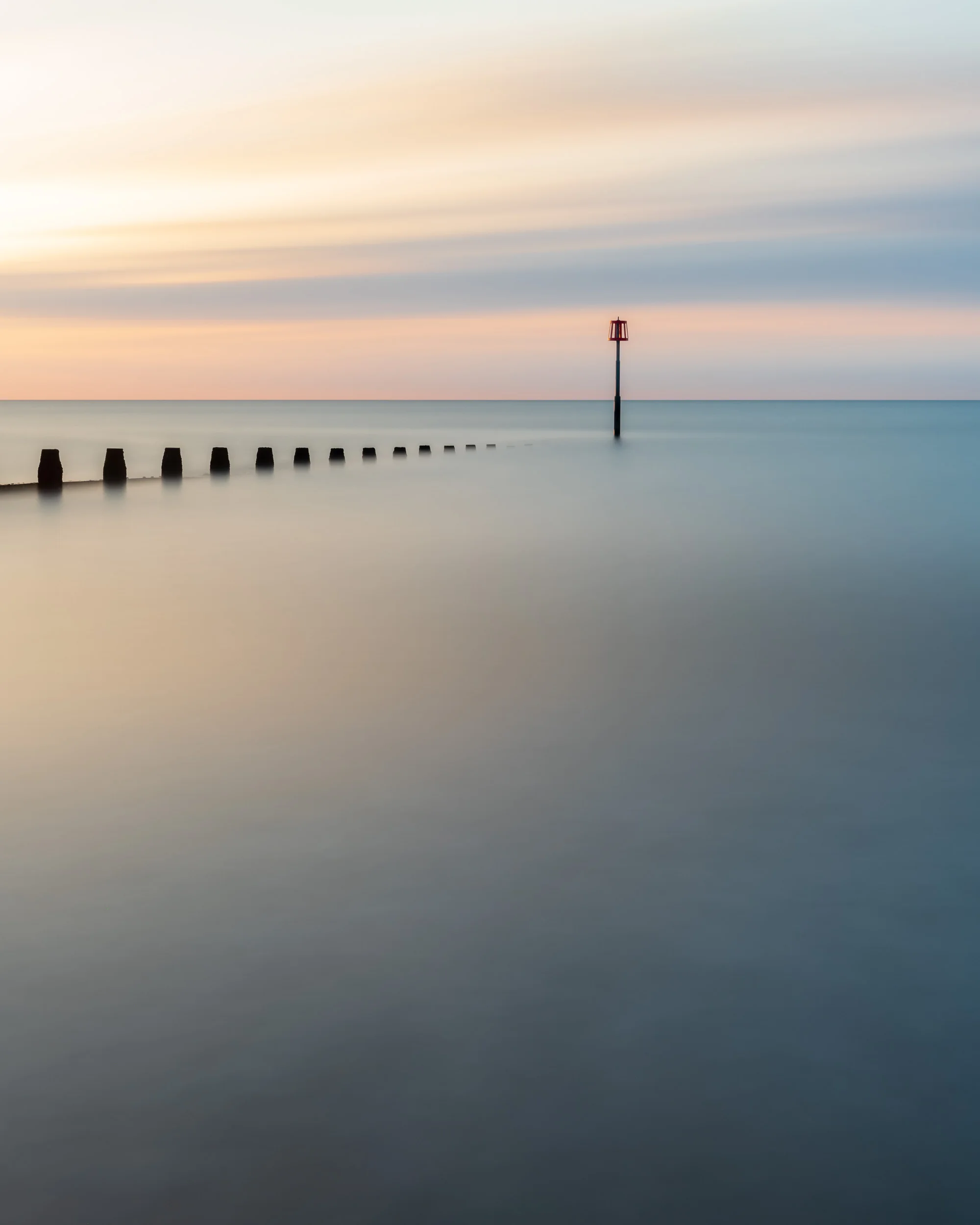
Into the Sea, Dawlish Warren, Devon - Nikon D850, Nikkor 24-70 mm f/2.8 at 48 mm, 339 seconds at ISO 64, f/11. Lee Filters Circular Polariser and ND Grad,
While this image was captured after sunrise, the long exposure helps capture what light there was and the calmness of the ocean that morning.
It’s always fascinating to see how other photographers interpret the same scene so I was really interested to see how Neil Burnell, who was with me that morning, shot the same scene. Check out his Instagram post to see his take on the beach that morning.
What is your favourite time of day to shoot? Do you use techniques like ICM or long exposures to create a sense of mood? Let me know in the comments below.

Unexpected Creativity from a Dreary Dartmoor
Sometimes landscape photography can be hard and this was certainly true of my most recent visit to Dartmoor in Devon. However, even when you are feeling creatively challenged, inspiration can appear to come from nowhere. Read on to learn how I got inspired on that dull, grey evening on Dartmoor!
A Quick Happy Birthday
Just before I tell you about my Dartmoor adventure, I just want to announce that this post comes on the day that this very blog celebrates its 2nd birthday! Two years ago today I decided to start documenting my photographic adventures.
As with any creative process, the writing has sometimes been easy and sometimes it's been hard. However, most of all it has been fun and its really helped me with my photography. I wrote a lot about the benefits last year when I wrote a post about the blog's first birthday.
Over the last 24 months, I've written a new blog post every week, and I see no reason why this won't continue into the future. Thanks to all the support and comments I get from everyone on this blog, and other social media channels, I feel inspired and motivated to keep this blog going. So thanks to everyone who has and continues to show support of my work. It is very much appreciated.
And now….
Landscape Photography is Hard
I love landscape photography. I have a real passion for it and there are few things as good as heading out into the wilderness with the camera to capture some landscape photographs. Sometimes the process of capturing those photographs is hard. The weather can be challenging or you can simply lack the imagination or creative energy to produce a good photograph.
For me, there is an additional factor that makes landscape photography hard, and that is time. I think most photographers, pro or amateur, suffer at the hands of the old enemy of time. The amount of time I can commit to my art is limited and more often than not I have to go out when the conditions aren't ideal.
Devon's Dreary Dartmoor
My most recent to Dartmoor is a great example of when I decided to head out with the camera when really I should have stayed at home. The weather forecast for most of the south-west was overcast and rain showers. The trouble was that if I didn't out that evening, it was going to be several days before my next window of opportunity and I had a real need to scratch that creative itch.
I wanted to go and shoot somewhere on the Cornish coast but I saw little point in committing to 3 to 4 hours of driving with the predicted weather conditions. I thought the best thing to do was to keep in local and head up to Dartmoor. The weather forecast for Haytor was looking poor, but it did predict a small break in the clouds that might yield some nice results. To be honest, I think I was being rather optimistic but I grabbed my camera and went out anyway.
Finding Something Out of Nothing
As I drove up the hill from Bovey Tracey to Haytor, things did not look great. While the clouds were at least above the hills, it all looked rather uninspiring. I decided to drive a little further on and park up for Emsworthy Tor.
As I wasn't in a particular hurry I decided to make the walk to Emsworthy Tor at a slower pace. As I walked I made sure I took the time to look for compositions. Occasionally I would hold my eye up to the camera to see what an image would look like, but nothing seemed to capture my imagination.
When I reached Emsworthy Tor I just stood there and wondered why on earth I even bothered coming out. Don't get me wrong. I love Dartmoor. It can look spectacular in many different ways, and it's rare that I can't find something to appreciate. The view in front of me was indeed impressive but that doesn't mean it was going to translate into a good photograph.
It soon dawned on me that the viewpoint I wanted to photograph wasn't going to work in these conditions. As I sat there looking at the great expanse that is Dartmoor, I thought about going home. In the distance was a large dark cloud that was sure to bring a heavy shower. Perhaps it was time for an early exit and a glass of wine.
Just as I was about to pack up and go I had a moment of inspiration. As I looked east there was a small break in the cloud, and from the north was that stormy looking cloud. I know from previous experience that approaching storm clouds can look dramatic when shot with a wide angle lens. So I quickly got the camera out and shot this image:
Approaching Storm on Dartmoor, Devon - Nikon D850, Nikkor 16-35 mm f/4 at 16 mm, 0.5 seconds at ISO 64, f/11, Lee Filters ND Grad.
I had to work fast to get the image because the cloud was rolling in fast. While the image would have greatly benefited from some scattered light on the distant tors, it does show Dartmoor as it was that evening, and perhaps reflects my mood a little.
I then wanted to fine tune my composition a little. I like the rocky tors in the foreground of the first image, but I felt that they were a too close to the bottom of the frame. I also felt that the clouds were a more important element of the photograph, so I decided to point the camera up more to give me this composition.
Storm Clouds over Dartmoor, Devon - Nikon D850, Nikkor 16-35 mm f/4 at 18 mm, 0.6 seconds at ISO 64, f/11, Lee Filters ND Grad.
I'm not sure which image I prefer. The sky in the first image is more appealing as the dark cloud hasn't covered all of the skies yet, but I prefer the overall composition of the 2nd image. To be honest, I'm just really happy to have captured anything. I was sure I was going to go home empty-handed and a little unhappy (creatively speaking).
It was a challenging evening but aside from the pleasing images, I can always take away two positives. Firstly, it's always great to be outdoors. Even if I took no photographs, spending the evening on beautiful Dartmoor is rarely a bad thing. Secondly, it was good to be out with the camera. That time out with the camera gave me more photographic experience and practice that I can put to good use when I really need it. You can be in the most amazing location with the most amazing light, but if you don't how to use your camera properly or know how to read a scene, you might come away with nothing.
Have you ever been out with the camera on a seemingly pointless adventure? Which of my two images did you prefer? Let me know in the comments below.