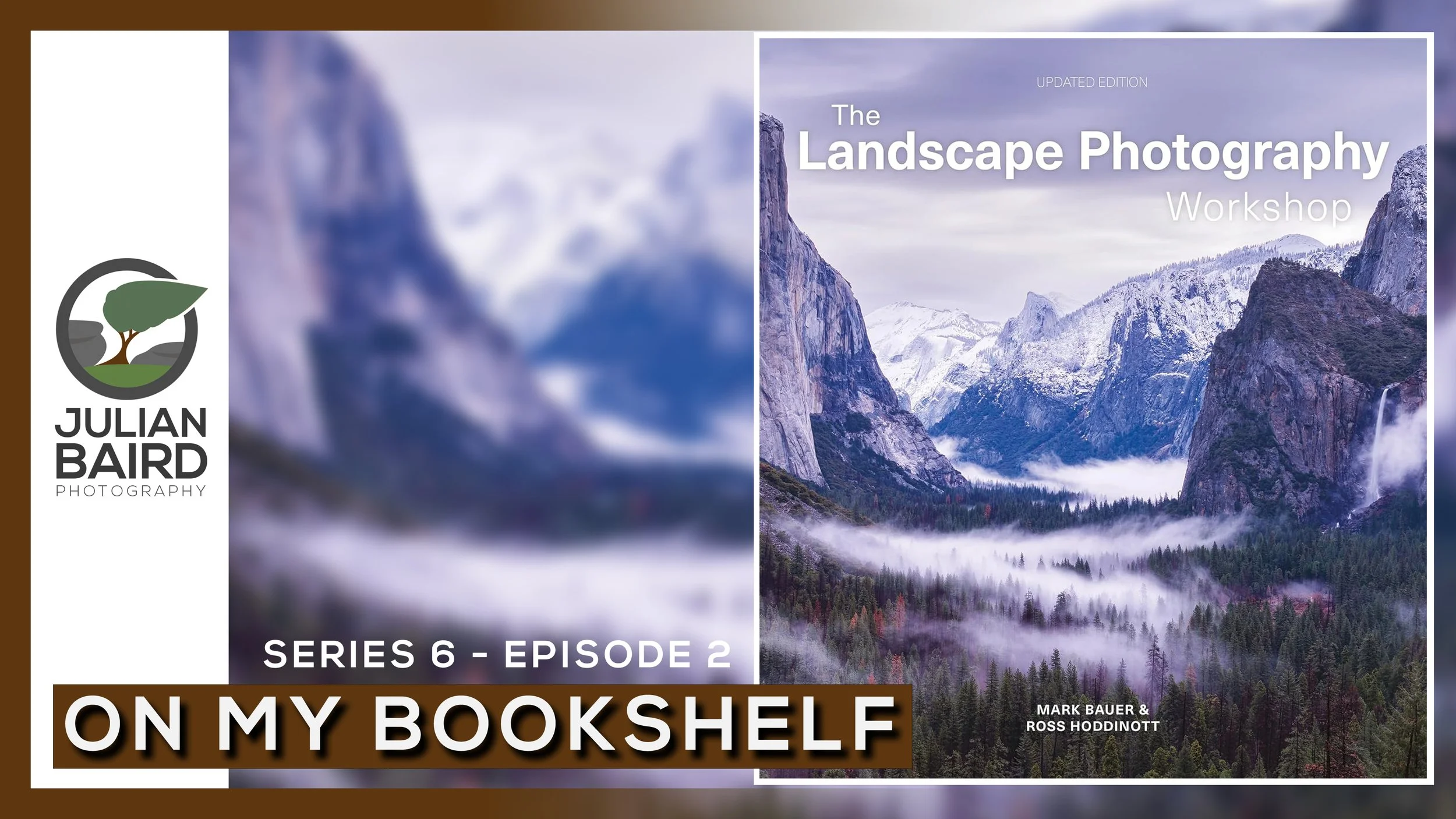
The Landscape Photography Workshop by Mark Bauer and Ross Hoddinott - On My Bookshelf S06E02
In their updated edition of The Landscape Photography Workshop, two of the UKs leading landscape photographers, Ross Hoddinott and Mark Bauer, are aiming to teach you everything you need to know to take amazing landscape photographs. Have they succeeded?
An Updated Edition
As they did last year with The Art of Landscape Photography, Ross Hoddinott and Mark Bauer, have now updated The Landscape Photography Workshop. The updated edition of The Art of Landscape Photography is a book I can easily recommend to anyone wanting to develop their skills in composition. So, when I heard they were also updating The Landscape Photography Workshop, I thought I’d better check it out to see if it would become my book recommendation for those want to learn more about the technical aspects of landscape photography.
Well, the updated edition has arrived, I’ve read it and I can now share my thoughts in the latest episode of On My Bookshelf!
You can buy both updated editions of the books with the links below. They make an excellent pairing!
🛒 Landscape Photography Workshop (Updated Edition) - https://amzn.to/3qBTHIW
🛒 The Art of Landscape Photography (Updated Edition) - https://amzn.to/45Z3WHn
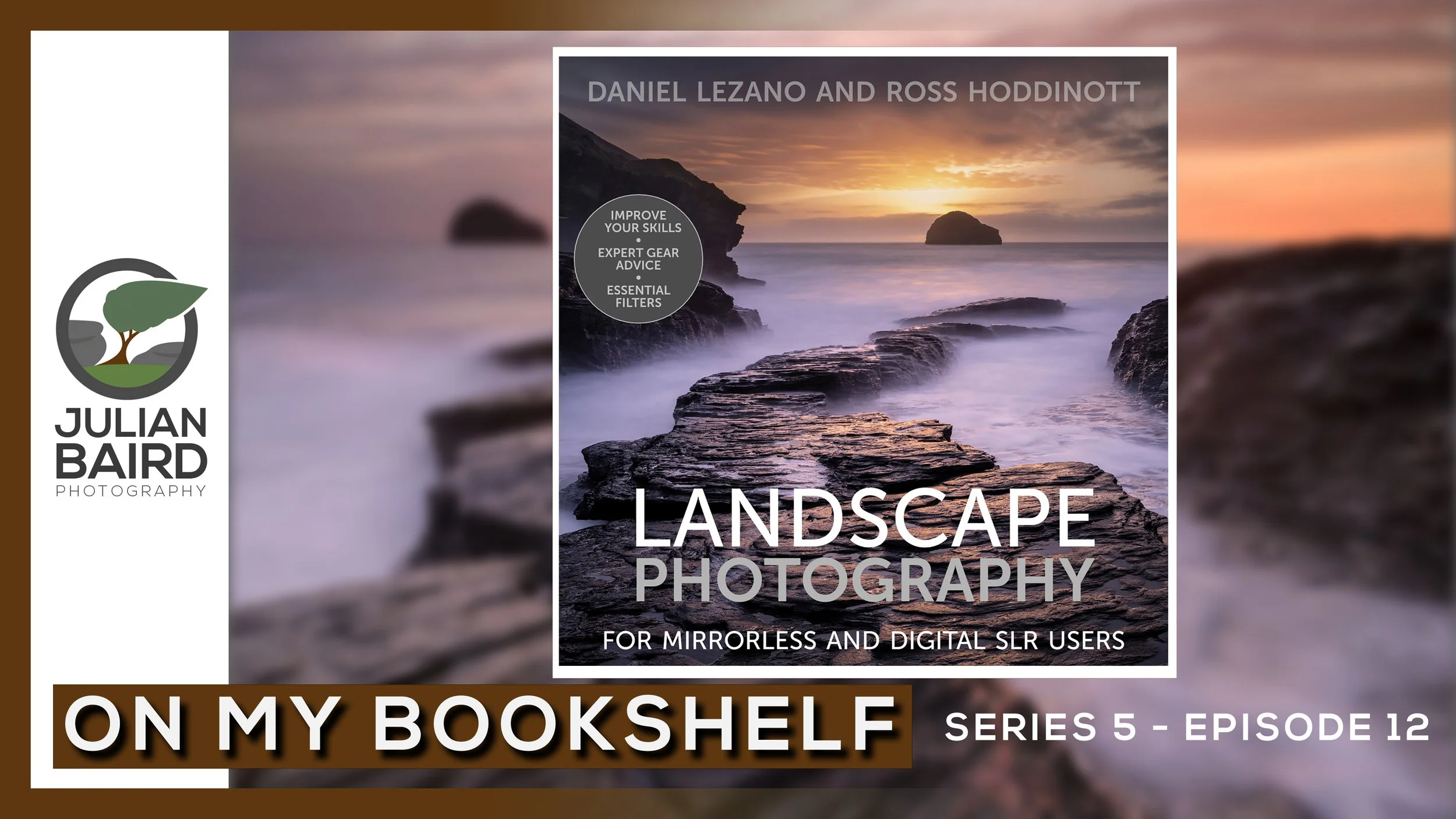
Landscape Photography Audiobook - Ross Hoddinott & Daniel Lezano - On My Bookshelf S03E12
Have you just got a CAMERA? Are you new to LANDSCAPE PHOTOGRAPHY? Are you looking to gain a better understanding of landscape photography TECHNIQUE? If so, then "Landscape Photography: For Mirrorless and Digital SLR Users" by Ross Hoddinott and Daniel Lezano could be for you. In this special audiobook edition of On My Bookshelf, I tell you all about this unique title.
Learning Landscape Photography While on the Move
I spend a lot of time in the car travelling to locations for my landscape photography. Even though I’ve spent most of 2022 photographing my local area (i.e., Dartmoor), I still spend anywhere between 30 and 60 minutes just getting to a location. That’s not to mention how long it takes to walk to the spot I want to photograph after I’ve parked!
I’m not complaining. I’m just highlighting how much time I spend on the move. To make those car journeys pass a little quicker I love to listen to audiobooks. If you’ve ever been put off by the size of the Lord of the Rings or Game of Thrones books, then the audiobook could be the perfect option.
However, I’d never considered listening to an audiobook to learn landscape photography. Sure, I listen to a lot of photography podcasts, but can you teach landscape photography from an audiobook. After all, photography is such a visual medium how can you teach landscape photography without seeing anything?
Ross Hoddinott and Daniel Lezano believe they can and they sent me a copy of their audiobook “Landscape Photography: For Mirrorless and Digital SLR Users” to try out. I must admit that I was rather curious, so I put it to the test, and I share my thoughts on this audiobook title in this episode of On My Bookshelf.
If you like to pick up a copy of “Landscape Photography: For Mirrorless and Digital SLR Users” by Ross Hoddinott and Daniel Lezano, you can do so here - https://amzn.to/3YVL1tR
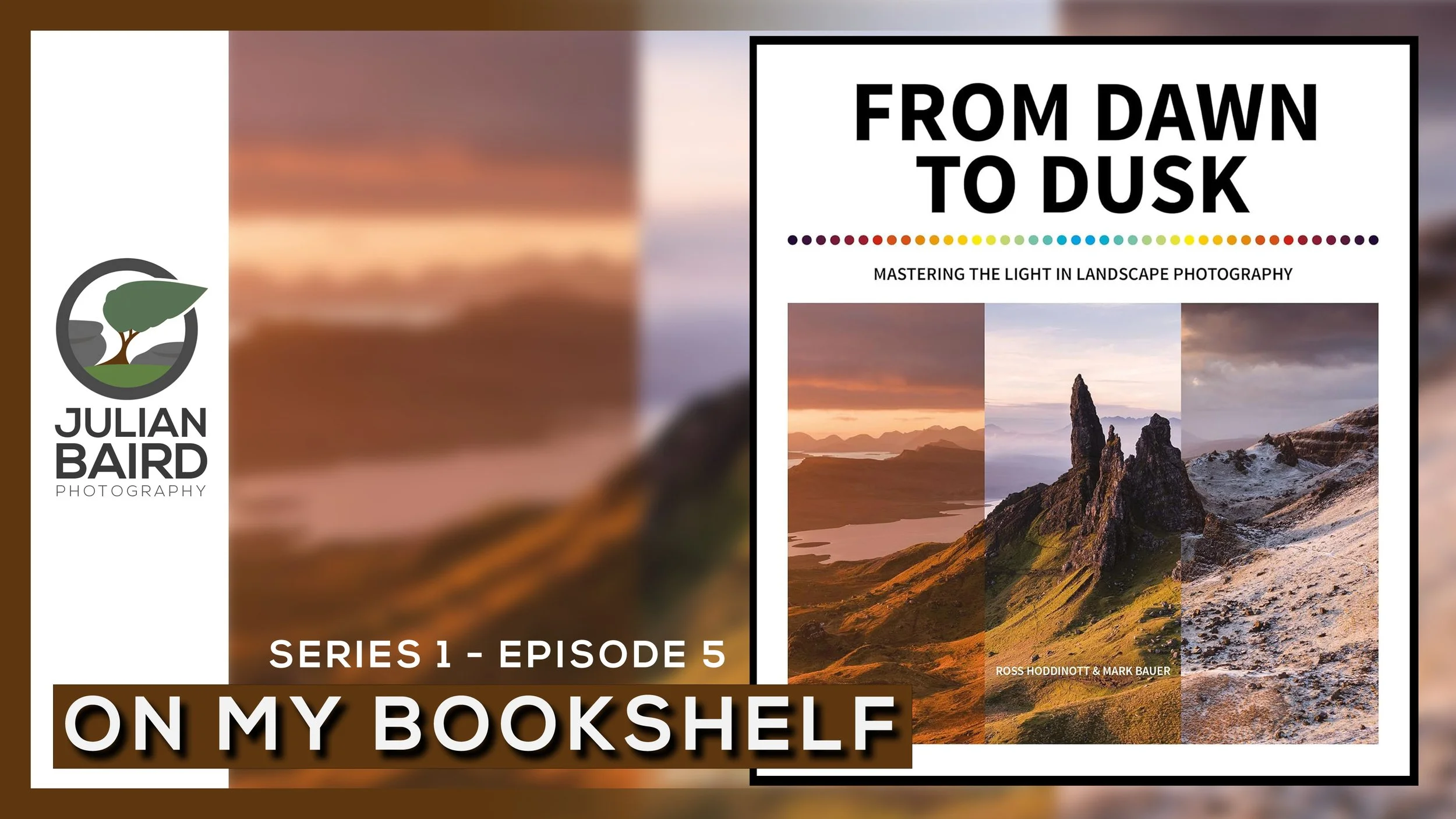
From Dawn to Dusk - Mastering the Light in Landscape Photography - On My Bookshelf S01E05
In this very special blog post I share with you the latest episode of On My Bookshelf. In the episode I interview Mark Bauer and Ross Hoddinott about their latest book on landscape photography, From Dawn to Dusk. I also tell you about a giveaway where you can win all three of their books.
On My Bookshelf
Over the last few months, I've been sharing with you the On My Bookshelf series of videos. Even though my photography life is predominately digital, I still believe the printed book is an important part of my development and enjoyment of photography. So in each episode of On My Bookshelf, I've told you about a book that I've enjoyed reading in the hope that it will also inspire you.
From Dawn to Dusk
When I first heard that two of my favourite landscape photographers were writing another book I knew straight away that I would need to get myself a copy. After all, their last book, The Art of Landscape Photography, had a big impact on my development as a photography and I read it many times.
As the publication date got closer I reached out to Ross Hoddinott and Mark Bauer and asked if they would like to appear on an episode of On My Bookshelf. I was delighted when they both agreed and they invited me along to see them sign and dispatch the first batch of orders of From Dawn to Dusk - Mastering the Light in Landscape Photography.
They also kindly agreed to an interview where I got the chance to ask them about their latest book, what's in it, who's it for, and how it differs from their previous 2 titles. You can see the full interview in the video below.
Book Giveaway!
After the interview, Mark and Ross offered me a signed copy of their latest book to give away to one lucky viewer. Not only that, they also gave me two signed copies of their previous two titles The Art of Landscape Photography and The Landscape Photography Workshop.
There are two ways in which to gain an entry to win all 3 books:
Watch this episode of On My Bookshelf: From Dawn to Dusk on YouTube and then leave a comment in the YouTube comments section for the video. Comments are welcome here, but to enter you need to leave a comment on the video itself.
Share the Facebook post for this video. You can find it here: <insert URL>
You a free to enter using one, either, or both of the above ways. If you do both though, you will be entered into the giveaway twice!
Entries for the giveaway close 12 pm (GMT) 28th May 2018.
If you can't wait to get a copy of From Dawn to Dusk - Mastering the Light in Landscape Photography you can still order a signed copy straight from the authors at http://www.dawn2duskphotography.co.uk/books/
Finally, I just want to say a big thanks to Mark and Ross for the interview! It was a real pleasure talking to you both and judging by the number of pre-orders you were signing and sending out it looks like From Dawn to Dusk - Mastering the Light in Landscape Photography is going to be a big success!
Some of the links used in this article are Amazon affiliate links. By buying through the links I may receive a commission for the sale. This has no effect on the price for you.

Getting to Know Colmer's Hill
In this blog post I tell about my 3rd visit to Colmer's Hill and how despite the experience of the previous 2 visits I still have a lot to learn about this fantastic Dorset location.
Third Time Lucky?
On paper Colmer's Hill is a relatively straightforward location to shoot. Its conical shape makes it stand out from the rest of the landscape luring the photographer into some obvious but pleasing compositions. However, as I've just learnt the most obvious composition isn't always the best.
My most recent visit to Colmer's Hill is my third this year. The previous two visits had largely been unsuccessful but I was putting both those visits down as exploratory shoots while I looked for the optimal position. On my third visit, I decided that I would opt to shoot the hill from a less elevated viewpoint so that the top of the hill would be above the horizon. On my previous visits, I had adopted a position on top of the hill opposite Colmer's Hill. This drops the top of the hill below the horizon which, based on the images I've seen, work best when mist surrounds the hill leaving just the peak visible, similar to this image I took on my first visit in January of 2017.
The weather forecast for my most recent visit wasn't for any mist but it did show signs that the high-level cloud could be well illuminated by the rising sun. These predicted conditions together with the plan but of shooting from a lower elevation I thought would provide me with the best chance of getting a good photo. With my plan decided I set the alarm for 04:30!
On my arrival at Quarr Lane at 05:45 the conditions were already looking promising so I quickly headed to my chosen spot. Sure enough, the top of Colmer's Hill was placed nicely above the horizon and I was sure I know had the best spot. So I started to set up my camera and waited for the cloud and light show to start. And start it did. Just not where I wanted it to be. Sure there was sufficient cloud above the top of the hill but the real action was happening just 45 degrees to my right.
Not Quite the Right Spot
The most glorious show of pink clouds was happening just above the spot where the rising sun was. As a personal preference, I don't shoot straight into the sun so I had positioned myself so that it would be excluded from the frame. It seemed like a good plan at the time, after all, the good colour in the sky is not often limited to a single spot. However if I had selected a more northerly position, so the sun was rising directly behind the hill, I would have been able to include the dramatic clouds in my composition.
However, landscape photography is a combination of luck, planning and experience. I had done my planning and luck I can't really control but having little more experience at the location may have allowed me to assess the conditions more effectively and possibly change the spot I was shooting from. It would have been a bit of a walk and might have needed a brisk run but it probably would have been worth it.
However the morning wasn't wasted as I still got out with the camera, enjoyed a lovely sunrise and managed to get this pleasing image.
Nikon D750, Nikkor 70-200mm f/2.8 @ 70mm, f/11, 1/13 sec, ISO 100, Lee Filters ND 0.9 soft grad.
Understanding Your Location
So what did I learn from this trip out with the camera? Well, despite the experience of my previous two visits, and planning for the third, I found that I still had plenty to learn about shooting Colmer's Hill. As I described in my previous blog article, Perseverance - Photographing Bowerman's Nose, it can take many, many trips to a location before you really get to know it and get an image that is worthy of the location. In some cases, you might never really know a location and it will continue to throw you a surprise or two. To be honest, that's probably a good thing though.
Even though I've been there three times I will certainly be going back again. Each time I go though I will understand the location a bit better and I will be able to make the necessary adjustments to increase the likely hood of success.
My Top 3 Tips for Colmer's Hill
So if you fancy a trip to Colmer's Hill, and why wouldn't you, here are my three top tips:
Take a long lens. You'll want something in the range of 24-70mm, but if you have it take a 70-200mm (or something can reach past 100mm).
Explore. You can shoot Colmer's Hill from a number of spots, covering a range of elevations and distance. You might need to go a few times to understand which spots work best and when.
Check Weather and Direction of Light. Colmer's Hill is both a sunrise and sunset location, and it works in a variety of weathers. Choose your spot(s) based on the conditions, but be prepared to change them.
If you'd like to see more of Colmer's Hill why not check out my 5 Minute Photo Adventure video that I shot while I was there. You can see how I created the images above and give you an idea of what it's like to shoot there.
So have you shot Colmer's Hill before? Do you have a favourite spot to shoot it from? Do you have a favourite location that you've visited many times but you still feel you are getting to know it? Let me know in the comments below.

The Benefits of Tuition and Mentoring
Tuition and mentoring has had a massive impact on my photography. Read more about this part of my photographic journey in this blog post.
In the beginning...
One of my early landscape images taken in Glen Coe in 2008.
I bought my first DSLR in 2006 when I purchased a Nikon D80. Previous to that I had a Minolta DiMAGE A1 so this was a big step up for me. It was at this point that I started to want to learn more about the craft of photography. So as many people do I went to my the nearest newsagent and picked up a photography magazine. And so started a journey of several years of reading a lot about photography.
The problem was I wasn't actually taking that many pictures. Sure I was inspired by what I was reading and saw, but despite having considerably more free time back then I didn't practice the craft of photography as much. (Read my blog post on Practicing the Craft of Photography). I also wasn't that focused on a specific genre of photography. Most photography magazines have a broad range of articles from portraits to macro so I would often spend time trying these things out. Don't get me wrong, I did go out with my camera, but looking back I don't think I was trying hard enough to really learn about photography.
Changing My Approach
This changed back in 2013, when I decided to go full frame and buy a Nikon D600. I promised myself that if I was going to invest all this money in a camera (and lenses!) I was for sure going to learn how to improve my photography. By this stage though I was fairly sure that my heart lay with landscape photography.
Some early lessons about composition with David Nightingale.
I decided that the best way to make progress was to actually go out and shoot more, and to engage the services of a professional for some 1-2-1 tuition. At the time I was following the work of Blackpool based photographer David Nightingale and so I booked a whole weekend of tuition and got to work on improving my photography. The weekend went well and it was a bit of an eye opener for me. Firstly, I actually didn't know as much about my camera as I thought. While I knew some of my composition skills were lacking, I thought I knew my camera well but this wasn't really the case! It all goes back to practicing the art of photography, something I hadn't been very good at!
Up till this point I had wondered if it were actually possible to teach someone about composition and how to make a beautiful photograph. As many of my previous photographs had been average at best, I was beginning to think that you couldn't really learn an art, you had to have a natural talent for it to start with. While many people do find creating art easy, for me I had to learn about it. Fortunately David reassured me that I could learn the art of photography. So for that reason alone that weekend was a success.
Making Progress
A year later I had kept to my promise of going out more with my camera. I was still bound by my work and family commitments but I was at least using my spare time to go out and shoot. In 2014 I went on a Dawn 2 Dusk Photography workshop on Dartmoor where not only did I have a lot of fun with some like minded photographers but I also learnt a considerable amount about landscape photography. On the workshop I also met Ross Hoddinott, one of the tutors. I had been looking for a local tutor to help with my learning journey and Ross seemed the ideal person.
Learning about timing and waiting for the light on a 1-2-1 with Ross.
A few months later I met Ross for a 1-2-1 session and in that one day I probably learnt more about composition that I had done since I purchased my first DSLR 2006. Not only did I become inspired from that session but I also became more confident with my photography. Since that first 1-2-1 session with Ross I have regularly met with Ross for further 1-2-1s and portfolio reviews and this has had a significant impact on my photography. Each session I learn something new. Sometimes it's a really small change in how I might compose an image, but it often has a big impact.
So this brings me to the point of this blog post. If you are struggling with your photography or you've reached a plateau then I can strongly recommend that you find a tutor or mentor to help with your photography. Find someone close to home or who's work you respect. Most photographers offer some kind of tuition on a 1-2-1 basis now. Or if that seems a little much as a first step try a photography workshop such as those offered by Dawn 2 Dusk Photography.
We spend so much money on gear (something I'm definitely guilty off) but the one thing that has had the biggest impact on my photography is the time I've spent with a professional photographer. No matter what stage you are at with your photography journey I believe a little mentoring and tuition can be very beneficial. Of course I still read photography magazines, Outdoor Photography being my personal favourite, but when it comes to developing as a photographer 1-2-1s for me are invaluable.
Do you have a photography mentor or favourite tutor? What do you think of 1-2-1 days with professional photographers? Let me know your thoughts.